Prep & Assembly
Blooming Gelatin
Hydrating gelatin in cold liquid so it dissolves smoothly without lumps when warmed.
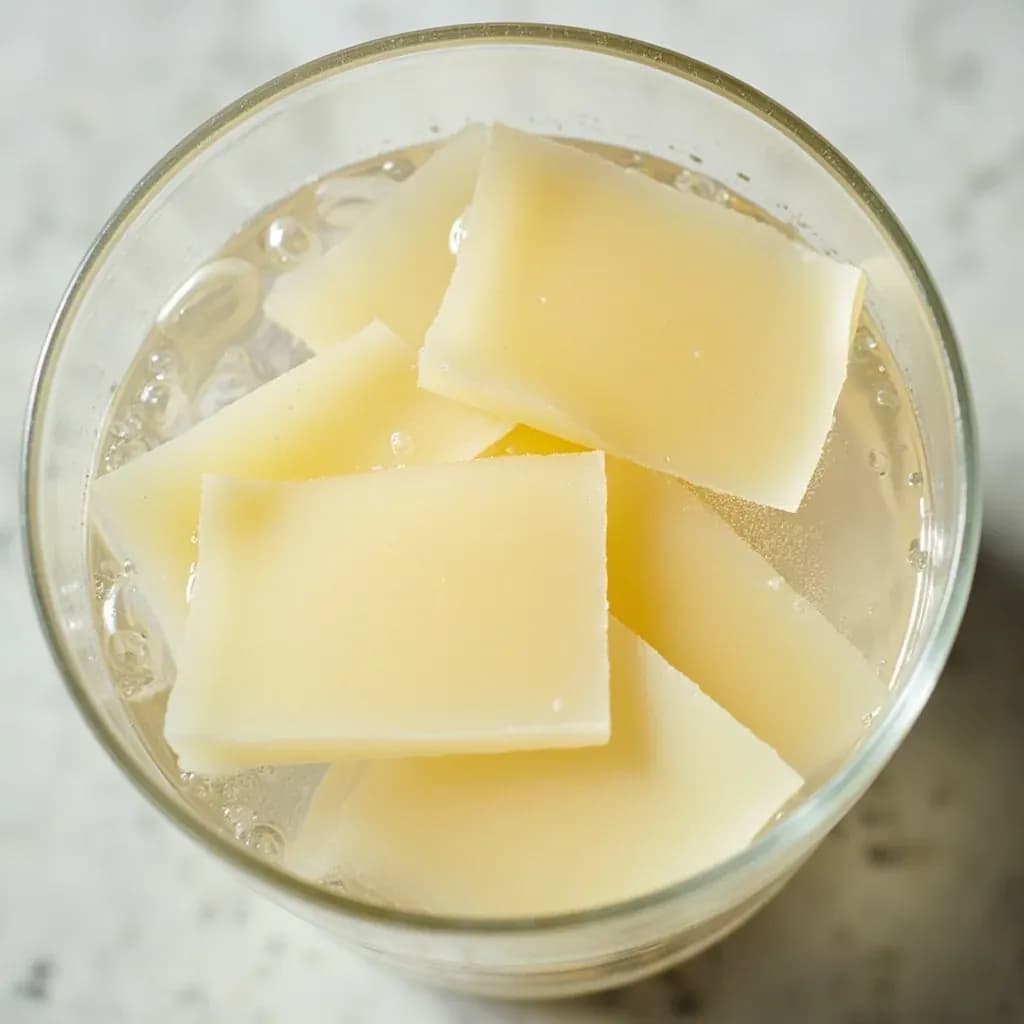
Blooming gelatin softens powdered or sheet gelatin in cold water or other liquid until it swells and absorbs moisture. The hydrated gelatin then melts evenly into a warm mixture, setting cleanly without clumps or graininess. Skipping the bloom leaves undissolved gelatin and a weak, uneven set.
Blooming gelatin is the simple but non-negotiable step of hydrating gelatin in cold liquid before it ever sees heat. Gelatin granules, when plunged into warm or hot liquid, gelatinize almost instantly on the outside, forming a watertight shell that traps dry powder inside and produces the familiar gritty, lumpy texture that ruins a panna cotta or aspic. Blooming gives the granules time to absorb liquid uniformly so they can dissolve cleanly the moment they meet a warm base.
The technique applies to both powdered (granulated) gelatin and sheet (leaf) gelatin, though each behaves slightly differently. Powder is scattered over cold liquid and left to swell into a spongy mass; sheets are submerged flat in cold water until pliable, then squeezed and added directly to a warm base. Sheet gelatin is the professional pastry default because it essentially cannot clump, but American home cooks overwhelmingly reach for envelopes of powder, and blooming makes powder behave with the same reliability.
Proper blooming also gives you a window to verify your measurement and hydration before committing to the recipe. A correctly bloomed mass should look thick, glossy, and uniform, with no dry streaks; anything else means you need more liquid or more time. From there the bloomed gelatin is whisked into a warm base, never boiled, and chilled to set. The whole process adds only a few minutes to a recipe and is the difference between a satin-smooth dessert and a grainy disappointment.
- Difficulty
- Easy
Types & varieties
Grain form sold in envelopes or jars; the American home-kitchen standard and easy to measure by weight.
Translucent sheets sold in standardized weights; the professional pastry choice for clarity, consistent strength, and no measuring.
Softest set at roughly 125 Bloom; suited to delicate mousses and light glazes.
Standard professional strength at about 160–180 Bloom; the workhorse for pâté en gelée, terrines, and bavarois.
Firmest at roughly 200–220 Bloom; used for firm aspics, structured entremets, and fruit confit.
Some pre-hydrated powders and agar or gellan blends dissolve without blooming; they are not direct substitutes for traditional gelatin in set or texture.
How to do it
- 1
Measure the cold liquid
Pour about 50–60 ml (roughly 1/4 cup) of cold water, milk, or another recipe liquid per envelope (7 g / 1/4 oz) of powdered gelatin into a small bowl. For sheet gelatin, fill a wide bowl with enough cold water to fully submerge the sheets without crowding.
- 2
Sprinkle the gelatin over the surface
For powder, scatter it from a short height in a thin, even shower across the entire surface of the liquid — never dump it in a single heap. For sheets, submerge them one at a time, laying each flat so they do not stick together or fold over.
- 3
Let stand undisturbed
Wait 5 to 10 minutes. The powder will absorb the liquid and swell into a thick, spongy, uniform mass; the sheets will become soft, pliable, and slightly enlarged. Do not stir during this time — the granules need to drink, not be moved around.
- 4
Finish hydrating
For powder, whisk or stir the bloomed mass with a small whisk or spoon until smooth, with no visible dry granules or streaks. For sheets, lift them out individually, give them a gentle squeeze to release excess water, and they are ready to use.
- 5
Incorporate into the warm base
Whisk the bloomed gelatin into a warm — not boiling — base, typically 50–60°C/120–140°F, stirring until fully dissolved. For small amounts that would cool the base too much, melt the bloomed mass over a bain-marie first, then stir it in. Avoid boiling or simmering gelatin for more than a minute or two; prolonged heat weakens the set.
- 6
Chill to set
Refrigerate the finished preparation until fully gelled — usually 2 to 4 hours for individual servings, overnight for larger molds and terrines. Gelatin will not set reliably above roughly 21°C/70°F, so a cool refrigerator is essential.
Why gelatin clumps — and why cold water fixes it
Gelatin works by unfolding long protein chains that, on cooling, tangle into a three-dimensional net trapping liquid. That unfolding needs water and gentle heat, in that order. Drop dry granules into something warm and the outer layer of each grain soaks up water and swells into a sticky gel almost immediately, sealing the dry interior away from the liquid. The grain looks hydrated, but its core is still powder, and no amount of stirring will rescue it without re-melting.
Blooming sidesteps this by keeping the water cold so the granules absorb liquid slowly and evenly through their full thickness. By the time the mass hits your warm base, every granule is uniformly hydrated and will dissolve in seconds. This is also why sheet gelatin exists: a thin, uniform sheet has so much surface area and so little mass that it hydrates in cold water almost instantly, and it is almost impossible to clump.
Working with acidic mixtures and tropical fruits
Two non-obvious constraints will sabotage a gelatin set even after a perfect bloom. Acid interferes with gel formation, so very acidic mixtures (heavy citrus, wine reductions, sour-cherry or passion-fruit purées) typically need 10–20% more gelatin to set at the same firmness as a neutral one. Bloom the extra gelatin into a small portion of the acidic liquid and confirm the set on a chilled spoon before committing.
Fresh pineapple, kiwi, mango, papaya, fig, and ginger contain proteolytic enzymes (bromelain, actinidin, papain, ficin) that chew up gelatin's proteins and prevent a set entirely. Cooking the fruit to about 80°C/176°F denatures those enzymes and restores normal behavior. Canned versions of the same fruits are usually safe because the canning process has already heated them.
Common uses
Tips & pitfalls
- Always start with cold liquid; warm or hot water causes the outer granules to gel instantly and seal dry powder inside.
- Sprinkle powdered gelatin in a thin, even shower across the whole surface rather than dumping it in a single mound — this prevents dry pockets that never hydrate.
- Resist the urge to stir while the gelatin blooms; let it absorb undisturbed, then whisk only after the 5–10 minutes are up.
- Submerge sheet gelatin flat in a wide bowl of cold water so the sheets hydrate evenly and do not stick to each other or to the bowl.
- After blooming, dissolve gelatin into liquid that is warm, not boiling — aim for 50–60°C/120–140°F — and never simmer the finished mixture for more than a minute or two, since prolonged heat denatures the proteins and weakens the set.
- Bloom gelatin in a small portion of the recipe's own milk or cream for dairy desserts; this keeps flavors clean and avoids diluting the base with water.
- If bloomed gelatin firms up while you finish the rest of the recipe, gently remelt it over a bain-marie and use it as if freshly bloomed — do not throw it out.
- For very acidic mixtures (citrus, wine), bloom 10–20% extra gelatin to compensate for the weaker set, and test on a chilled spoon before pouring into molds.
Good to know
- Also called
- Hydrating, sponging, or softening gelatin
- Applies to
- Both powdered (granulated) and sheet (leaf) gelatin
- Liquid ratio (powder)
- About 50–60 ml (1/4 cup) cold liquid per envelope (7 g / 1/4 oz)
- Bloom time
- 5–10 minutes for both powder and sheets
- Powder-to-sheet conversion
- 1 envelope (7 g / 1/4 oz) ≈ 4 sheets of standard silver-grade leaf gelatin
- Bloom strength
- Powder typically 200–225 Bloom; sheets graded bronze (≈125), silver (≈160–180), gold (≈200–220)
- Setting and melting points
- Sets below ~70°F/21°C; melts at body temperature ~95°F/35°C
- Common inhibitors
- Fresh pineapple, kiwi, mango, papaya, fig, and ginger contain proteolytic enzymes that prevent setting unless cooked first
Also called
Hydrating Gelatin · Softening Gelatin
Dishes that rely on it
Related

Whisk
Beat ingredients smooth and aerated with a looping wire motion

Sift
Pass dry ingredients through mesh to aerate and remove lumps

Strain
Pour through mesh to separate solids from liquid for a smooth result

Filter
Pass liquid through fine material to clarify out the smallest particles

Rice
Press cooked potatoes through small holes for fluffy, lump-free texture

Mash
Crush soft cooked food into a rustic, creamy purée

Grind
Crush food into a coarse to fine texture, from spices to meat

Grate
Shred food into fine bits against a sharp-toothed surface