Transform & Preserve
Brine / Marinade Injection
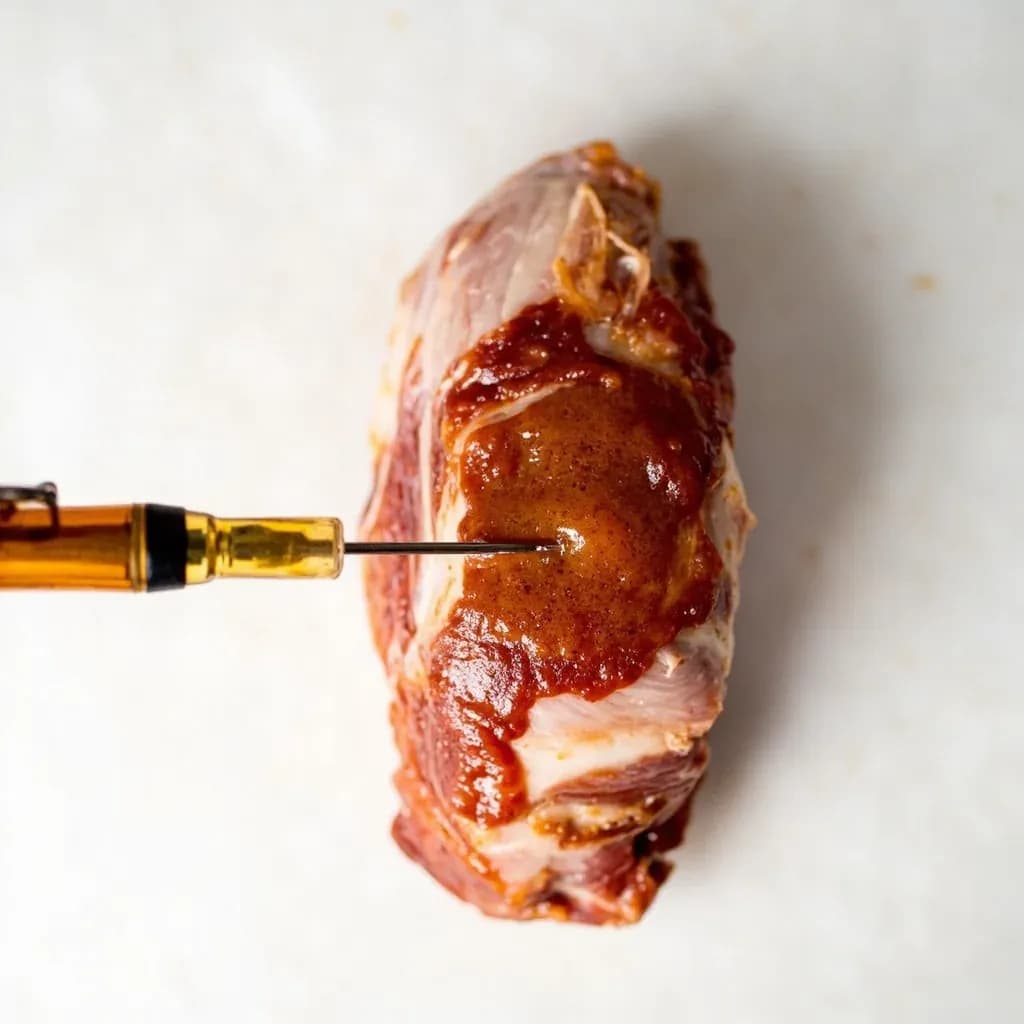
Using a needle syringe to push brine or marinade deep into the interior of meat.
Injection forces a seasoned liquid brine or marinade directly into the muscle of large cuts using a meat-injection needle. Unlike surface marinating, it seasons and moistens the interior of thick roasts, whole turkeys, or pork shoulder where flavor would otherwise never penetrate. It is especially common for barbecue and dishes like pernil, distributing salt, fat, and aromatics evenly before a long cook.
Brine and marinade injection is the practice of loading a syringe-style meat injector with a flavored liquid and pushing it deep into the muscle of a cut, depositing seasoning and moisture where surface rubs and shallow brines can't reach in any reasonable time. The technique is most valuable on thick, lean, or large pieces of meat — brisket flat, pork shoulder, whole turkey, pork loin, lamb leg — where a dry exterior rub and even hours of wet brining still leave the center underseasoned and prone to drying out during a long cook. Once injected, the liquid sits in small pockets inside the muscle and then migrates outward during a refrigerator rest, equalizing the salt and flavor concentration well before heat ever touches the meat. The result is a roast that seasons all the way through and retains more of its juices during cooking, without the waterlogged exterior that long wet brines can leave on smoked and roasted meats.
Injection is not a substitute for surface seasoning or sound cooking technique; it is a tool that solves a specific problem: getting salt, phosphate, and flavor past the first half-inch of a thick cut. It is standard in competition brisket and pork butt, in deli-style cured meats, and in restaurant production, but it is just as useful at home for a holiday turkey or a weeknight pork loin that tends to dry out before the center is properly seasoned.
- Difficulty
- Medium
Types & varieties
Standard 1.5–3 in needle with 1–3 side ports; fine for small roasts and turkey breasts.
Single needle with many side holes; fans liquid over a wider swath and requires fewer passes per pound.
4–6 in needle for whole turkeys, whole hog, and the deepest muscles of a brisket or shoulder.
4–12 oz barrel for competition and restaurant cooks; faster on big batches but heavier in the hand.
Stainless barrels and needles are dishwasher-safe, more durable, and won't absorb odors from garlic, smoke, or spice.
How to do it
- 1
Build and chill the injection liquid
Combine water or stock with salt (about 1 tsp/6 g per cup for ~2.5% salinity), sugar, and any flavorings in a saucepan. Heat just enough to dissolve the solids, simmer briefly to meld flavors, then chill to 40°F/4°C or below. Add phosphates last and stir until fully dissolved; never inject warm liquid.
- 2
Strain the liquid
Pass through a fine-mesh strainer or cheesecloth into a measuring cup. Any spice flake, seed, or undissolved grain will clog the needle; a perfectly clear solution is mandatory.
- 3
Load the injector
Submerge the needle tip in the liquid and draw back the plunger to fill. Point the syringe upward, tap the barrel, and press the plunger slightly to push trapped air out through the needle.
- 4
Plan the injection grid
Mentally divide the meat into points roughly 1–1.5 in (2.5–4 cm) apart. Expect 15–25 insertion points for a brisket flat, 8–12 for a turkey breast, and 20–30 for a whole pork shoulder.
- 5
Inject the meat
Insert the needle at a 20–30° angle deep into the muscle, then slowly depress the plunger while withdrawing the needle so the liquid fans out in a cone rather than pooling in a single pocket.
- 6
Rotate and repeat
Move to the next grid point and vary the angle of insertion between passes so liquid reaches different muscle planes. Keep the meat on a sheet pan or in a bag in the refrigerator as you work.
- 7
Rest before cooking
Cover and refrigerate at least 1 hour, ideally 4–24 hours, so the brine migrates and equalizes through the muscle rather than sitting in localized pockets.
- 8
Cook and check for purge
Proceed with the recipe. A light sheen of clear liquid on the surface is normal; heavy or cloudy purge means the meat was over-injected or under-rested.
Injection vs. Surface Brining
Wet brining submerges meat in seasoned water and seasons it by diffusion, a process that works well on small cuts but slows dramatically as thickness increases. A whole turkey can take 24–36 hours to fully equalize in a wet brine, and the exterior often turns soft and ham-like — a problem on a smoked bird or a seared roast where bark and crust matter. Injection skips the slow diffusion step by placing the liquid directly in the muscle, then lets the resting period do the equalizing. Salt and moisture end up distributed through the meat without prolonged water contact, which means a drier surface ready for browning and smoke.
- Injection works in hours, not days, because the brine starts where it needs to be — inside the muscle.
- Surface stays dry enough to form a proper bark or sear, an advantage on smoked brisket, pulled pork, and roasted turkey.
- Wet brining is still the better choice for small cuts (chicken pieces, pork chops, small whole fish) where a quick soak is practical and skin texture isn't the priority.
- For very large, whole-animal projects like a whole hog, injection is essential; surface brining simply cannot reach the interior in a workable time.
Common uses
Tips & pitfalls
- Always strain the injection liquid through a fine mesh — a single spice flake will clog the needle mid-stroke.
- Inject cold meat with cold liquid; warm injection drops the meat into the food-safety danger zone and can partially cook the surface.
- Pull the needle back as you press the plunger to fan the liquid in a cone, not a single pocket — pockets bleed out during cooking.
- Vary the angle of insertion between passes so liquid hits different muscle planes instead of stacking on the same plane.
- Cap injected liquid at about 10% of the meat's weight; beyond 15% the meat weeps, won't form bark, and won't sear properly.
- Rest the meat in the refrigerator for at least an hour, and ideally overnight, so the brine equalizes through the muscle.
- Common mistakes: clumping liquid in one spot, using un-strained thick marinades, injecting warm liquid, skipping the rest, and over-injecting — all of which cause purge, soft bark, or uneven seasoning.
Good to know
- Tool
- Syringe-style meat injector, 1–2 oz (30–60 ml) barrel; stainless preferred for durability and odor resistance
- Needle
- 1.5–4 in (4–10 cm) stainless, closed tip with side-outlet holes; longer needles for whole birds and large briskets
- Salinity
- 1.5–3.5% salt by weight of liquid for general use; up to 6–7% for short, intense shots on big cuts
- Load
- About 10% of meat weight (e.g., ~4 oz/115 g liquid for a 2.5 lb/1.1 kg roast); more than 15% causes heavy purge
- Liquid temperature
- Inject at or below 40°F/4°C to keep meat out of the food-safety danger zone
- Rest time
- Minimum 1 hour; 4–24 hours in the refrigerator is standard for whole birds and brisket
- Phosphates
- 0.3–0.5% sodium tripolyphosphate raises pH and improves water-holding capacity, reducing cook-time purge
- Best on
- Thick, lean, or large cuts: brisket, pork butt, whole turkey and chicken, pork loin, lamb leg, whole hog
Also called
Marinade Injecting · Marinade Injection (Pernil) · Injecting · Meat Injection
Related

Confit
Cook slowly submerged in fat for silky tenderness and keeping

Cure
Draw out moisture with salt and time to preserve and concentrate

Pickle
Steep in acidic brine for bright, tangy, crunchy preservation

Ferment
Let friendly microbes transform food into tangy, complex flavor

Marinate
Soak in a seasoned mix to flavor and tenderize before cooking

Brine
Soak in salt water so meat stays juicy and seasoned throughout

Dehydrate
Slowly dry out moisture to concentrate flavor and extend shelf life

Cold-Smoke
Perfume cured food with smoke without cooking it through