Heat & Fire
Bunjay (Dry-Fry / Reduce)
Caribbean technique of frying spiced meat until the liquid cooks off and clings.
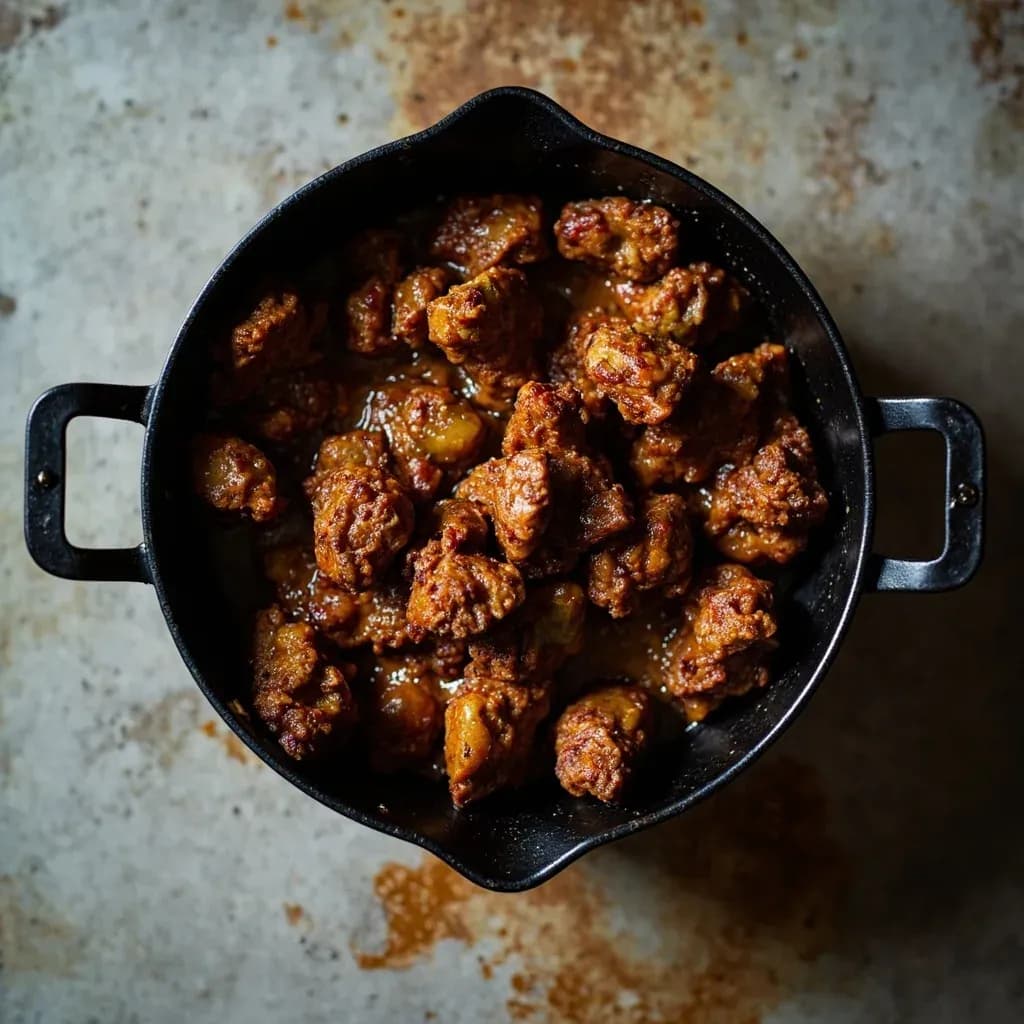
Bunjay (or bun-jay) is a Caribbean method of cooking down seasoned, often curried meat until the braising liquid reduces and the spices fry in the rendered fat, leaving a thick, intensely flavored coating. The dish is cooked until 'dry,' with sauce just glazing the meat. It concentrates flavor and develops a slight caramelized crust on the pieces.
Bunjay (also spelled bunjaye, bunjie, or bun-jay) is a Jamaican dry-braising technique in which seasoned meat is cooked slowly in its own juices until virtually all the liquid has cooked off, leaving a dark, sticky paste of concentrated spices clinging directly to the meat. It is neither a stew nor a stir-fry but sits between them: the pot begins moist, the meat tenderizes in its own marinade, and the cook then drives that liquid back into the food, so the seasoning itself becomes the sauce. The result is intensely flavored, dense, and glossy — a small portion reads as a big one, which is why bunjay is favored for tougher, fattier, or more strongly flavored cuts like goat, mutton, pork, and oxtail.
The technique has West African roots and is one of the most efficient ways Caribbean home cooks concentrate flavor without adding thickeners or finishing cream. Its defining moment is visual and auditory: when a spoon dragged across the bottom of the pot leaves a dry track for a second or two before the spiced oil seeps back in, the bunjay is done. Because the dish finishes almost dry, it travels and reheats better than saucy stews, and the residual oil left in the pot becomes the ready-made seasoning for a follow-up side of cabbage or callaloo.
- Difficulty
- Medium
Types & varieties
Scotch bonnet, scallion, thyme, garlic, and allspice — the classic, no curry powder
Jamaican-style curry powder folded into the seasoning; common with goat or chicken
Browning (caramel) sauce or burnt sugar stirred in for deeper color and slightly bitter, roasted notes
Heavy hand on scotch bonnet and black pepper; often used for pork or mutton
Made with salted cod or firm white fish; shorter cook time and gentler handling
How to do it
- 1
Prepare the seasoning base
Blend or finely chop scallion, thyme, garlic, onion, scotch bonnet (stemmed and seeded for less heat if you prefer), allspice berries, black pepper, and salt. For curry bunjay, toast Jamaican-style curry powder in a dry pan briefly to wake the spices, then stir it into the wet mix.
- 2
Marinate the meat
Cut the meat into bite-sized pieces, trimming hard fat but leaving some marbling for flavor and moisture. Rub thoroughly with the seasoning and a small splash of vinegar or lime juice, cover, and refrigerate at least 1 hour, ideally overnight so the salt and acid begin to tenderize before any heat is applied.
- 3
Start cold in a heavy pot
Place the marinated meat and all of its juices into a cold heavy pot. Add no extra oil unless the meat is very lean. Set over medium heat and bring it up slowly so the meat releases its own liquid instead of seizing and browning too early.
- 4
Bring to a gentle simmer
Once the liquid bubbles, drop the heat to low, cover the pot, and cook undisturbed for 20 to 30 minutes. The meat should simmer quietly in its own juices, never fry.
- 5
Begin the dry phase
Uncover, raise the heat slightly to medium-low, and let the liquid reduce. Stir every 10 to 15 minutes, scraping the fond from the bottom so it dissolves back into the meat rather than burning.
- 6
Adjust moisture as needed
If the bottom begins to scorch before the meat is fork-tender, add 2 to 4 tablespoons of water or stock and recover briefly. Once the meat yields easily, add no more liquid — extra water at this point will only dilute the final coat.
- 7
Reduce to the clinging coat
Continue cooking uncovered, stirring more often, until the juices thicken into a dark, glossy paste that grips the meat. The pot should look almost dry with a thin sheen of spiced oil and a spoon track that stays clean for a second or two before refilling.
- 8
Rest and finish
Off the heat, cover and let the bunjay sit 5 to 10 minutes so the fibers relax and the coating sets. Taste, adjust salt and pepper, and skim pooled fat if the meat was fatty. Serve with rice and peas, white rice, festival, hard dough bread, or boiled ground provisions.
How Bunjay Differs from Stewing and Stir-Frying
Confusion with neighboring techniques is the most common mistake for cooks new to bunjay. Each method has a different ratio of liquid to food and a different moment of doneness.
- Stew: liquid stays in the pot at the end and becomes part of the dish; bunjay discards the liquid, keeping only flavor on the meat.
- Stir-fry: high heat, fast, almost no liquid from the start; bunjay is low heat, long, and built on a long wet phase first.
- Braise: typically adds external stock or wine; bunjay cooks in the meat's own released juices and a splash of marinade only.
- Confiting: submerges in fat, not its own water; bunjay is dry, with fat skimmed off rather than preserved.
The Two Phases in the Pot
Thinking of bunjay as two distinct phases — the wet phase and the dry phase — is the single most useful mental model for executing it well.
- Wet phase (covered, low heat): the meat simmers in released juices and marinade until tender; this is where collagen breaks down and flavor infuses the flesh.
- Transition (uncovered, heat nudged up): liquid visibly reduces and the fond on the pot bottom becomes the seasoning reservoir.
- Dry phase (uncovered, frequent stirring): moisture cooks off, fond re-coats the meat in a dark, glossy paste, and pooled oil is the final sheen.
- Rest (off heat, covered): fibers relax and the clinging coat sets so it does not slide off when served.
Relatives Across the Caribbean
Bunjay belongs to a wider Caribbean family of dry-finished meat dishes, all built on the same principle of reducing sauce until the spices themselves become the seasoning.
- Haiti: pork preparations cooked down until almost dry, often with epis and scotch bonnet.
- Dominican Republic: carnero guisado seco, where lamb is reduced to a clinging coat similar to bunjay.
- Trinidad: 'dry curry,' a curry-coated meat finished with little to no gravy.
Common uses
Tips & pitfalls
- Marinate overnight whenever you can; salt and acid need time to start tenderizing the meat before the heat ever does.
- Start in a cold pot so juices release gradually — a hot sear locks the surface and traps moisture inside.
- Use a heavy-bottomed pot; thin pans scorch the spice paste long before the meat is cooked through.
- Keep a tight-fitting lid on during the early wet phase to help tenderize, then uncover fully in the last stretch so the sauce reduces to a clinging coat.
- Resist the urge to add water when the pot looks dry early on — the meat and the tight lid will supply what is needed.
- If you must add liquid during the dry phase, do it a few tablespoons at a time and never after the meat is already tender.
- Keep heat low to medium-low; high heat drives moisture off too fast and burns the crust before the inside catches up.
- Stir every 10 to 15 minutes, not constantly — you want the bottom to brown, release, and brown again.
- Skim excess fat at the end if the meat was fatty (goat, mutton, oxtail); the residual oil carries a lot of flavor and can be reserved for a side of cabbage or callaloo.
- Salt at the end only; bunjay concentrates seasoning, and salt added early can make the finished dish harsh.
Good to know
- Origin
- Caribbean, particularly Jamaica, with roots in West African cooking traditions
- Also known as
- Bunjaye, bunjie, bun-jay, dry-fry
- Technique type
- Dry-braising / reduction
- Heat level
- Low to medium-low, steady and patient
- Typical cook time
- 45 minutes to 2.5 hours depending on cut and piece size
- Liquid at finish
- Almost none; moisture cooks off so spices cling to the meat
- Ideal cookware
- Heavy-bottomed pot or cast-iron pan; Dutch oven works well
- Typical meats
- Goat, pork, mutton, oxtail, chicken, and sometimes salted cod
- Key aromatics
- Scallion, thyme, garlic, onion, scotch bonnet, allspice (pimento), black pepper
- Difficulty
- Moderate — forgiving on timing but demands patience and heat control
Also called
bun-jay · dry curry
Related

Sear
Blast the surface hot for a deep-browned, savory crust

Sauté
Cook quickly in a little fat over lively heat, tossing as you go

Stir-Fry
Toss bite-sized pieces over roaring heat for fast, smoky cooking

Pan-Fry
Crisp food in a shallow layer of hot fat, turning once or twice

Deep-Fry
Submerge in hot oil for an all-over crackling crust

Roast
Cook uncovered in dry oven heat for browned edges and tender centers

Bake
Cook with steady, surrounding oven heat — the soul of bread and pastry

Broil
Hit food from directly above with fierce overhead heat