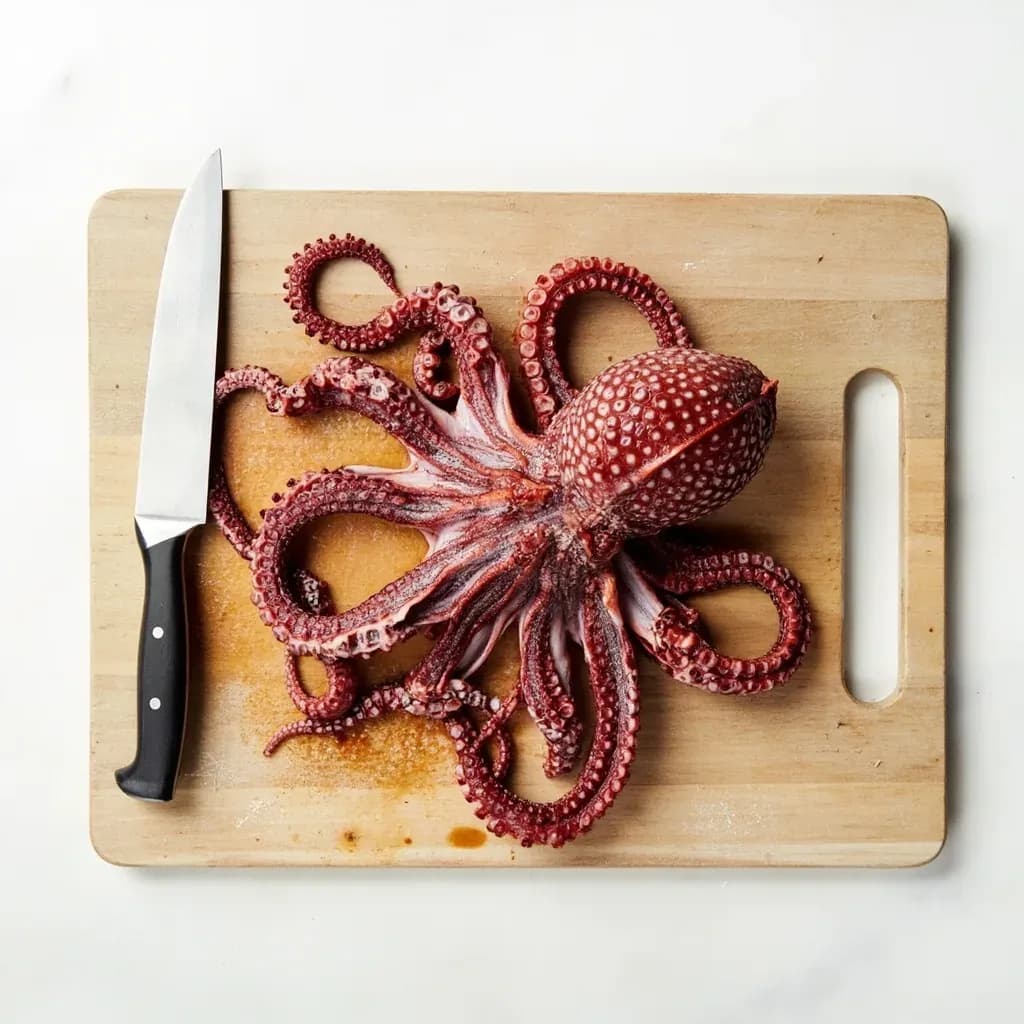
Prep & Assembly
Cleaning Octopus
Removing the beak, ink sac, and innards and tenderizing octopus before cooking.
Cleaning octopus removes the hard beak, eyes, ink sac, and internal organs from the head, then rinses the body and tentacles. It often includes tenderizing, achieved by massaging with salt, pounding, or freezing, since the muscle is tough when raw. Proper cleaning prevents grit and bitterness, while tenderizing yields a tender bite after braising or grilling. The skin can be left on for color or rubbed off for a smoother surface.
Cleaning an octopus is the bridge between a whole, rubbery sea creature and the tender, meaty ingredient that anchors dishes from Galician pulpo to Greek stifado. The process is mostly anatomical rather than technical: a cook needs to identify and remove the beak, ink sac, and visceral mass, then decide how aggressively to tenderize the muscle. Done well, cleaning yields roughly 75 to 85 percent of the purchased weight in usable flesh, plus a reserved ink sac that can color pasta, risotto, or rice dishes a dramatic midnight black.
The cleaning itself takes only ten to twenty minutes for a medium one-to-two-kilogram specimen, but it is the gateway to tenderness. Octopus muscle is dense with collagen, and how you handle it before cooking—whether by freezing, salting, massaging, or pounding—largely determines whether the final dish is silky or chewy. A confident cook who knows the anatomy can clean an octopus in a single pass; a hesitant one often ruptures the ink sac, leaves the beak embedded, or throws away usable head meat along with the guts.
What separates a clean octopus from a butchered one is restraint. The skin should be preserved on the tentacles for grip and presentation, the head sac kept whole if it will be grilled or stuffed, and the tentacle cluster kept intact as a single unit so the classic presentation of a coiled, suckered medallion remains possible. The trimmings themselves have value: the beak and scraps enrich a fumet, and even the rinsing liquid carries salt and protein into the braise.
- Difficulty
- Medium
Types & varieties
The standard market octopus, 1–3 kg typical; cleanest anatomy for beginners.
Small (under 500 g) specimens, often cleaned whole; ink sac and viscera are tiny and frequently left intact.
Very large specimens; requires heavier knife work and the head sac is often discarded due to toughness.
Smaller, with a single row of suckers; beak is comparatively small and easy to miss.
Often sold pre-frozen; cleaning is typically limited to removing beak and separating tentacles.
How to do it
- 1
Rinse and assess
Rinse the whole octopus thoroughly under cold running water. Lay it flat on a clean cutting board with the tentacles pointing away from you and the rounded head sac facing you. Pat dry and identify the eyes, the base where the tentacles join, and the apex of the head.
- 2
Separate the head from the tentacles
Insert a thin knife just below the eyes, cutting through the soft tissue where the head sac meets the ring of tentacles. Make a clean circular cut so the tentacles come away as one intact cluster. Set the tentacles aside.
- 3
Remove the beak
Turn the tentacle cluster upside down so the base faces you. Press your thumb firmly into the very center of the base; the hard, blackish beak (two interlocking chitinous plates) will push out through the opening. Pull it free with your fingers or tweezers and discard.
- 4
Empty the head sac
Slice the head sac open lengthwise from the cut edge down toward the tip. Reach inside and pull out the viscera—the translucent digestive gland, stomach, and reproductive organs. Locate the small, silvery-pearl ink sac nestled among the guts; tease it out gently with your fingers or a spoon without puncturing it, and reserve if using. Remove the eyes by pushing them out from inside or snipping them with scissors.
- 5
Rinse again
Wash both the head sac and the tentacle cluster under cold running water, rubbing off any remaining slime, grit, or membrane. Inspect for any lingering ink or soft tissue and trim with kitchen shears if needed.
- 6
Tenderize
Sprinkle the tentacles liberally with coarse sea salt and knead them firmly between your palms for 5–10 minutes, then rinse. Alternatively, freeze the octopus for 24–48 hours before cooking, or pound the tentacles lightly against the work surface—both methods begin breaking down collagen so the flesh will turn tender during cooking.
- 7
Store or cook
Pat the cleaned octopus dry, place it in a sealed container, and refrigerate for up to 2 days, or freeze for longer storage. It is now ready for braising, grilling, or any other application.
Anatomy of a Market Octopus
Understanding the three zones of a market octopus makes the entire cleaning process intuitive. The head sac is the rounded, bulbous body—often mistaken for the head—where the eyes, brain, and all the visceral organs sit. Beneath it, where the head sac tapers, the eight tentacles radiate from a single point. Right at the center of that join, hidden inside, sits the beak: two hard, chitinous, blackish plates that interlock like a parrot's bill. It is the only truly inedible hard part, and once you know where to press, it pops free in seconds.
- Head sac: contains the eyes, brain, ink sac, and digestive organs; soft, edible when cleaned, and ideal for stuffing or slicing thin for grilling.
- Tentacle base: the convergence point of all eight arms; cut just below the eyes to separate the head from the tentacles as a single unit.
- Beak: two interlocking dark plates at the dead center of the tentacle base; the only hard, non-edible structure.
- Ink sac: a small silvery-pearl sac tucked among the viscera; ruptures easily and stains everything it touches black.
- Eyes: round and gritty; remove before cooking for cleaner flavor and texture.
Tenderizing Traditions and Methods
Tenderizing is not strictly part of cleaning, but the two are so intertwined in practice that most cooks treat them as one. Octopus collagen does not melt until it reaches around 80°C (175°F), so the goal of pre-cooking prep is to damage the muscle fibers enough that they surrender their chew during a long, gentle braise or a short, hot sear. Mediterranean tradition offers a menu of options, and they can be combined.
- Freezing for 24–48 hours: ice crystals rupture cell walls; this is the most common modern method and is why fishmongers often sell octopus already frozen.
- Sun-drying (Greek/Cretan): a few hours of sun and wind dehydrates the surface, concentrating flavor and firming the skin for grilling.
- Salt massage: coarse sea salt rubbed into the tentacles for 5–10 minutes abrades the surface and draws out excess moisture.
- Pounding: striking the tentacles against a stone or work surface mechanically breaks down fibers; a stand-mixer paddle on low does the same in a kitchen.
- Blanching: the Galician 'asustar' technique—lifting the octopus in and out of boiling water two or three times before the final cook—curls the tentacles, tightens the skin, and helps leach out surface salts.
- Sous-vide: a clean alternative, where 4–6 hours at 77°C (170°F) tenderizes the muscle without any prior mechanical work, though cleaning steps remain identical.
Common uses
Tips & pitfalls
- Freeze the octopus for 24–48 hours before cleaning whenever possible; ice crystals tenderize the muscle and firm the skin so it peels away cleanly.
- Always cut just below the eyes when separating the head from the tentacles; cutting too high leaves the beak embedded in the tentacle base and forces a second pass.
- Press firmly into the center of the tentacle base to pop the beak out without a knife—using a blade risks slipping and cutting through to the skin.
- Remove the ink sac intact before any cutting that might puncture it; once ruptured, the ink stains hands, board, and flesh irreversibly.
- Discard the eyes, which harbor grit and carry a bitter note.
- Handle the emptied head sac gently so it can be stuffed whole or sliced thinly for grilling without tearing.
- Work over a bowl of cold water rather than directly over a drain to catch the ink sac intact if you plan to use it.
- Massage tentacles with coarse salt for 5–10 minutes, then rinse; this both cleans the surface and begins tenderizing the fibers.
- Reserve the beak and other trimmings to enrich a seafood stock or fumet.
Good to know
- Difficulty
- Moderate; primarily requires careful knife work and familiarity with the anatomy
- Time
- 10–20 minutes for a medium octopus (1–2 kg); longer for very large specimens
- Key parts removed
- Beak (hard mandibular plates), ink sac, viscera (digestive organs), eyes, and tough outer skin from the head sac if desired
- Yield
- Roughly 75–85% of purchased weight is edible after cleaning
- Common species cleaned
- Octopus vulgaris (common octopus), Octopus maya, Eledone cirrhosa (horned octopus), and various small 'baby' octopuses
- Tenderizing methods
- Massaging with salt, freezing overnight, sun-drying (traditional Greek), blanching, or mechanical pounding
- Storage of cleaned octopus
- Refrigerate up to 2 days in a sealed container; freeze up to 2 months; whole frozen octopus is widely preferred for tenderness
- Ink usage
- The ink sac can be carefully excised and reserved for pasta, risotto, sauces, or to blacken rice dishes like arroz negro
Also called
Tenderizing Octopus
Related

Whisk
Beat ingredients smooth and aerated with a looping wire motion

Sift
Pass dry ingredients through mesh to aerate and remove lumps

Strain
Pour through mesh to separate solids from liquid for a smooth result

Filter
Pass liquid through fine material to clarify out the smallest particles

Rice
Press cooked potatoes through small holes for fluffy, lump-free texture

Mash
Crush soft cooked food into a rustic, creamy purée

Grind
Crush food into a coarse to fine texture, from spices to meat

Grate
Shred food into fine bits against a sharp-toothed surface