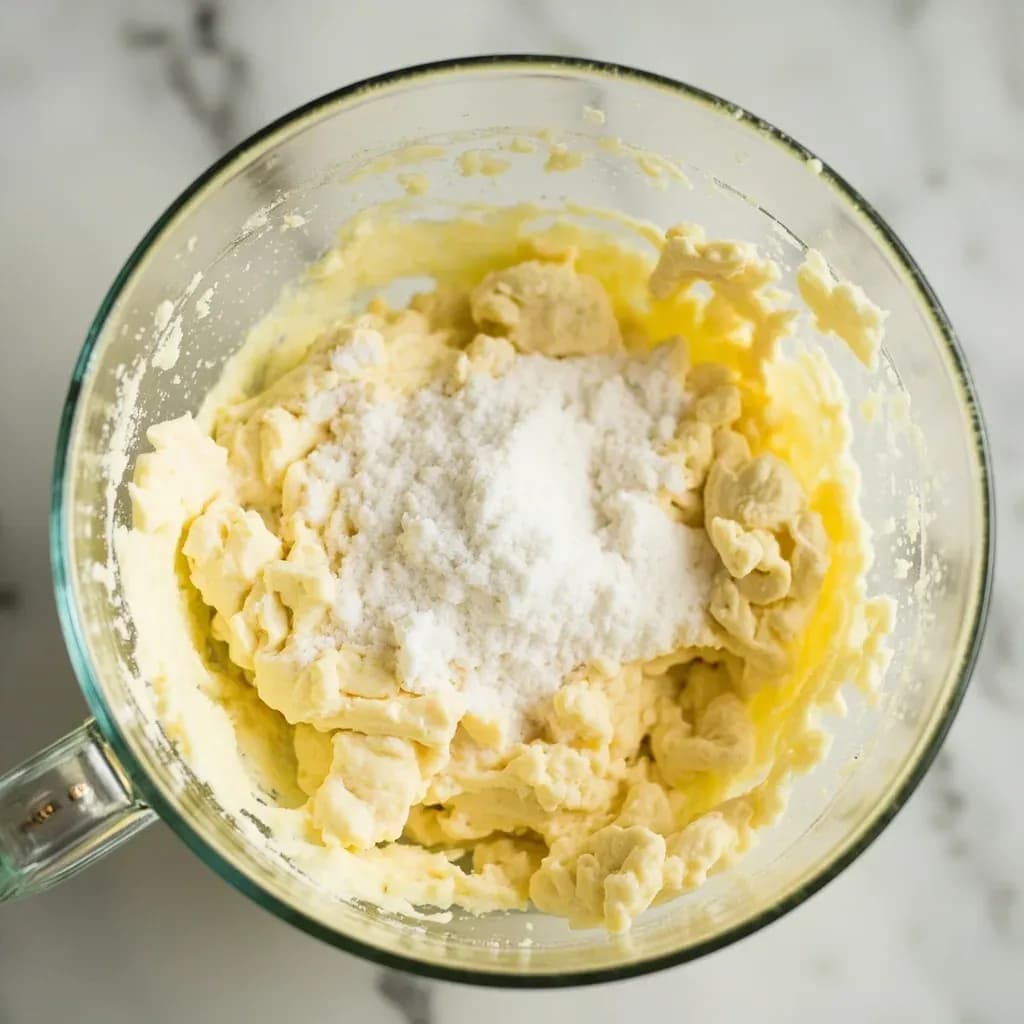
Prep & Assembly
Creaming Butter & Sugar
Beating softened butter with sugar until pale and fluffy to aerate cakes and cookies.
Creaming beats softened butter together with sugar until the mixture turns pale, light, and fluffy, the foundational first step for many cakes, cookies, and frostings. The sharp sugar crystals cut tiny air pockets into the butter, and those trapped bubbles expand in the oven to give baked goods their rise and tender crumb. Room-temperature butter and a few minutes of beating are essential, since cold butter won't aerate properly.
Creaming is the foundational mixing method behind most butter-based cakes and many cookies: softened butter is beaten with sugar until the mixture turns pale, light, and noticeably fluffy. The goal is mechanical aeration — the cook is not dissolving sugar, but forcing tiny air bubbles into the fat so the batter can rise in the oven even before chemical leaveners kick in. A properly creamed mixture will roughly double in volume and shift from butter-yellow to a near-white cream, the visual cue that enough air has been incorporated.
The mechanism is simple but precise. Sharp sugar crystals shear into the pliable fat, creating thousands of microscopic pockets that the fat matrix holds open. As the batter heats in the oven, those trapped air cells expand and give the cake its initial lift, with baking powder or soda contributing the rest of the rise. The technique only works when the butter is in a narrow temperature window — soft enough to deform under the beater, firm enough to trap air rather than absorb it — and when the work stops at the right moment.
- Difficulty
- Easy
Types & varieties
The classic method: butter and sugar beaten together until fluffy, then eggs added one at a time, then alternating dry and wet ingredients.
Dry ingredients are blended with butter first, then liquid is added. Popularized by Rose Levy Beranbaum in The Cake Bible; produces a finer, more even crumb and very moist layer cakes.
Used in some pound cake and high-ratio recipes; butter is beaten with a portion of the sugar, then eggs and the remaining sugar are added in stages.
Shortened mixing time used in some commercial and home recipes where a denser, less airy texture is acceptable.
Coating flour with butter before adding liquids to limit gluten, yielding a fine, tender, velvety cake crumb with a flat, even top.
How to do it
- 1
Bring the butter to the right temperature
Soften butter to 65–70°F (18–21°C): it should yield slightly when pressed but still hold its shape. Cut it into tablespoon-sized pieces so it warms evenly. Avoid the microwave — partially melted butter will not trap air and the cream will fail.
- 2
Combine butter and sugar
Place the softened butter in the bowl of a stand mixer (or a large mixing bowl if using a hand mixer) and add the sugar. A general ratio is roughly 1 part butter to 1–1.25 parts sugar by weight, though recipes vary.
- 3
Begin on low, then increase speed
Beat on low for about 30 seconds just to combine — this prevents sugar from flying out of the bowl. Then raise the speed to medium.
- 4
Cream 3–5 minutes
Beat on medium, scraping down the bowl and paddle once or twice with a rubber spatula so no butter hides on the sides. Watch for the mixture to turn noticeably paler, roughly double in volume, and look light and fluffy.
- 5
Test for readiness
Lift the paddle: the mixture should fall in a slow, ribbon-like trail that briefly holds its shape on the surface before sinking in. It should look creamy, not greasy or separated.
- 6
Proceed with the recipe
Add eggs one at a time, beating well between each, then alternate additions of dry and wet ingredients as the recipe directs. Avoid over-mixing once the flour is in — that is a separate, later stage where gluten is at risk.
How it works
Creaming is a mechanical process, not a chemical one. Sugar is far harder than butter, so when the two are beaten together the crystals act like a fleet of tiny chisels, cutting into the fat and dragging air down into it. The fat, in turn, behaves like a stable foam: its fat crystals hold the air pockets in place at room temperature and continue to do so through the first minutes of baking. This is why temperature matters so much — butter that is too cold resists the beater and the sugar cannot shear into it, while butter that is too warm cannot hold air and the mixture turns greasy. Creaming works in concert with baking powder or baking soda: the air you beat in provides the scaffolding, and the chemical leavener provides the long, sustained rise.
Troubleshooting
Most creaming problems trace back to butter temperature, mixing time, or the wrong attachment. A quick read of the bowl usually tells you which.
- Mixture looks grainy and dense: butter was too cold, or mixing was too brief. Let it warm slightly and beat longer.
- Mixture looks greasy or separated: butter was too warm, or the kitchen is hot. Chill the bowl 10–15 minutes and re-beat briefly.
- Cake rises dramatically in the oven then sinks: over-aerated butter and sugar, or unstable air pockets from a warm kitchen. Cream less next time, or chill the bowl briefly before baking.
- Crumb is tunneled or tough: almost always from over-mixing after the flour was added, which develops excess gluten. Creaming is not the culprit — but a poorly creamed base often tempts the baker to remix, and that is where the damage is done.
- Cookies spread too much: butter was too soft when creamed, or the recipe leans on brown sugar, which adds moisture and encourages spread.
Common uses
Tips & pitfalls
- Soften butter at room temperature for 30–60 minutes; do not microwave — uneven melting will not hold air.
- If the butter is too cold, grate it on a box grater or cut it into small cubes to speed softening without melting.
- If it is too warm, chill 10–15 minutes in the refrigerator before beating so the fat can firm back into the right range.
- Scrape the bowl and beater down at least once during creaming; a streak of uncreamed butter on the side will sabotage aeration.
- Use the paddle attachment, not the whisk, in a stand mixer; a whisk over-aerates the fat and the structure can collapse during baking.
- Stop at pale and fluffy — over-creaming can destabilize the fat matrix, cause the butter to break in a warm kitchen, or build air pockets that collapse in the oven and leave a denser, tougher crumb.
- Add eggs one at a time, beating well after each, before alternating dry and wet ingredients so the emulsion stays stable.
- Brown sugar creams differently from white — it traps moisture and produces a denser, chewier result; always weigh it packed.
- Use a room-temperature bowl — a cold bowl will firm the butter on contact and stall aeration.
Good to know
- Purpose
- Mechanically incorporates air into fat to leaven and tenderize cakes and cookies
- Ideal butter temperature
- 65–70°F (18–21°C) — pliable but holds its shape
- Mixing time
- 3–5 minutes on medium speed with a stand mixer
- Volume change
- Mixture roughly doubles in volume
- Color change
- From butter-yellow to pale cream or near-white
- Primary equipment
- Stand mixer with paddle attachment, or electric hand mixer
- Attachment note
- Paddle is preferred; a whisk over-aerates and the structure can collapse during baking
- Sugar type effect
- Granulated gives the most lift; caster/fine gives a finer crumb; brown sugar yields a denser, moister result
- Typical butter-to-sugar ratio
- Roughly 1 part butter to 1–1.25 parts sugar by weight, depending on the recipe
Also called
Creaming · Cream Butter and Sugar
Dishes that rely on it
Related

Whisk
Beat ingredients smooth and aerated with a looping wire motion

Sift
Pass dry ingredients through mesh to aerate and remove lumps

Strain
Pour through mesh to separate solids from liquid for a smooth result

Filter
Pass liquid through fine material to clarify out the smallest particles

Rice
Press cooked potatoes through small holes for fluffy, lump-free texture

Mash
Crush soft cooked food into a rustic, creamy purée

Grind
Crush food into a coarse to fine texture, from spices to meat

Grate
Shred food into fine bits against a sharp-toothed surface