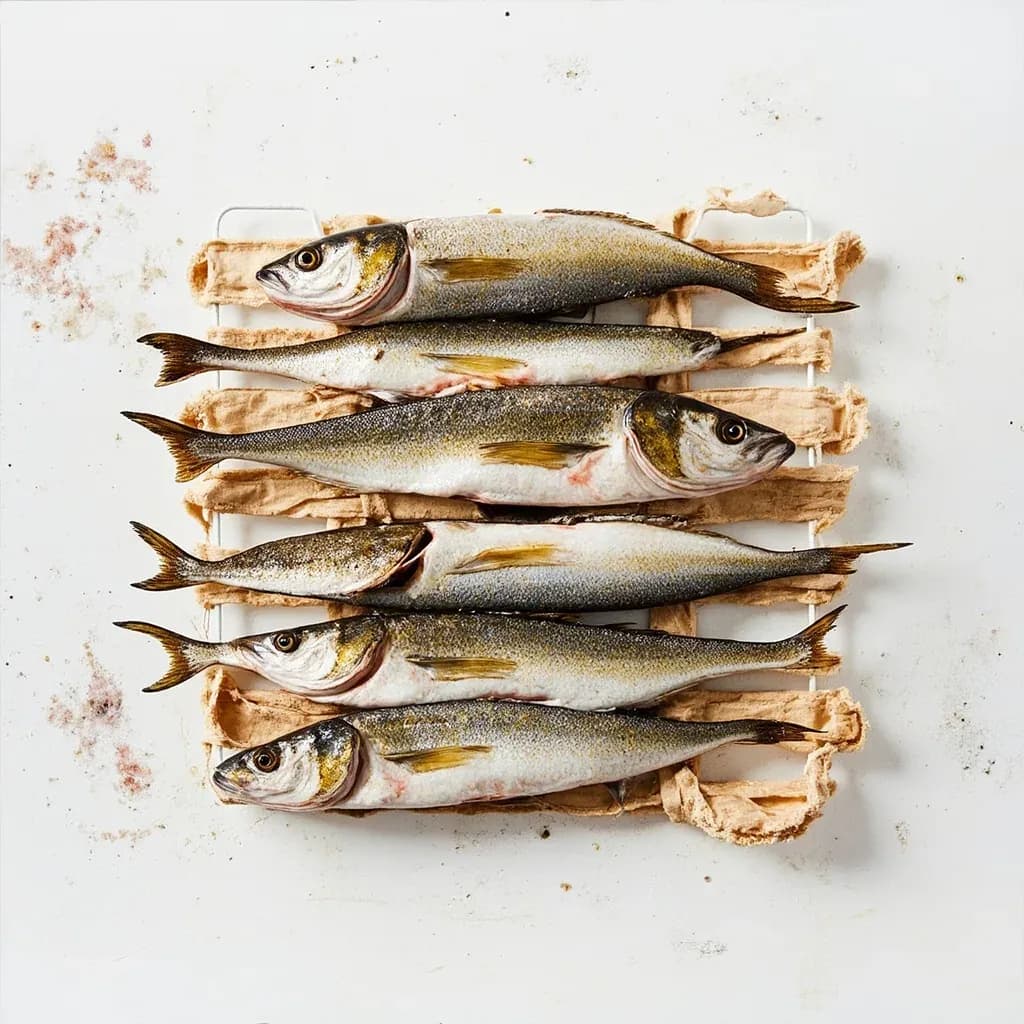
Transform & Preserve
Sun-Drying Fish
Salting and drying fish in open air to preserve it and concentrate flavor.
Sun-drying fish is a preservation method where cleaned, often salted fish is laid out in the sun and wind until much of its moisture evaporates. Lowering the water content inhibits spoilage bacteria so the fish keeps for weeks and develops a chewy, intensely savory character. It's the basis of foods like dried anchovies, stockfish, and Filipino daing, which are later rehydrated, fried, or simmered.
Sun-drying fish is a two-part preservation method that pairs a heavy salt cure with open-air exposure to sun and wind, reducing the fish's moisture from roughly 80% down to 15–25% — a range too dry for bacteria and molds to grow. The salt does the initial work by drawing water out of the flesh through osmosis and lowering surface water activity; the sun and a steady breeze then finish the job by evaporating what remains. Done well, the result is shelf-stable, lightweight, and intensely flavored, with a dense, savory, almost cheese-like character that comes from enzymatic changes, lipid oxidation, and slow surface browning as the flesh ages.
The method is one of humanity's oldest food technologies, and every coastal tradition has tuned it to its own climate and pantry. Norwegians hang split cod on wooden hjell racks for months to make stockfish; Filipinos salt small herring for a day or two to make tuyo eaten with garlic rice; Iberians salt cod heavily and finish it in the open air as bacalhau. For a home cook, the same logic applies on any scale: choose lean fish, salt thoroughly, and treat the drying rack as something that needs checking at dawn and dusk — because dew, not sunlight, is the constant enemy.
- Difficulty
- Medium
Types & varieties
Norwegian (Lofoten) unsalted cod and related whitefish, split and air-dried on wooden hjell racks for 2–3 months; the base for bacalao and lutefisk.
Norwegian salt-cured cod, salted then pressed and dried on coastal cliffs (klipper); saltier and denser than stockfish.
Iberian salt-cod tradition in which heavy salting dominates and open-air drying finishes the cure.
Icelandic air-dried haddock or cod, eaten as a snack with butter or crumbled onto flatbread.
Icelandic Greenland shark that is buried and pressed before being hung to dry for several months, developing a characteristic ammonia note.
Filipino sun-dried salted herring or anchovies, pan-fried until crisp and served with garlic rice and a vinegar dip.
Indian bummalo (bombil), butterflied, salted, and sun-dried until brittle and intensely savory.
Sri Lankan cured and smoked-dried skipjack tuna, crumbled into curries and sambols for umami depth.
Indonesian and Malaysian salted, sun-dried mackerel or similar fish, often lightly smoked.
Caribbean and West African tradition of heavily salting and drying herring for long-term storage.
How to do it
- 1
Select fresh, lean fish
Use impeccably fresh, gutted whole fish or thick fillets of a lean white species such as cod, haddock, pollack, or whiting. Keep the fish on ice until you begin; spoilage starts before the salt has time to penetrate.
- 2
Butterfly or split the fish
Slice along the backbone and open the fish flat, or fillet and score the skin side in shallow diagonal cuts. The goal is even thickness — uniform pieces dry at the same rate and don't trap moisture in a thick center.
- 3
Salt generously
Pack the fish flesh-down in dry salt, or submerge in a fully saturated brine (~360 g salt per liter of water) for 12–24 hours depending on thickness. Salt draws water out through osmosis and lowers surface water activity where bacteria would otherwise grow.
- 4
Rinse and surface-dry
Rinse off excess salt under cold water, pat dry with clean cloths, and rest the fish in shade for 1–2 hours until a tacky pellicle forms on the surface. This film slows further moisture loss from the inside while protecting the flesh from flies.
- 5
Set up the drying rack
Use raised wooden or bamboo racks, netting, or clean clotheslines at least 60 cm off the ground, positioned in full sun with a steady cross-breeze. Avoid dusty ground sites; elevation keeps out rodents and prevents humidity from pooling under the fish.
- 6
Lay fish skin-side down
Arrange the fish in a single layer, not touching, with the cut side facing the prevailing wind so moisture leaves the flesh rather than the skin. Leave space between pieces for air to circulate.
- 7
Cover against insects and bring in at night
Drape fine mesh or cheesecloth over the rack to keep flies off. Pull the fish indoors or cover them whenever humidity rises — at night, in fog, and at the first sign of rain. Dew is the chief cause of mold on sun-drying fish.
- 8
Turn and rotate daily
Flip the fish once a day and rotate the rack or sheets so pieces closest to the wind don't over-dry. Small fish (sardines, anchovies, tuyo) may be done in 1–3 days; split cod on hjell racks needs 2–8 weeks.
- 9
Test for doneness
Properly dried fish is stiff and leathery, pale gold to dark brown on the surface depending on the species and salt level, and noticeably light for its size. Press the thickest part — it should give like firm leather, not squish. The flesh should smell concentrated and briny, never sour or ammoniac.
- 10
Condition and store
Before long-term storage, stack the fish loosely for several days in a dry, airy indoor space so residual moisture equalizes between pieces. Then wrap in kraft paper or muslin and store in a cool, dark, dry place — never in plastic, which traps remaining moisture and causes mold.
The science in plain terms
Sun-drying fish works because microorganisms need liquid water to grow, and salt draws that water out of the flesh. A fully saturated brine is about 26% salt by weight, and even a 10% salt environment is hostile to most spoilage bacteria. When you combine that with steady evaporation, the water activity (a_w), not just moisture percentage, drops below the 0.6 threshold at which microbes cannot multiply. The flavor concentration you taste is partly water loss and partly slow chemistry: enzymes in the flesh break down proteins into free amino acids, while lipid oxidation and limited non-enzymatic browning at the surface produce the deep, savory, almost cheesy character of a well-dried piece.
- Water activity (a_w) is the real measure of safety, not just moisture percentage.
- A heavy surface salt concentration is what buys the time sun-drying needs to drive water activity below the safe threshold.
- Enzymatic autolysis continues during the first days of drying and is responsible for much of the concentrated flavor.
Climate and timing
You cannot sun-dry fish in a damp, cool climate without help. The traditional windows — Mediterranean summer, the Norwegian Arctic spring (February to May on the Lofoten), the Filipino dry season — share the same traits: daytime heat to drive evaporation, low humidity so evaporated moisture keeps moving, and steady wind to carry it away. In marginal climates, a dehydrator, a low oven (around 60°C/140°F with the door cracked), or a smokehouse finishes what the sun cannot.
- Aim for daytime temperatures above 25°C (77°F) and relative humidity below 60%.
- Cross-breeze is more important than direct sun; stagnant air stalls drying and invites mold.
- Plan around the weather: a 3-day dry forecast is the minimum for small fish; thick cuts need a stretch of stable, dry days.
Storage and conditioning
Dried fish is not finished when it comes off the rack. Conditioning — stacking the fish loosely in a dry, airy indoor space for several days — lets residual moisture equalize between pieces so none of them is wetter than the others. Only then should you wrap and store. Plastic is the enemy; it traps the last traces of moisture and guarantees mold within weeks.
- Wrap in kraft paper, muslin, or clean cotton; never in plastic bags or cling film.
- Store in the coolest, driest, darkest place available — a pantry shelf, a cellar, an unheated closet.
- Check stored fish monthly for any soft spots or off smells and re-dry those pieces briefly if needed.
Common uses
Tips & pitfalls
- Choose the leanest fish you can find — cod, haddock, pollack, whiting — because unsaturated fat goes rancid long before the flesh finishes drying.
- Salt is non-negotiable: a thorough dry-salt cure or a 12–24 hour soak in fully saturated brine drops surface water activity and buys you the time sun-drying needs.
- Bring fish in at night and whenever humidity rises; dew rehydrates the surface and is the single most common cause of mold on sun-dried fish.
- Test doneness by feel — properly dried fish is stiff and leathery, bending without cracking; if it flexes soft or smells sour, return it to the rack.
- Avoid oily species like mackerel and sardines for long storage unless you plan to eat them within weeks — they oxidize quickly and turn metallic.
- Don't overdry to the point of brittleness unless you intend to grind the fish; slightly pliable pieces rehydrate more evenly in cooking.
- Store finished fish wrapped in breathable paper or muslin, never plastic, in the coolest, driest spot you have.
Good to know
- Origin
- Among the oldest preservation methods; practiced in coastal cultures worldwide for thousands of years, referenced in Egyptian tomb paintings, Mesopotamian records (including the Codex Hammurabi), and Roman texts.
- Best fish for drying
- Lean, white-fleshed species such as cod, haddock, pollack, and whiting; oily fish like mackerel and sardines oxidize and go rancid before they fully dry.
- Ideal climate
- Hot days with low humidity and steady wind — traditionally 25–35°C (77–95°F) with relative humidity below 60%.
- Drying time
- 1–4 days for small whole fish such as sardines, anchovies, and tuyo; 2–8 weeks for split cod hung on traditional racks.
- Salt ratio
- Dry-salting at roughly 1 part salt to 5–10 parts fish by weight; brining in a fully saturated solution (~360 g salt per liter of water) for 12–24 hours.
- Target moisture
- Reduced from about 80% to 15–25% to drop water activity below the threshold for microbial growth.
- Shelf life
- 6–12 months in a cool, dark, dry place when fully dried and stored wrapped in breathable paper or cloth — never plastic.
- Primary functions
- Preservation, weight reduction for transport, and flavor concentration through enzymatic activity, lipid oxidation, and slow surface browning.
Also called
Sun-Drying Fish · Drying Fish
Related

Confit
Cook slowly submerged in fat for silky tenderness and keeping

Cure
Draw out moisture with salt and time to preserve and concentrate

Pickle
Steep in acidic brine for bright, tangy, crunchy preservation

Ferment
Let friendly microbes transform food into tangy, complex flavor

Marinate
Soak in a seasoned mix to flavor and tenderize before cooking

Brine
Soak in salt water so meat stays juicy and seasoned throughout

Dehydrate
Slowly dry out moisture to concentrate flavor and extend shelf life

Cold-Smoke
Perfume cured food with smoke without cooking it through