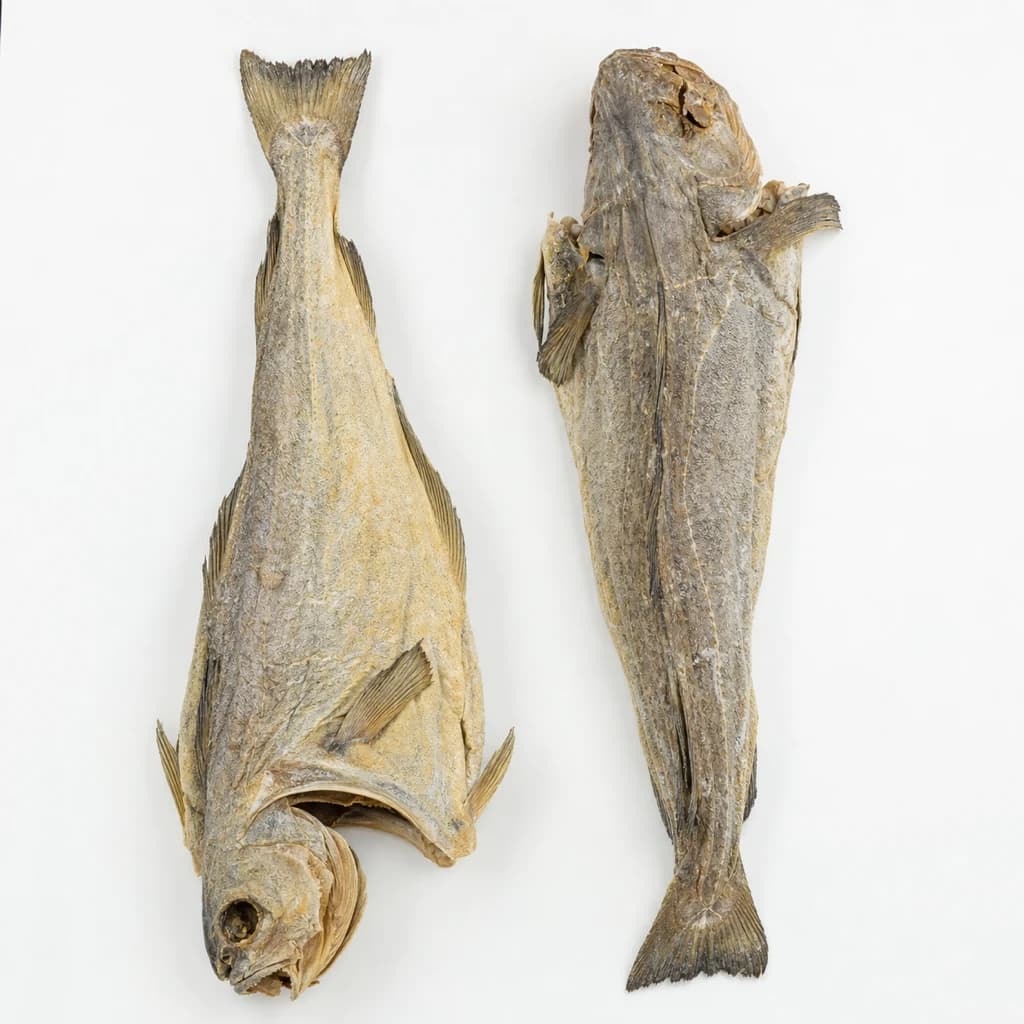
Natural form
Whole dried stockfish: rigid, pale yellow-grey cod with board-like texture.
Shows the defining characteristic of stockfish — its completely desiccated, hard, unsalted state — so readers can recognize it in markets or at home.
Proteins
Stockfish (Stoccafisso)
Air-dried (unsalted) cod, rehydrated for Italian and Nordic stews.
Stockfish, or stoccafisso, is cod that has been air-dried without salt on outdoor racks, producing a hard, preservable fish. It must be soaked for days to rehydrate before being simmered into dishes like Italian baccalà-style stews and Nordic lutefisk preparations. Unlike salt cod (baccalà), it relies on drying alone for preservation.
Stockfish—Italian stoccafisso, Norwegian tørrfisk—is air-dried white fish, most commonly cod, that has been preserved without salt. This distinguishes it fundamentally from baccalà, its salted counterpart. The Norwegians hang split fish on outdoor wooden racks called hjell during the cold, dry Arctic winter; the moisture slowly extracts through pure desiccation, concentrating the proteins and leaving a firm, almost wood-colored loin. This centuries-old method, practiced since the Viking era, produces a product that keeps for years when stored properly but requires patience and care to bring back to life.
Rehydration is the critical technique that separates successful stockfish cookery from frustration. Depending on thickness, pieces demand anywhere from 48 hours to a full week submerged in cold water, changed twice daily. The flesh should yield slightly to pressure when fully restored—under-soaked stockfish stays dense and board-like, and no amount of cooking will remedy it. Over-soaked pieces, conversely, turn mushy and fall apart. Properly treated, the finished fish has a firm, dense, almost meaty quality quite different from fresh fish, with an intensely savory, mildly oceanic flavor that holds its own against bold Mediterranean aromatics.
Norway supplies more than 90 percent of global stockfish production, with the Lofoten Islands producing the most prized grades. Historical trade routes brought this preserved fish south to Catholic Mediterranean countries, where it became a Lenten staple celebrated in Neapolitan stews, Venetian pies, and Sicilian preparations with tomatoes and pine nuts. In Scandinavia, the same product reappears in lutefisk—soaked in lye water before cooking—an entirely different culinary tradition built on the same raw material. Understanding stockfish means understanding two parallel worlds united by one humble, ancient fish.
- Measured in
- g
- Storage
- Pantry
Allergens
Types & varieties
The classic and most prized stockfish; firm, white flesh
Larger fish, yields thicker loins; mild flavor
Smaller species; tender texture
Haddock stockfish; slightly darker flesh, stronger flavor
Thick-bodied fish; excellent for stews
Premium quality from Lofoten; superior color and texture
Common uses
Tips & pitfalls
- Soak in COLD water only—warm or hot water causes the proteins to break down unevenly, resulting in mushy texture
- Change soaking water at least twice daily to prevent bacterial growth and remove purines
- Test doneness by pressing the flesh—properly rehydrated stockfish yields slightly to pressure but remains firm
- For thinner cuts, pounding with a wooden mallet before soaking can accelerate water penetration
- After soaking, remove any remaining bones and skin; the flesh should flake naturally along the grain
- Common mistake: under-soaking, which results in a tough, cardboard-like texture that does not improve with cooking
- Common mistake: using stockfish that was previously frozen or improperly dried, which will not rehydrate properly
- In Norway, stockfish is traditionally hung on outdoor wooden racks called 'hjell' during the cold, dry winter months—this natural air-drying produces superior quality
- Once rehydrated, use within 2–3 days or freeze for longer storage
Nutrition
Energy
1213 kJ · per 100 g
Where the calories come from
Protein
62.8g
126% DV
Carbs
0g
0% DV
Fat
2.4g
3% DV
Fiber
0g
0% DV
Sugars
0g
of which
Sodium
7027mg
306% DV
Source · USDA FoodData Central · approx. Fish, cod, Atlantic, dried and salted
View on FDC →In the shops
Matched grocery products
No matched grocery products for Stockfish (Stoccafisso) yet.
Good to know
- Type
- Air-dried white fish (cod, haddock, or pollock); NOT salted (distinguishes it from baccalà)
- Origin
- Norway, particularly the Lofoten Islands, where it has been produced since the Viking era
- Primary Producers
- Norway supplies >90% of global production; also produced in Iceland and Newfoundland
- Shelf Life
- Years when stored in a cool, dry place; deteriorates rapidly in humidity
- Rehydration Time
- 48–72 hours for thin pieces; 4–7 days for thick loins, in cold water changed daily
- Yield
- Dries to approximately 20–25% of fresh weight; rehydrates to 80–90% of original fresh weight; protein becomes highly concentrated
- Flavor Profile
- Concentrated, savory, mildly fishy; texture becomes meaty and dense when cooked
- Difficulty
- Moderate—patience required for proper soaking; over-soaking yields mushy texture
- Traditional Equipment
- Wooden soaking vessels or food-grade plastic buckets; wooden club for tenderizing
Substitutes
- Salt cod (baccalà) — Requires different preparation (soaking to remove salt) and yields a different—saltier, more pronounced—flavor; not interchangeable in recipes developed specifically for stockfish
- Dried pollock — Similar drying method; milder flavor; acceptable substitute in a pinch
- Unsalted dried cod fillets — Fresh cod that has been dried at home or commercially; closest flavor and texture match
Pairs with
Also called
Stockfish · Dried Cod
Appears in these dishes

Related

Egg
The kitchen's everything ingredient — bind, leaven, enrich, or fry

Chicken Breast
Lean, quick-cooking white meat for everyday dinners

Ground Beef
Versatile minced beef for burgers, ragù, tacos, and meatballs

Pork Loin
Lean, tender roasting cut that stays juicy with care

Salmon
Rich, rosy fish that roasts, grills, or cures beautifully

Egg White
Pure protein that whips to airy peaks for meringue and more

Egg Yolk
Rich, golden yolk for custards, mayonnaise, and pasta

Quail Egg
Tiny, speckled eggs for garnishing and elegant bites