Prep & Assembly
Extruding
Pushing dough or paste through a shaped die to form pasta, noodles, or piped shapes.
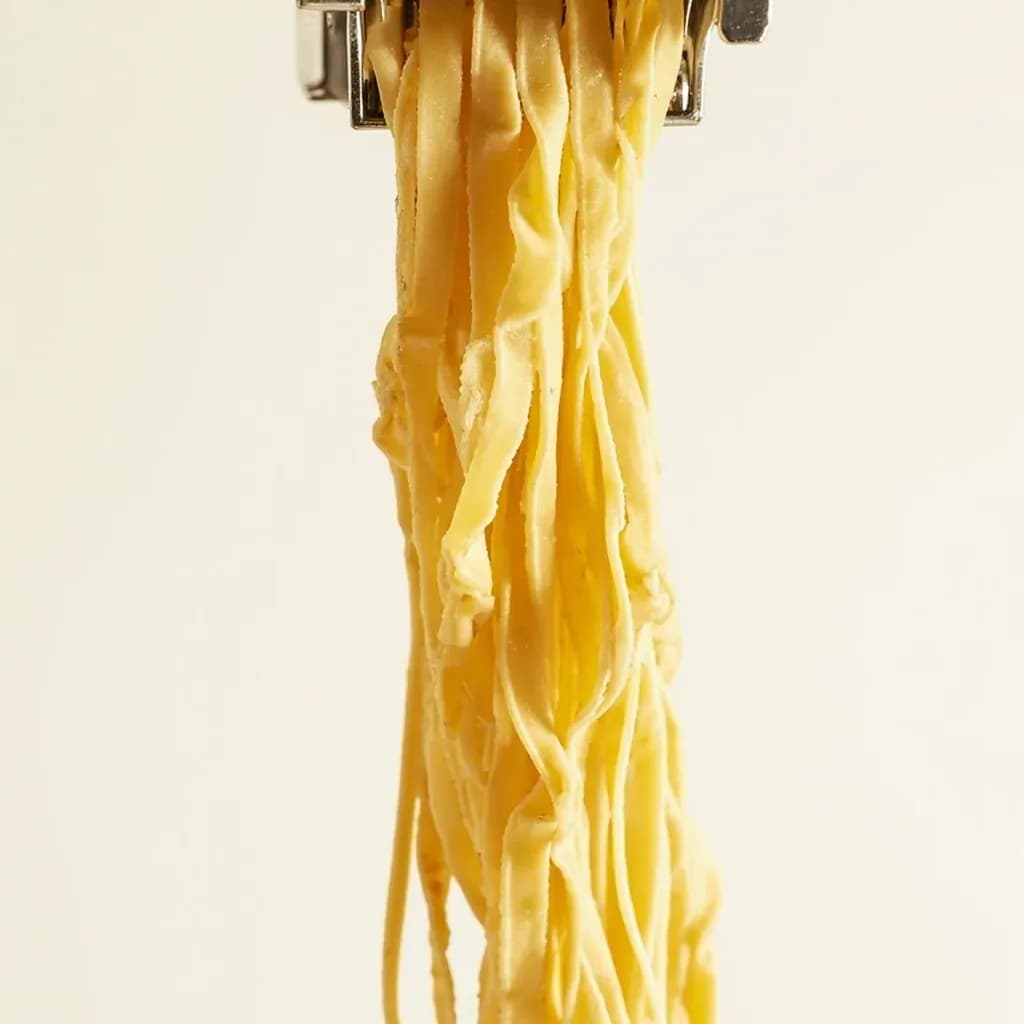
Extruding forces a stiff dough or paste through a die or press to create uniform shapes like macaroni, bucatini, or fresh noodles. The die's openings determine the final form, from tubes to strands to ridged shapes. Extrusion gives a rougher surface than rolled pasta, which helps sauce cling. It also applies to pressing sausages into casings and piping firm batters.
Extruding is the act of forcing a soft food mass — a dough, paste, batter, or puree — through a shaped opening under pressure so it emerges as a continuous piece with a uniform cross-section. The shape of the die (or nozzle, or tip) defines the cross-section; the pressure and feed rate set the throughput; and a wire or blade sets the length. It is the same physical principle whether you are cranking penne through a bronze die, piping choux rosettes through a star tip, packing forcemeat into a sausage casing, or running hydrated semolina through an industrial press rated at several hundred bar.
What makes extrusion worth understanding as a single technique, rather than as four or five separate tricks, is that the variables are the same everywhere: moisture in the dough, pressure applied, die geometry, and — at industrial scale — temperature and shear. Get the moisture wrong and the strand fractures or slumps. Get the pressure uneven and the surface tears. Get the die geometry wrong and the sauce won't cling. Most home failures with pasta machines, cookie presses, and sausage stuffers trace back to one of these.
Extrusion also bridges the home kitchen and the factory floor. The same hand-cranked press that pushes egg dough through a bronze die in a home cook's kitchen is the direct descendant of the steam-powered pasta presses patented in France in 1826 and built in Pressburg in 1828, and the ancestor of the twin-screw extruders that today cook, puff, and shape breakfast cereal in a single barrel.
- Difficulty
- Medium
Types & varieties
Material is shaped at or near room temperature with minimal heat buildup. Used for fresh pasta, sausages, cookie dough, and piped decorations.
Heat and shear cook and expand the product in a single pass; the standard industrial process for puffed snacks, breakfast cereals, and textured vegetable protein.
Hydrated semolina or flour-and-egg dough pressed through bronze or Teflon dies to form spaghetti, penne, fusilli, rigatoni, and other shapes.
Softened butter cookie dough forced through a decorated metal or plastic disk to make spritz, rosemary shortbread, and similar molded cookies.
Seasoned forcemeat packed into natural or collagen casings with a hand-cranked or hydraulic stuffer — a classic low-pressure extruder.
Choux, royal icing, whipped cream, mashed potato, or crème pâtissière forced through star, round, leaf, or specialty tips.
An N₂O-charged canister aerates and expels cream through a tip; a small-scale example of pressurized extrusion, also used for espumas.
Cold-pelleted dough that is later fried or puffed; the basis for 3D snacks, bugles, and many extruded corn curls.
Single-screw is common for cereal and snack lines; twin-screw gives better mixing and moisture control and is standard for high-moisture and protein-texturing applications.
Soft cooked potatoes, gnocchi, or vegetables pressed through perforated disks; a manual, low-pressure form of extrusion that produces an even, lump-free texture.
How to do it
- 1
Select the die and prep the equipment
Choose a die with the cross-section you want — bronze for a textured, sauce-clinging surface, Teflon for a smooth, glossy one. Fit it to the barrel, secure the cutting knife, and lightly oil any metal-to-metal contact points. Have the receiving tray, drying rack, or baking sheet in position before you start.
- 2
Mix and hydrate the dough
Combine flour or semolina with water (or eggs and water) and mix until the dough is uniformly moist and just cohesive. For semolina pasta, target about 28–32% hydration: a damp, sandy crumb that just holds when squeezed, never a tight ball. Rest the dough, covered, for 20–30 minutes so the flour fully absorbs the liquid.
- 3
Load the barrel
Feed the dough in small handfuls, tamping gently to displace air pockets. Do not pack it so tightly that the auger stalls, and do not leave it so loose that pressure builds unevenly and the strand pulses.
- 4
Extrude under steady pressure
Crank, push, or run the auger at a constant rate. Watch the strand as it leaves the die: it should emerge as a continuous, evenly shaped piece with no splits, bubbles, or fraying. If the surface looks torn, the dough is too dry; if the shape slumps, the dough is too wet or too warm.
- 5
Cut to length
Use the fitted knife, a wire cutter, or kitchen shears to cut the strand as it is produced. For short pasta shapes, time the cut with the rotation of the die plate. Catch the cut pieces on a lightly floured tray or a drying rack so air circulates around each one — piling causes dents and uneven drying.
- 6
Dry, cook, or fill
Fresh pasta is best cooked within a few hours of extruding. For dried pasta, move the pieces to a low-humidity drying room (under 60% RH) for 12–48 hours to prevent surface checking. For filled shapes, pair the extruded tubes or sheets with a separate filling and molding step. For piped doughs (cookies, choux, royal icing), pipe directly onto the baking sheet or cake.
- 7
Clean the die immediately
Scrape excess dough from the die before it dries and hardens — once it sets inside the bore, it is almost impossible to clear without damaging the die. Use a dry brass brush on bronze dies, warm water for Teflon dies, and never soak bronze dies or run them through a dishwasher, which dulls and tarnishes the metal.
The five variables that control any extruder
Every extrusion job — home or industrial — comes down to the same five levers, and changing one without thinking about the others is the most common source of failure.
- Moisture in the dough. For semolina pasta, 28–32% hydration is the workable band; below it, the strand fractures on exit; above it, the shape slumps.
- Pressure and feed rate. Steady pressure produces an even surface; jerky cranking produces thickness variation and tearing at the die face.
- Die geometry. The cross-section and any internal land (the length of the bore the dough travels through) control surface texture and final shape fidelity.
- Die material. Bronze tears the surface of the dough as it leaves, creating microscopic roughness that grabs sauce; Teflon gives a smooth, glossy, more uniform skin.
- Temperature and shear (industrial only). Together they cook, gelatinize, or expand the product in the barrel, and must be balanced against moisture to avoid scorched starch or ungelatinized grain.
Why bronze and Teflon dies change the finished pasta
A bronze die's roughened surface is not cosmetic. The micro-tears it leaves on the pasta give sauces something to grip, which is why traditionalists in Gragnano and along the Amalfi coast still insist on it for dried pasta destined for ragù or pesto. Teflon dies are faster to clean and run cooler, and they produce a sleek, premium-looking strand suited to simple butter or oil sauces. A cook choosing between them is really choosing the dish, not the die.
Common uses
Tips & pitfalls
- Aim for a uniformly damp, sandy-crumb texture when mixing semolina pasta dough: it should just hold when squeezed in the hand, not form a tight, smooth ball. The wrong hydration is the single most common cause of torn or slumped strands.
- Choose the die to match the dish. Bronze for a rustic surface that grips a chunky ragù or pesto; Teflon for a smooth, premium strand suited to butter, olive oil, or delicate cream sauces.
- Keep cranking pressure steady. Jerky pressure produces uneven thickness, surface tears, and a mix of broken and slumping pieces in the same batch.
- For cookie presses, chill the dough so it holds the die pattern on the sheet. Warm dough slumps, blurs the ridges, and the cookies lose their definition in the oven.
- For sausage stuffing, keep the casing slightly slack on the nozzle and prick out air pockets as you go. Tight casings burst on the grill or in the pan.
- On an industrial hot extruder, match screw speed, barrel temperature, and moisture together. Too much shear scorches the starches and produces off-flavors; too little leaves an ungelatinized, gritty core.
- Dry extruded pasta slowly at low humidity (under 60% RH) before the final drying stage. Rushing the dry causes surface checking — fine cracks that split the pasta during cooking.
- Never soak bronze dies. A short rinse in cool water to loosen dough, followed by a dry brush, is the right routine. Soaking tarnishes the bronze and can shift tolerances, producing thicker strands on later runs.
Good to know
- Definition
- A shaping technique that forces a soft food mass through a die or nozzle under pressure so it emerges in a continuous, uniform cross-section.
- Operating principle
- Pressure from a piston, screw, auger, or hand force pushes material through an opening; the die's shape defines the cross-section and a cutting wire or blade sets the length.
- Key equipment
- Pasta extruder (hand-crank or electric), cookie press, sausage stuffer, piping bag with tips, ricer, and pressurized siphons; industrially, single- and twin-screw extruders.
- Die materials
- Bronze gives a rough, porous surface that grips sauce; Teflon (PTFE) gives a smooth, glossy, more uniform finish.
- Dough moisture window
- Fresh pasta dough for extrusion runs roughly 28–32% hydration; too dry and the strand fractures, too wet and it loses shape.
- Pressure range
- Hand extruders work at low pressure; industrial pasta presses reach several hundred bar; snack-food extruders combine high pressure with 100–200 °C heat and high shear.
- First patent
- Alexandre and Eugène Fichet patented a pasta extrusion press in France in 1826; Carl Heinrich Seidel built the first steam-powered pasta press in Pressburg (Bratislava) in 1828.
- Cleanup
- Clear dough from the die before it dries; bronze dies respond to a dry brass brush and must never be soaked, which dulls and tarnishes the metal.
Related

Whisk
Beat ingredients smooth and aerated with a looping wire motion

Sift
Pass dry ingredients through mesh to aerate and remove lumps

Strain
Pour through mesh to separate solids from liquid for a smooth result

Filter
Pass liquid through fine material to clarify out the smallest particles

Rice
Press cooked potatoes through small holes for fluffy, lump-free texture

Mash
Crush soft cooked food into a rustic, creamy purée

Grind
Crush food into a coarse to fine texture, from spices to meat

Grate
Shred food into fine bits against a sharp-toothed surface