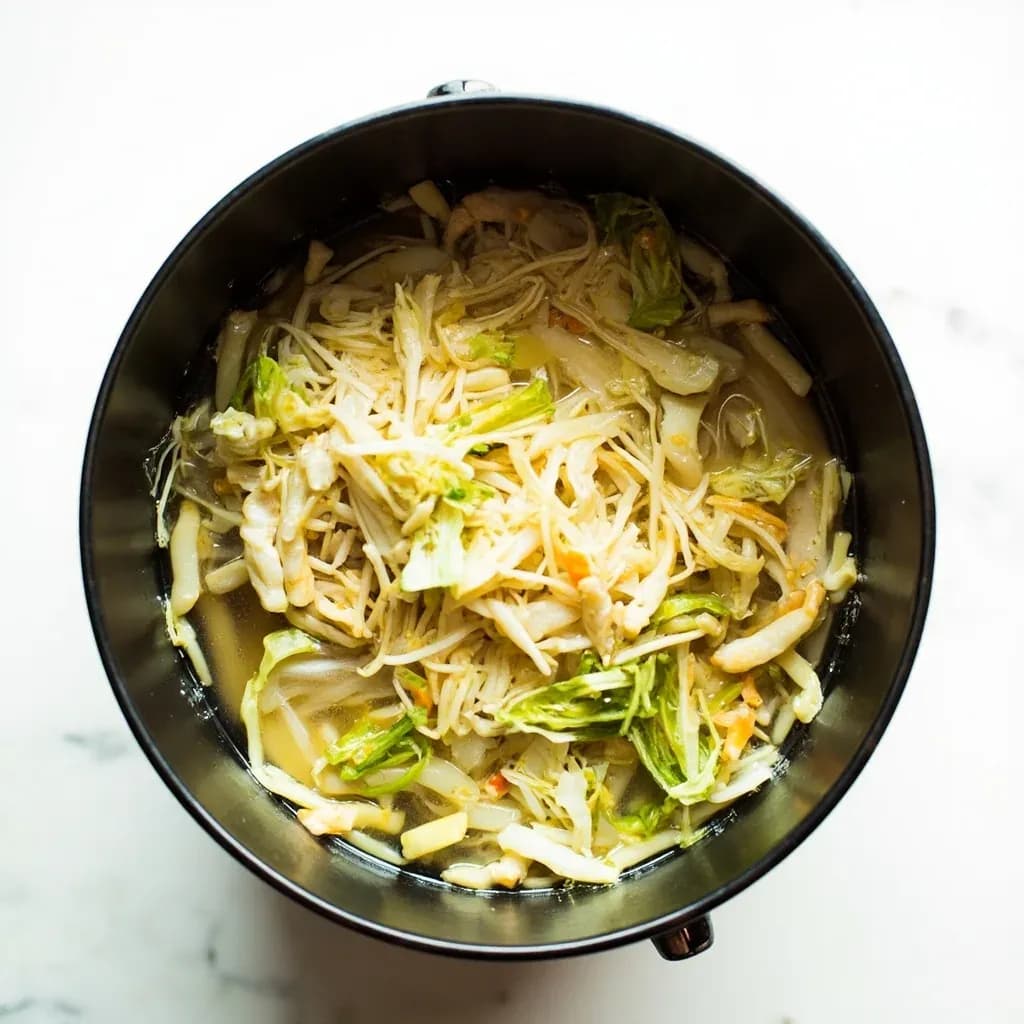
Transform & Preserve
Cabbage Fermenting / Sauerkraut
Salting and submerging shredded cabbage so lactic bacteria ferment it into sauerkraut.
Cabbage fermenting salts shredded or whole-head cabbage and packs it under its own brine, where naturally present lactic-acid bacteria convert sugars into sour, preserving acids. The result, sauerkraut and its many regional cousins, keeps for months and gains a tangy flavor and gut-friendly probiotics. Keeping the cabbage submerged and oxygen-free is key to a clean, safe ferment.
Lacto-fermentation is one of the oldest kitchen technologies in the world, and shredded cabbage salted and pressed under its own juices is its purest, most reproducible form. The cabbage carries lactic acid bacteria on its leaf surface — chiefly Leuconostoc mesenteroides early on, then Lactobacillus brevis and Lactobacillus plantarum as acidity climbs. Salt (typically 2 to 2.25 percent of the cabbage's weight) pulls water out of the shreds, suppresses spoilage organisms, and gives the desired bacteria a head start. Within days, the cabbage softens, turns translucent, and sits in a tangy, effervescent brine that is, chemically, a pickle and a preserve in one.
The technique matters because it does three things at once: it preserves cabbage for many months without heat, it transforms a bland, watery vegetable into something pungent and savory, and it produces a live-culture food that contributes beneficial bacteria to the diet. Sauerkraut is the Western European expression of a near-universal practice; the same method, with different cabbage varieties and flavorings, yields Korean kimchi, Chinese pao cai, and Salvadoran curtido. The method is forgiving enough for a first-time fermenter, but a few choices — salt type, temperature, and how firmly the cabbage is packed — have an outsized effect on the final texture and flavor.
Well-made sauerkraut is crunchy-tender, vividly sour, and aromatic with the cabbage's own esters rather than any sharp vinegar note. The brine should taste clean and bright, slightly saline, with a faint fizz when the jar is opened. Once you understand the rhythm — salt, squeeze, submerge, wait — the process is almost entirely hands-off, and a single 5-pound head of cabbage will reliably yield about 2½ quarts of finished kraut.
- Difficulty
- Medium
Types & varieties
Plain salted green cabbage, often finished with caraway; long, slow fermentation
French/German style flavored with juniper berries, caraway, white wine, or Riesling; the base for choucroute garnie
Salvadoran ferment of cabbage with carrots, onions, and oregano; traditionally served with pupusas
Napa cabbage base with gochugaru, garlic, ginger, fish sauce, and daikon; shorter, often colder fermentation
Chinese fermented mustard or napa cabbage, often aged in brine; milder, used in soups and stir-fries
Cabbage fermented with whole caraway seeds, a traditional digestive pairing
Same method with red cabbage; yields a vivid magenta kraut that bleeds color into dishes
Whole or quartered leaves fermented in brine with no shredding; used for stuffed cabbage and Reuben fillings
How to do it
- 1
Prepare the cabbage
Discard any wilted outer leaves (save a clean one for later). Quarter the head, cut out the dense white core, and shred the cabbage fine to medium — about 2 to 3 mm — on a mandoline or by knife. Thicker hand-shreds give a crunchier, more rustic kraut.
- 2
Salt and draw out the brine
Weigh the shreds. Sprinkle with non-iodized salt at 2 to 2.25 percent of the cabbage weight (about 1 tablespoon per pound of kosher salt). Toss well, then massage and squeeze the mixture for 5 to 10 minutes until a pool of liquid sits in the bottom of the bowl and the cabbage feels limp, wet, and reduced in volume by a third.
- 3
Pack the vessel
Transfer cabbage and brine to a clean ceramic crock or wide-mouth glass jar. Add it in fistfuls, tamping firmly with a wooden tamper, a potato masher, or the flat base of a glass after each addition. Press until brine rises above the cabbage. Leave 2 to 3 inches of headspace in jars, since fermenting kraut can bubble over.
- 4
Weigh down and cover
Set a glass or ceramic weight directly on the cabbage so every shred stays under the brine. Tuck the reserved clean outer leaf over the surface as an extra shield, then cover with a loosely fitted lid, a cloth secured with a rubber band, or a fermentation airlock. The cover must let CO₂ escape while keeping dust and flies out.
- 5
Ferment at room temperature
Set the vessel in a cool, dark spot at 65 to 72°F (18 to 22°C). Within 24 to 48 hours, small bubbles should rise through the brine. Skim any foam or surface film daily, press any floating cabbage back under the brine, and burp sealed jars once a day for the first week to release gas and prevent overflow.
- 6
Taste and age to preference
Begin tasting at day 5. Most kraut is ready between 2 and 4 weeks — tangy, aromatic, and still crunchy. Longer aging at cool temperatures deepens the acidity and softens the texture; pull jars into the fridge once the flavor suits you.
- 7
Store
Ladle the finished kraut and its brine into clean jars, cap, and refrigerate. Properly salted and submerged kraut keeps 6 months or more cold. For shelf-stable storage, process in a water-bath canner for 15 minutes (pints) or 20 minutes (quarts).
The microbes at work
A successful ferment is a controlled ecological succession. In the first 24 to 48 hours, heterofermentative Leuconostoc mesenteroides dominates, producing carbon dioxide (the bubbles you see), lactic acid, and the fruity, slightly yeasty top notes characteristic of young kraut. As acidity rises and oxygen is excluded, homofermentative Lactobacillus plantarum takes over, joined by the heterofermentative L. brevis, driving pH below 3.5 and producing the clean, sharp sourness of mature sauerkraut. The whole sequence happens automatically on the leaf surface; you do not need a starter. Salt simply tilts the contest in favor of the lactobacilli and against spoilage bacteria and wild yeasts.
Troubleshooting
- Mold or pink film on the surface: skim it off with a clean spoon; the submerged kraut beneath is still safe. If fuzzy growth recurs, the cabbage is surfacing and needs a heavier weight or more brine.
- Soft or slimy texture: fermentation ran too warm, or the salt ratio was too low. Next time, ferment cooler and weigh salt more carefully.
- No bubbles after 3 days: too cold, too little salt, or not packed tightly enough. Tamp again, move to a warmer spot, or top up with a 2% brine.
- Kraut too salty: rinse finished ferment briefly under cold water before serving, but drop the next batch to 1.75% salt.
- Brine level dropped below the cabbage: top up with a 2% saltwater solution so the surface stays anaerobic.
Common uses
Tips & pitfalls
- Use non-iodized salt only — iodine inhibits lactic bacteria. Pickling salt, kosher salt, and fine sea salt all work; avoid flaky or coarse salts whose volume is hard to measure.
- Keep the cabbage fully submerged at all times. Exposed surface invites yeasts and mold; skim any film that appears, since the kraut underneath is fine.
- Pack the crock firmly in layers and tamp after each addition to drive out oxygen — a loose pack ferments slowly and turns brown.
- Burp sealed jars daily in the first week to release CO₂ and prevent the lid from popping or the brine from overflowing.
- Taste at one week; kraut is usually ready between 2 and 4 weeks. Longer aging deepens flavor but softens texture.
- Use a glass or ceramic weight, not a stone. Mineral leaching and porosity in natural stone can harbor bacteria and taint the ferment.
- Do not use aluminum, copper, or other reactive metal vessels; the developing acid will pit the metal and taint the kraut.
- Reserve a few spoonfuls of active brine to inoculate the next batch — it shortens the lag time and standardizes flavor.
Good to know
- Technique
- Lacto-fermentation of cabbage in its own salted juice
- Salt ratio
- 2–2.25% of cabbage weight (about 1.5–1.8 oz / 45–55 g non-iodized salt per 5 lb / 2.25 kg cabbage)
- Active fermentation
- 3–7 days at room temperature; visible bubbling signals CO₂ release
- Total fermentation
- 2–4 weeks for balanced sourness; can age for months
- Ideal temperature
- 65–72°F (18–22°C); cooler slows fermentation, warmer risks soft kraut
- Yield
- About 1 quart (≈900 g) finished kraut per 2 lb (900 g) fresh cabbage
- Shelf life
- 6+ months refrigerated in sealed jar; indefinitely if water-bath canned
- Key microbes
- Leuconostoc mesenteroides (early), Lactobacillus brevis and L. plantarum (later)
Also called
Cabbage Fermenting (Kiseljenje Kupusa) · Fermenting Sauerkraut (Kysání Zelí) · Making Sauerkraut
Dishes that rely on it
Related

Confit
Cook slowly submerged in fat for silky tenderness and keeping

Cure
Draw out moisture with salt and time to preserve and concentrate

Pickle
Steep in acidic brine for bright, tangy, crunchy preservation

Ferment
Let friendly microbes transform food into tangy, complex flavor

Marinate
Soak in a seasoned mix to flavor and tenderize before cooking

Brine
Soak in salt water so meat stays juicy and seasoned throughout

Dehydrate
Slowly dry out moisture to concentrate flavor and extend shelf life

Cold-Smoke
Perfume cured food with smoke without cooking it through