Water & Steam
Foil-Packet Cooking
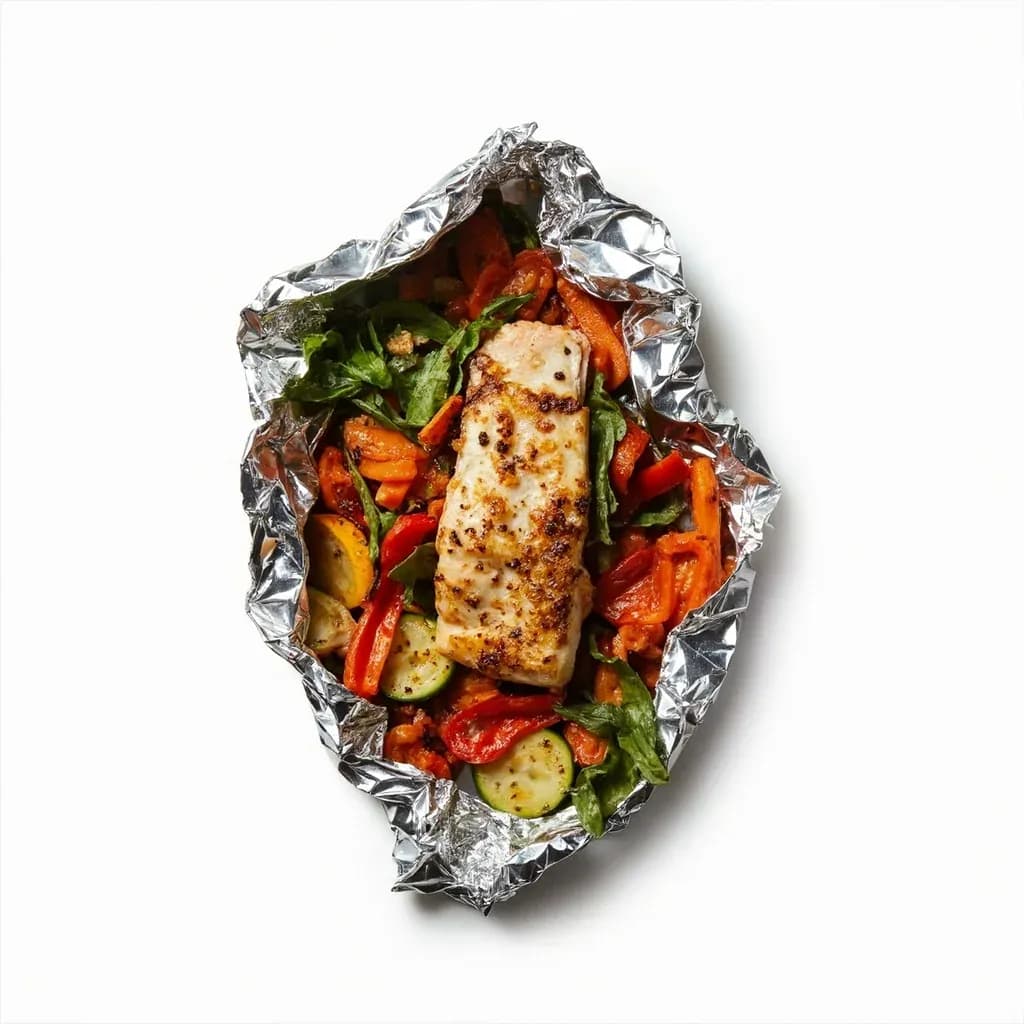
Sealing food in a foil parcel to steam and roast it over coals, grill or oven in its own juices.
Foil-packet cooking wraps food in aluminum foil to create a sealed pouch that traps steam and juices, cooking the contents over a grill, campfire coals or in the oven. It keeps food moist, simplifies cleanup, and lets vegetables and proteins cook together. A foil version of en papillote, it is a camping and barbecue staple often called a hobo packet.
Foil-packet cooking is a method in which food is sealed inside a folded envelope of heavy-duty aluminum foil and cooked by heat from an outside source — oven, grill, or campfire embers. Inside the sealed pouch, a small amount of added liquid turns to steam and the food braises gently in its own juices while the foil's high thermal conductivity delivers an even, surrounding heat. The result is a hybrid of steaming and roasting: tender interiors, lightly caramelized exteriors where the food touches the foil, and concentrated flavor from juices that would otherwise drip away.
The technique is the everyday, utilitarian cousin of the French en papillote, which uses parchment paper folded into a half-moon and is typically opened at the table for drama. Foil packets are less elegant but far more rugged — they tolerate the rough heat of a campfire, the drippings of a grill, and hours of make-ahead assembly. Their biggest practical virtue is the cleanup, or lack of one: diners can eat straight from the foil, which is why the method has been the default for campouts, scout groups, and tailgates for generations.
The main caveats are material-based. Bare aluminum reacts with strongly acidic ingredients (tomato, lemon, wine, vinegar), producing a metallic taste and pitting the foil; a parchment liner solves this. Foil also conducts heat more efficiently than parchment, so packets heat up quickly and need a careful eye to avoid overcooking delicate fish or vegetables, with a brief rest after cooking to let carryover heat finish the job evenly.
- Difficulty
- Easy
Types & varieties
Cooked on grill grates or directly on coals; benefits from grill smoke and char
Baked on a sheet pan; even, predictable heat — the most controlled method
Placed in or near embers; requires double-wrapping and longer, slower cooking
Foil shaped into a cup with no top seal; functions more like a roasting tray than a sealed packet
French technique using parchment paper folded into a half-moon pouch; gentler, non-reactive, classic for fish
Same principle using banana leaf in Caribbean, Southeast Asian, and Latin American cooking; imparts grassy aroma
How to do it
- 1
Choose and prep your foil
Tear off a sheet of heavy-duty aluminum foil roughly 12–18 inches long per serving. For campfire or rough grill grates, layer two sheets to prevent tears. If working with acidic ingredients like tomato, lemon, or wine, line the inside with a slightly smaller sheet of parchment paper to keep the food from reacting with the metal.
- 2
Build the packet base
Lay the foil on a flat surface. Lightly oil or butter the center to keep food from sticking. Center your ingredients, keeping denser items like potato or carrot on the bottom so they sit closest to the heat, and quicker-cooking items like fish or tender greens on top.
- 3
Season and add liquid
Season the contents with salt and aromatics, then add 2–4 tablespoons of liquid per packet — broth, wine, citrus juice, or water — along with any butter, oil, or fresh herbs. The liquid is what turns the packet into a steamer; without it, the food sweats and never cooks properly.
- 4
Fold and seal
Bring the two long sides up and over the food, then crimp them together with a tight series of folds. Fold the two short ends upward the same way, creating a sealed pouch with a little air space inside for steam to circulate. Press gently to check the seal — it should feel firm, with no obvious gaps where steam could escape.
- 5
Cook at the right heat
Oven: place the packet on a sheet pan at 400–450°F (200–230°C). Grill: place seam-side up over medium-high indirect heat. Campfire: nestle into hot embers, not flames, and rotate every 10 minutes for even cooking. Times vary by content — generally 20–35 minutes for fish or shrimp, 30–45 minutes for chicken and dense vegetables.
- 6
Check for doneness
Carefully open a corner away from your face to release a burst of steam. Insert an instant-read thermometer for protein (145°F / 63°C for fish, 165°F / 74°C for chicken), or pierce a vegetable to check tenderness. Reseal and rest 2–3 minutes if it needs more time.
- 7
Serve
Either plate the contents or, for a more rustic presentation, carry the packet to the table and open it in front of guests so they get the full aroma of the released steam. Provide a second sheet of foil underneath if the first has thinned — particularly after campfire cooking.
The science of the packet
A foil packet works because two opposing forces operate in tandem. Aluminum conducts heat rapidly from the outside — the air of an oven, the radiant heat of coals, the metal grates of a grill — so the food warms quickly. But once inside, the foil is also a near-perfect seal. Steam from a splash of liquid (or from the food's own moisture) cannot escape, so the interior of the packet quickly becomes a humid, high-temperature environment, similar in principle to a pressureless steamer. Protein stays moist because water cannot leave; vegetables soften in steam rather than drying out; aromatics perfume the food instead of volatilizing into the air. The exterior of each piece of food also browns lightly where it touches the foil, giving the method a built-in roasting dimension that pure steaming lacks.
Foil versus parchment
Aluminum foil and parchment paper (the material of en papillote) cook very differently and reward different dishes. Understanding the trade-offs helps a cook pick the right one for the job.
- Foil conducts heat faster and withstands rough handling, open flames, and heavy juices — best for grills, campfires, and dense foods like chicken thighs or whole potatoes.
- Parchment is non-reactive, so it tolerates tomatoes, citrus, and wine without off-flavors; it also browns the food more gently, which is why chefs use it for delicate fish.
- Parchment packets are usually opened at the table for the burst of aromatic steam; foil packets are typically torn open in the kitchen.
- For acidic dishes in foil, line the inside with parchment; you get the ruggedness of foil and the chemical neutrality of paper in one packet.
Common uses
Tips & pitfalls
- Use heavy-duty foil and double the sheet over a campfire or sharp-edged grill grates to prevent punctures and leaks.
- Cut all ingredients to similar sizes so they finish at the same time; dense items like potato and carrot should be sliced thin or par-cooked before going in.
- Always add a small splash of liquid — wine, broth, citrus juice, or even water — to create the steam that actually cooks the food.
- Season lightly inside the packet: salt and aromatics concentrate as steam condenses, and it is easy to over-season.
- Crimp the seams tightly with at least three folds to lock in steam; any gap releases the moisture you need for even cooking.
- Place packets seam-side up on the grill so juices do not leak out through the folds.
- Open packets carefully, tilting the lid away from your face — escaping steam can cause serious burns.
- For acidic dishes (tomato, lemon, vinegar), line the foil with parchment paper to prevent metallic taste and foil pitting.
Good to know
- Also called
- Hobo packs, foil-wrapped cooking, campfire foil dinners, foil-baked
- Closely related technique
- En papillote (uses parchment paper rather than foil)
- Primary materials
- Heavy-duty aluminum foil; parchment paper as a non-reactive liner
- Typical oven temperature
- 400–450°F (200–230°C)
- Typical cook time
- 20–45 minutes, depending on contents and density
- Cooking principle
- Trapped steam braises the food; foil conducts heat from the outside
- Skill level
- Beginner-friendly; forgiving and low-mess
- Best foil type
- Heavy-duty aluminum foil, double-wrapped for campfire use
Also called
hobo packet · foil pack · campfire packet
Related

Boil
Cook in vigorously bubbling liquid at full rolling heat

Simmer
Hold liquid at a gentle shimmer for tender, unhurried cooking

Poach
Cook gently in barely-trembling liquid for silky, tender results

Steam
Cook in rising vapor to keep color, nutrients, and shape intact

Blanch
Plunge briefly in boiling water, then shock cold to lock color

Braise
Sear, then cook slow in a little liquid until fall-apart tender

Stew
Simmer bite-sized pieces fully submerged into a rich, unified pot

Sous-Vide
Seal and cook in precise warm water for edge-to-edge doneness