Knife Skills
Frenching
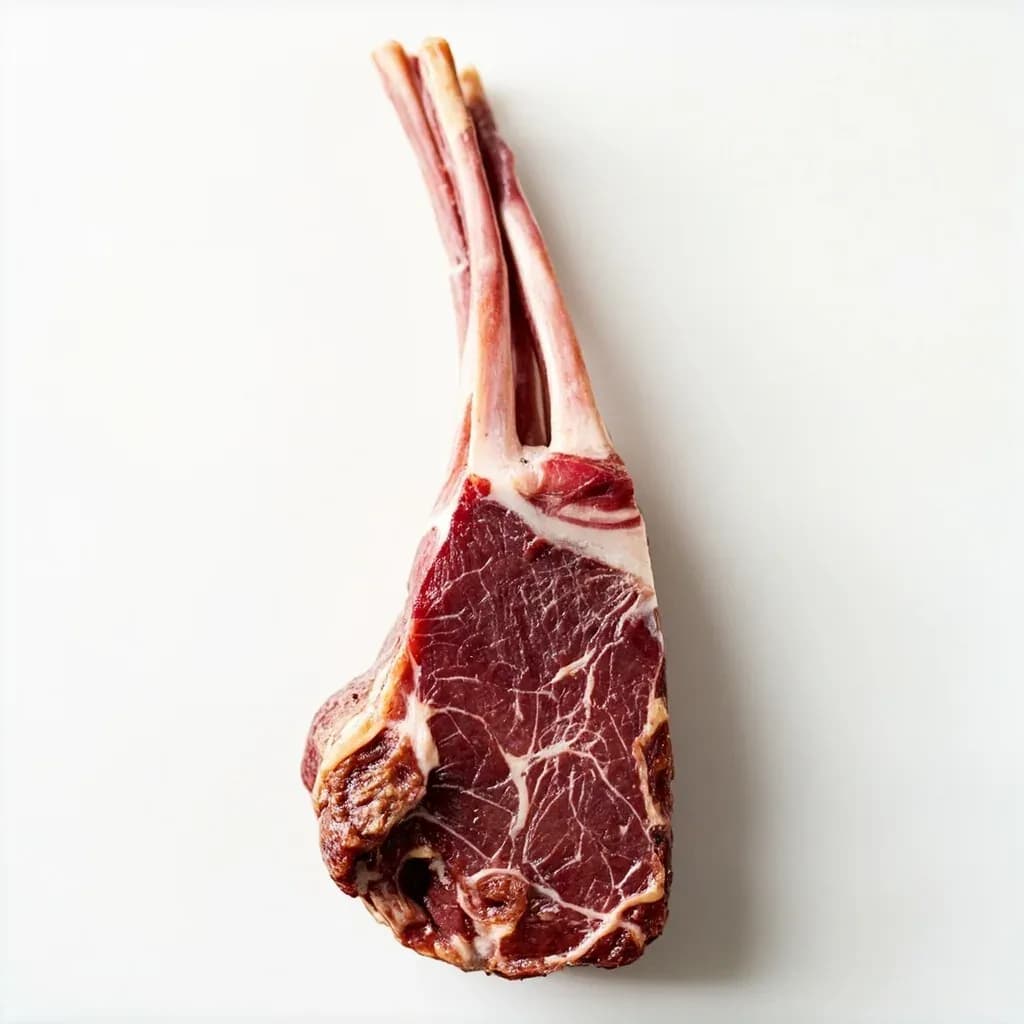
Trimming meat and fat off the ends of rib bones for a clean, elegant presentation.
Frenching cleans the fat, meat, and membrane off the exposed bone ends of a rib rack or chop so the bones stand bare and tidy. It's purely for presentation, giving rack of lamb, crown roasts, and tomahawk steaks their signature polished look. A sharp boning knife scrapes each bone clean, and the trimmings can be saved for stock.
Frenching is the butchery move that scrapes meat, fat, and membrane off the ends of rib bones to leave a clean, white 'handle' of exposed bone. It is a presentation technique at heart — the bones become a built-in grip the diner can pick up, and on a white tablecloth they read as deliberate, refined work. The trim is shallow: roughly 2–4 oz (55–115 g) comes off an 8-bone rack of lamb, so flavor loss and cooking-time shifts are minimal. What changes is the plate.
The technique travels well across species. Lamb and pork racks are the classic targets, but veal, beef standing rib roasts, and even chicken drumsticks get the same treatment. Frenched chicken drumsticks — the so-called 'lollipop' or 'popsicle' — strip the meat down to the tibia to make a two-bite appetizer. The same logic applies to quail and other small birds, where the humerus is scraped clean for fine-dining plating.
Done correctly, frenching is a quick job — about 5–10 minutes per 8-bone rack — but it punishes a dull knife and a heavy hand. The trick is a low, scraping angle, not a sawing cut, so the bone stays smooth and the loin meat remains attached. Chill the rack first, and the membrane peels away cleanly.
- Difficulty
- Medium
Types & varieties
One whole rack (usually 8 bones) with all rib ends scraped clean — the standard restaurant presentation.
Two frenched racks bent into a circle and tied, bones pointing up like a crown; the chine bone must be removed first.
Double chops cut from the middle of a frenched rack, leaving a long exposed handle bone for plated service.
Beef rib bones on a standing rib roast are trimmed clean for traditional holiday presentation.
Also called 'lollipop' or 'popsicle' chicken; the tibia is exposed by pushing meat down to create a handle for appetizers.
Humerus or drumstick bone scraped clean for fine-dining plating.
How to do it
- 1
Chill and position the rack
Place the rack of lamb (or pork, veal, or beef ribs) in the freezer for 20–30 minutes until firm but not frozen solid. Set it bone-side up on a stable cutting board, with a damp towel underneath to keep it from sliding.
- 2
Score along the rib bones
With a sharp boning knife, make a shallow lengthwise cut along the inside curve of each rib where the meat meets the bone. Cut only through the membrane and surface fat, not deep into the loin.
- 3
Scrape the meat downward
Starting at the bone tips, scrape firmly with the knife held nearly flat down the length of each rib toward the eye of the loin. The meat, fat, and membrane should peel away as a single flap. Work one bone at a time.
- 4
Clean between individual bones
Make short vertical cuts between each rib at the meaty end to release the connecting tissue, then scrape the sides of each bone until it is white and the membrane is fully removed. Wipe the blade as needed.
- 5
Trim and tidy the cap
Trim any remaining silverskin or loose fat from the loin cap. Square up the bone ends with a single clean cut so they are even, usually leaving 1.5–2.5 in. (4–6 cm) of exposed bone.
- 6
Tie and finish
Tie the rack at 1-inch intervals with butcher's twine to help it hold its shape during roasting. Cover the bone tips with small pieces of foil if you are cooking past medium-rare, to keep them from charring.
Frenching chicken drumsticks (the lollipop method)
The same logic — expose a clean bone as a handle — applies to chicken legs, but the geometry is different. The goal is to push the dark meat down to the thick end of the drumstick, leaving the tibia bone bare and ready to be picked up at a cocktail party. This is the cut sold frozen as 'chicken lollipops' or 'popsicle chicken' in many Asian markets.
- Cut through the skin and tendons in a circle at the narrow end of the drumstick, just above the tibia joint.
- Slice down along the bone to release the meat from it, keeping the blade tight against the bone.
- Push the meat firmly down toward the thick end of the leg, bunching it into a 'ball' that will crisp during cooking.
- Trim excess skin and exposed cartilage at the joint for a tidy, round shape; the exposed tibia becomes the handle.
Preparing a crown roast
A crown roast is two frenched racks seamed together into a circle, bones up. Frenching is only the first step; the crown needs additional butchery and a long, slow roast. The exposed bones stay white and dramatic on the platter, and the hollow center is traditionally filled with a stuffing or vegetable mixture.
- Remove the chine bone from both racks before frenching so the racks can bend cleanly into a circle without splintering.
- French each rack as above, leaving 1.5–2.5 in. of exposed bone.
- Stand the two racks on end, bones pointing up, and interlock them in a circle; tie securely with butcher's twine at 1-inch intervals.
- Cover the bone tips with foil during the roast and remove it for the last 10–15 minutes if you want a touch of color, or leave the foil on for stark white bones.
Common mistakes and how to avoid them
Most frenching errors come from working with a dull knife, using too steep an angle, or cutting too deeply between bones. The visual cues are obvious: ragged or pink bones mean you left membrane behind; a separated cap means you cut through the meaty eye of the loin.
- Dull blade: tears the membrane and leaves ragged bone surfaces — sharpen before starting.
- Sawing motion: scores the bone and leaves a gouge — use a single scraping pass with the blade nearly flat.
- Cutting too deep between bones: severs the loin cap from the ribs — score only the connective tissue.
- Working warm meat: the fat smears and the membrane resists — chill the rack 20–30 minutes first.
- Snapping bones to shorten them: splinters the bone — saw with a heavy knife instead.
Common uses
Tips & pitfalls
- Use a razor-sharp boning knife; a dull blade tears the membrane and leaves ragged bones.
- Chill the rack for 20–30 minutes before trimming — firm meat and fat scrape off cleanly.
- Make a shallow score along the inside curve of each rib first, then scrape the meat down in one pass toward the eye of the loin.
- Hold the knife at a low, almost flat angle when scraping so you don't cut into the bone or the loin meat.
- Wipe the blade (or use a paper towel) between bones to keep the exposed bone white.
- If you need to shorten the bone tips, saw through them with a heavy knife rather than snapping — snapping splinters the bone.
- Remove the chine bone before frenching if you plan to carve into chops later; it allows clean slicing between ribs.
- Common mistake: cutting too deeply between bones and severing the meaty cap from the ribs — only score the connective tissue.
Good to know
- Technique type
- Butchery and presentation trim
- Primary tool
- Sharp boning or chef's knife, ideally with a 3–4 in. blade
- Common applications
- Rack of lamb, pork rack, veal rack, beef rib roast, chicken drumsticks
- Difficulty
- Beginner to intermediate; the work is fast but unforgiving of a dull edge
- Typical time
- 5–10 minutes per 8-bone rack
- Yield loss
- About 2–4 oz (55–115 g) per 8-bone rack of lamb
- Bone exposure
- 1.5–2.5 in. (4–6 cm) of clean white bone revealed
- Origin
- Classical French cuisine; standardized in 19th- and 20th-century European fine-dining service
- Related term
- Sometimes called 'cleaning the bones' or 'facing the bones'
Also called
Frenching Bones · French Trimming
Related

Chop
Cut into rough, irregular pieces — the everyday workhorse cut

Dice
Cut into uniform cubes for even cooking and a tidy look

Mince
Cut as fine as possible so flavor melts evenly into the dish

Slice
Cut into even, flat pieces for consistent cooking and presentation

Julienne
Cut into thin matchsticks for fast cooking and elegant garnish

Brunoise
Cut into tiny, precise cubes — the finest dice in the kitchen

Chiffonade
Roll and slice leafy greens into delicate ribbons

Batonnet
Cut into tidy sticks, thicker than julienne — think classic fries