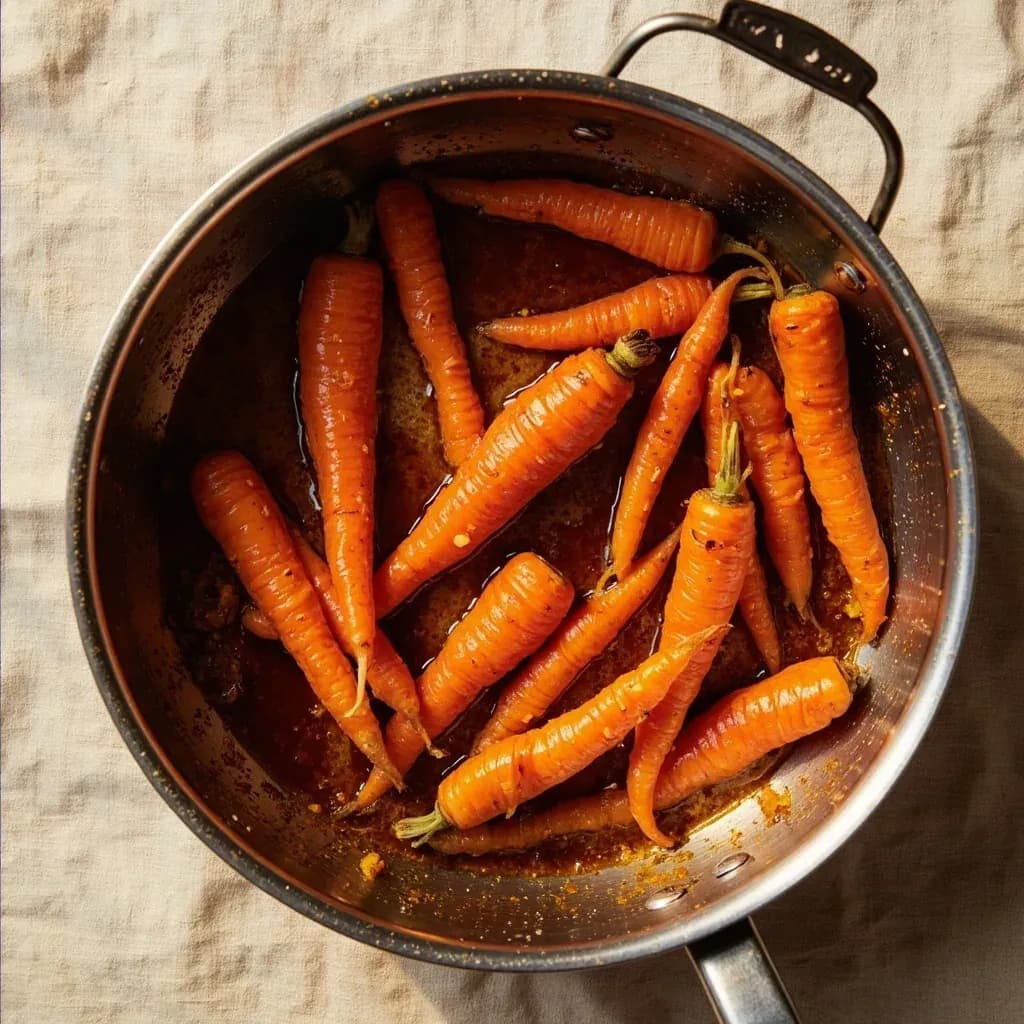
Heat & Fire
Glazing Vegetables (Glaçage)
Simmering vegetables in stock with butter and sugar until the liquid reduces to a shiny syrup that coats them in a glossy, sweet glaze.
Glaçage is a classical French finishing technique in which small, uniformly cut vegetables are simmered in just enough stock to come partway up their sides, then cooked uncovered until the liquid reduces to a butter-and-sugar syrup that clings to the vegetables in a glossy, lacquered film. Codified in the grande cuisine of Carême and Escoffier, it sits between braising and roasting: the vegetables cook through in moist heat, but the defining step is the reduction itself, which concentrates flavor and produces the shine that gives the technique its name.
The mechanics are simple but exacting. Sweetener — traditionally granulated sugar — seasons the stock, a small amount of butter enriches the liquid as it reduces, and at the end cold butter is swirled in to emulsify the syrup into a clinging sauce. Done well, the vegetables emerge tender, evenly glazed, and bright, finished in their own concentrated cooking liquid rather than dressed in a separately made sauce. Done poorly, they are either undercooked in a watery broth or scorched in a burnt syrup, which is why timing the reduction is the core skill the cook must develop.
The word glaçage is also used in pastry (apricot, fondant, royal icing) and in cold larder work (aspic glazing), but those are different media with different rules. In vegetable cookery, the technique belongs to the finishing reductions of garde-manger and entrée garnish work, where uniform, shining vegetables read clearly on a composed plate or at banquet scale.
- Difficulty
- Easy
Types & varieties
Cooked in white stock or water with sugar and butter; no caramelization; pale, shiny finish. Standard for white turnips, salsify, and pale carrots.
Cooked in brown stock; the natural color of the liquid deepens; pairs with roasted or braised meats and game.
Classic preparation using Vichy mineral water (or sparkling water) with sugar and butter; carrots cut into batons or neat coins.
Small whole onions cooked in stock, sugar, and butter until lacquered; standard garnish for platters and classical entrées.
Chestnuts simmered in stock with sugar and butter until glossy; served with game, poultry, or braised red meats.
Honey replaces or supplements sugar; more aromatic and slightly darker; common for carrots, parsnips, and baby beets.
Maple syrup used in place of sugar; popular in North American cooking for root vegetables and Brussels sprouts.
Balsamic reduction combined with butter; sweet-sour profile; used for shallots, cipollini, and beets.
Wine or cider vinegar added with the sugar for a sharp, balanced glaze; traditional with turnips, onions, and swede.
How to do it
- 1
Prepare the vegetables
Peel and trim the vegetables into uniform shapes — turned olives, ovals, batons, or neat coins for carrots, turnips, and parsnips; leave pearl onions whole after peeling and a quick blanch. Wash, drain, and pat dry so the cooking liquid is not diluted.
- 2
Build the cooking liquid
In a wide, heavy-bottomed pan combine stock (white stock for a pale glaçage blanc, brown stock for color and depth), a pinch of salt, and the sugar. The liquid should come about two-thirds of the way up the vegetables; do not fully submerge them. Add a small knob of butter.
- 3
Bring to a simmer and cook covered
Bring to a gentle simmer over medium heat. Lay a cartouche (a parchment round with a small steam hole) directly on the surface, or partially cover with a tilted lid. Simmer gently until the vegetables are just tender when pierced — usually 15 to 30 minutes depending on size and density.
- 4
Uncover and reduce the liquid
Remove the cartouche. Raise the heat slightly and let the liquid reduce steadily, swirling the pan occasionally. Do not stir aggressively or the vegetables will break up. The aim is a syrup that clings to the back of a spoon.
- 5
Mount with cold butter
Take the pan off the heat. Add cold butter in small pieces, swirling continuously so it emulsifies into the reduced liquid into a glossy sauce that coats the vegetables. Do not return the pan to high heat or the emulsion will break.
- 6
Adjust seasoning and serve
Taste and adjust with a final pinch of salt, a grind of pepper, or a few drops of vinegar or lemon to sharpen the glaze. The vegetables should be tender, evenly coated, and shining. Serve immediately; the glaze does not hold well once cooled.
Reading the glaze: doneness, nappe, and the final minutes
The single most important moment in glaçage is the last three to five minutes, when the stock and sugar are collapsing into syrup and the butter is going in. The two cues a cook must learn to read are vegetable doneness and the consistency of the liquid, and they must arrive together.
Vegetable doneness is judged by piercing with the tip of a paring knife or a small skewer: there should be almost no resistance, but the vegetable should still hold its shape. Nappe — the French term for the way a liquid coats the back of a spoon — is the cue for the syrup. Lift the spoon and turn it: a properly reduced glaze leaves a thin, even film that clings rather than running off in a sheet. At this point the vegetables should already be tender; if they are not, the cook has reduced too far and needs to add a splash of hot stock to continue cooking.
- Vegetables tender before the syrup is fully reduced: add a splash of hot stock, continue cooking briefly, then reduce again at the end.
- Vegetables still firm when the syrup is at nappe: pull the pan off the heat, add hot stock, and finish cooking over low heat rather than pushing the reduction further.
- Syrup at nappe and vegetables just tender: swirl in the cold butter, off the heat, in three or four additions.
- Syrup darkens or smells of caramel-burnt in the last minute: add a small splash of stock and a fresh knob of butter to rescue the gloss.
Common uses
Tips & pitfalls
- Cut vegetables to a uniform size and shape (turned, oval, baton, or coin) so they finish at the same moment — uneven sizes are the most common cause of glaçage failure.
- Use a wide, shallow pan: the more surface area, the more reliable and controllable the reduction; a deep pot will steam the vegetables long before the liquid reduces.
- Cover with a cartouche rather than a tight lid so the liquid reduces gently and evenly; a closed lid traps too much steam and prevents the syrup from forming.
- Salt the cooking liquid lightly — sugar needs a pinch of salt to taste balanced, not sweet, and the final seasoning can always be corrected at the end.
- Add the butter in stages at the end, off the heat; butter added at the start or under high heat can break, scorch, or cloud the glaze rather than shine it.
- Test vegetable doneness before the final reduction; if you reduce the syrup before the vegetables are tender, they will never cook through in the finished glaze.
- Watch the final reduction closely — in the last two to three minutes the syrup can move from glossy to burnt very quickly, and there is little time to recover.
- Avoid overcrowding the pan: too many vegetables will steam in their own moisture rather than reduce in the stock, and the glaze will be thin and watery.
Good to know
- Origin
- Classical French technique, codified in 19th- and early 20th-century grande cuisine (Carême, Escoffier).
- French name
- Glaçage; verb form glacer (to glaze).
- Ideal pan
- Wide, shallow, heavy-bottomed pan (sautéuse, sautoir, or copper rondeau) so the liquid reduces evenly.
- Cooking liquid
- White or brown stock (or a light court-bouillon), just enough to come two-thirds to three-quarters of the way up the vegetables.
- Sweetener
- Granulated sugar at roughly 5–10 g per 100 g of vegetables; honey, maple, or balsamic appear in modern variants.
- Finishing fat
- Whole butter, added in pieces at the end and emulsified into the reduced syrup for shine and roundness.
- Doneness test
- Vegetables tender when pierced; the glaze coats the back of a spoon (nappe) and clings to the vegetables in a thin, glossy film.
- Difficulty
- Intermediate — judging the moment when the vegetables are tender and the syrup is reduced is the main skill.
Also called
glacage · glazed vegetables · buttered glaze
