Knife Skills
Grating Onion
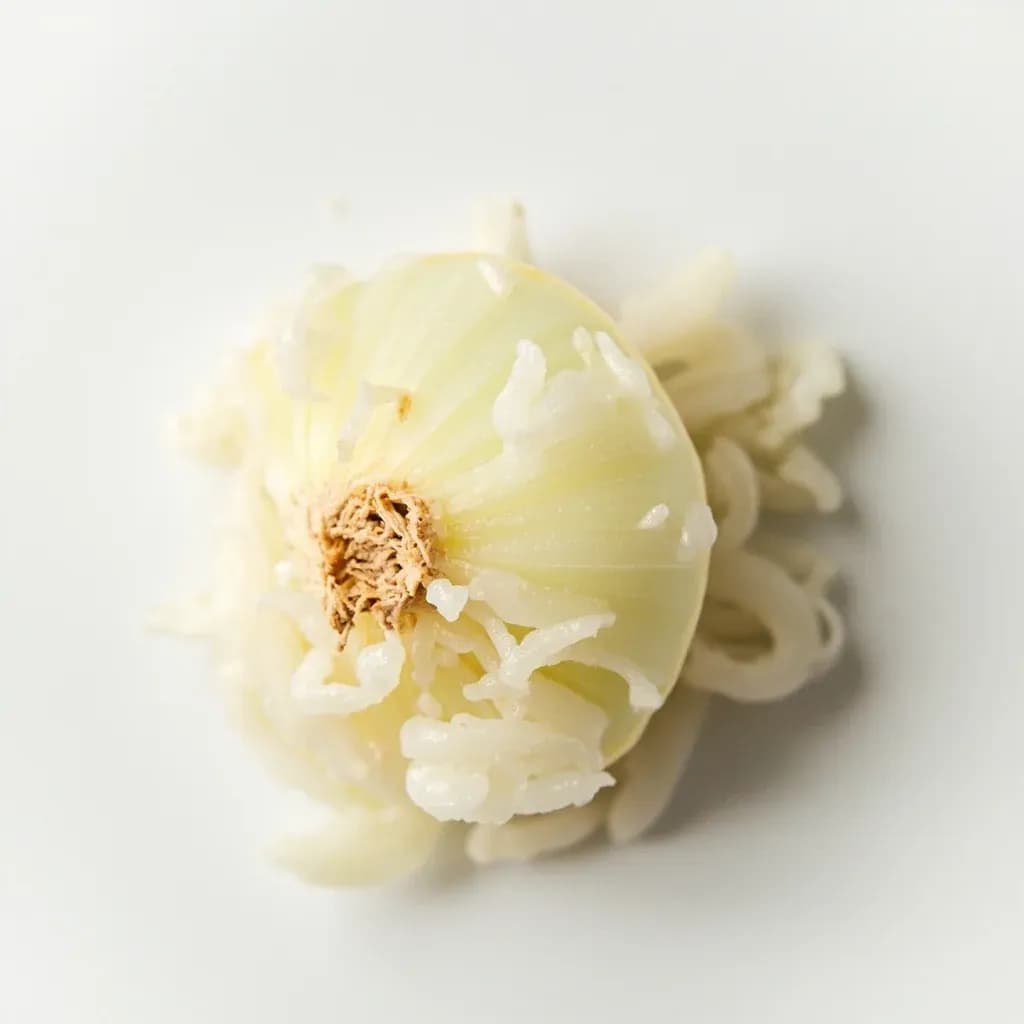
Grating onion to a pulp to release juice for marinades and patties.
Grating onion on a box grater or microplane reduces it to a fine pulp and juice rather than discrete pieces. The released liquid disperses evenly through marinades, kebab mixes, and burger or kebbeh patties, seasoning and tenderizing without leaving chunks. It is the go-to method when you want onion flavor and moisture but not visible texture.
Grating an onion against the large holes of a box grater — or the fine blade of a microplane or a food-processor grating disc — is a knife-free prep shortcut that produces a wet, juicy pulp rather than a clean dice. Where a chopped onion keeps its cell walls largely intact and delivers discrete pieces of texture, grating tears those walls open, freeing the onion's internal moisture along with its full load of water-soluble flavor: sulfur compounds, sugars, and natural glutamates. The result behaves almost like a liquid seasoning, binding seamlessly into ground meat, deglazing a pan, or disappearing into a sauce without leaving harsh, raw chunks behind.
The technique is most valuable in preparations where onion is meant to flavor the dish as a whole rather than appear in it. In a meatball or burger patty, grated onion releases juice directly into the protein, keeping the interior moist during cooking and eliminating the raw-onion pockets that can make a finished patty taste sharp or uneven. In a pan sauce, the pulp melts into the fat within seconds and forms the aromatic base for a gravy or quick braising liquid. The trade-off is a high tear factor: grating ruptures just as many cells as chopping, often more, so expect the full lachrymatory effect.
The method has long roots in Middle Eastern kibbeh and kofta, in Persian kuku and South Asian bharta, and in the meatloaf-and-meatball canon of American home cooking. Modern cooks reach for it whenever the recipe calls for onion to integrate rather than be seen.
- Difficulty
- Easy
Types & varieties
The standard method; produces a coarse shred plus plenty of juice. Safest when the onion is held by the root.
Produces an almost paste-like texture with maximum juice release; ideal for pan sauces and vinaigrettes where no visible shred is wanted.
Fastest method for large quantities; texture is slightly more uniform than a box grater.
Chilling the onion 15–20 minutes in the freezer (or longer in the refrigerator) firms the flesh and reduces tearing.
How to do it
- 1
Peel and halve the onion
Cut off the stem (top) end, leaving the root end intact. Halve the onion root-to-stem, then peel away the papery skin and the first fibrous layer.
- 2
Set up the grater
Place a box grater on a cutting board or in a wide bowl at a slight angle so it is stable and the pulp collects below. Have a flexible spatula ready to scrape the underside.
- 3
Grate cut-side down
Holding each half by the root, press the flat cut face against the large holes of the grater. Use short, firm strokes; rotate as needed to keep an even surface.
- 4
Stop at the root nub
When only the root end remains, discard it (or save it for stock). Do not grate the root itself — it is tough and fibrous.
- 5
Scrape and drain if needed
Use a spatula to gather the pulp from the grater and bowl. If the recipe requires drier pulp, transfer to a fine-mesh sieve and press gently for a few minutes to release excess juice.
- 6
Use or store
Use immediately for best flavor, or cover and refrigerate up to 2 days. The pulp darkens and loses pungency quickly once exposed to air.
Why grating changes the onion
Grating does something that a chef's knife cut cannot: it ruptures a high proportion of the cells in the flesh in a single pass. The large holes of a box grater tear through tissue a knife would simply slice between, and the free liquid that wells up is the onion's own — water carrying dissolved sugars, amino acids (including natural glutamates), and the sulfur precursors that become the vegetable's signature pungency on contact with air.
That released liquid is the reason the technique excels in ground-meat cookery. As a patty cooks, the onion juice migrates into the protein network and stays there as moisture, which is why a meatball made with grated onion tastes juicier than one made with finely diced onion of equal weight. In a hot pan, the same juice deglazes fond on contact, so grated onion can stand in for chopped onion as the start of a pan sauce in a single step.
The trade-off is volatility. Sulfur compounds escape faster from a wet pulp than from intact cells, so grated onion is best used within minutes of being made, or covered and refrigerated for no more than two days. Note: older British recipes that call for 'grated onion' sometimes mean 'finely chopped.' In modern American usage the term reliably means the box-grater method described in the steps below.
Common uses
Tips & pitfalls
- Keep the root end intact when halving — it acts as a safe handle and keeps the layers from shredding loose as you work.
- Always grate cut-side down on the box grater; the flat face gives stability and the root nub stays whole at the end.
- Use the large holes, not the small ones. Small holes turn the onion to watery mush with no body and leave little to grip.
- The last quarter of the onion is where most cuts happen. Wear food-safe gloves or keep fingertips well clear of the grating surface.
- If the pulp is too wet for your recipe (as it often is for burger patties), let it sit in a fine sieve for 5 minutes and press gently. Reserve the drained juice for pan sauces.
- Reduce tearing by chilling the onion for 20–30 minutes before grating, grating under a slow stream of cold water, or working next to a vent or open window.
- Save the root nub and any remaining skin for stock — the usable flesh is fully extracted by this method.
- Don't salt grated onion early if you are using it in a pan sauce; the salt draws out more liquid and can cause the pan to weep.
Good to know
- Category
- Knife Skills / Vegetable Preparation
- Primary tool
- Box grater, large holes
- Alternative tools
- Microplane or fine zester; food processor with grating disc
- Best onion
- Yellow onion (balanced flavor); sweet, red, or shallot also work well
- Typical yield
- ≈100 g pulp plus 30–40 ml juice from one medium onion (≈150 g)
- Time
- About 1–2 minutes per half onion
- Tear factor
- High — comparable to or greater than chopping
- Common dishes
- Meatloaf, meatballs, burger patties, kibbeh, marinades, pan sauces
Also called
Grating Onion for Patties
Dishes that rely on it

Related

Chop
Cut into rough, irregular pieces — the everyday workhorse cut

Dice
Cut into uniform cubes for even cooking and a tidy look

Mince
Cut as fine as possible so flavor melts evenly into the dish

Slice
Cut into even, flat pieces for consistent cooking and presentation

Julienne
Cut into thin matchsticks for fast cooking and elegant garnish

Brunoise
Cut into tiny, precise cubes — the finest dice in the kitchen

Chiffonade
Roll and slice leafy greens into delicate ribbons

Batonnet
Cut into tidy sticks, thicker than julienne — think classic fries