Prep & Assembly
Groundnut / Peanut Thickening
Using ground peanuts or peanut butter to thicken and enrich stews and sauces with body and nutty depth.
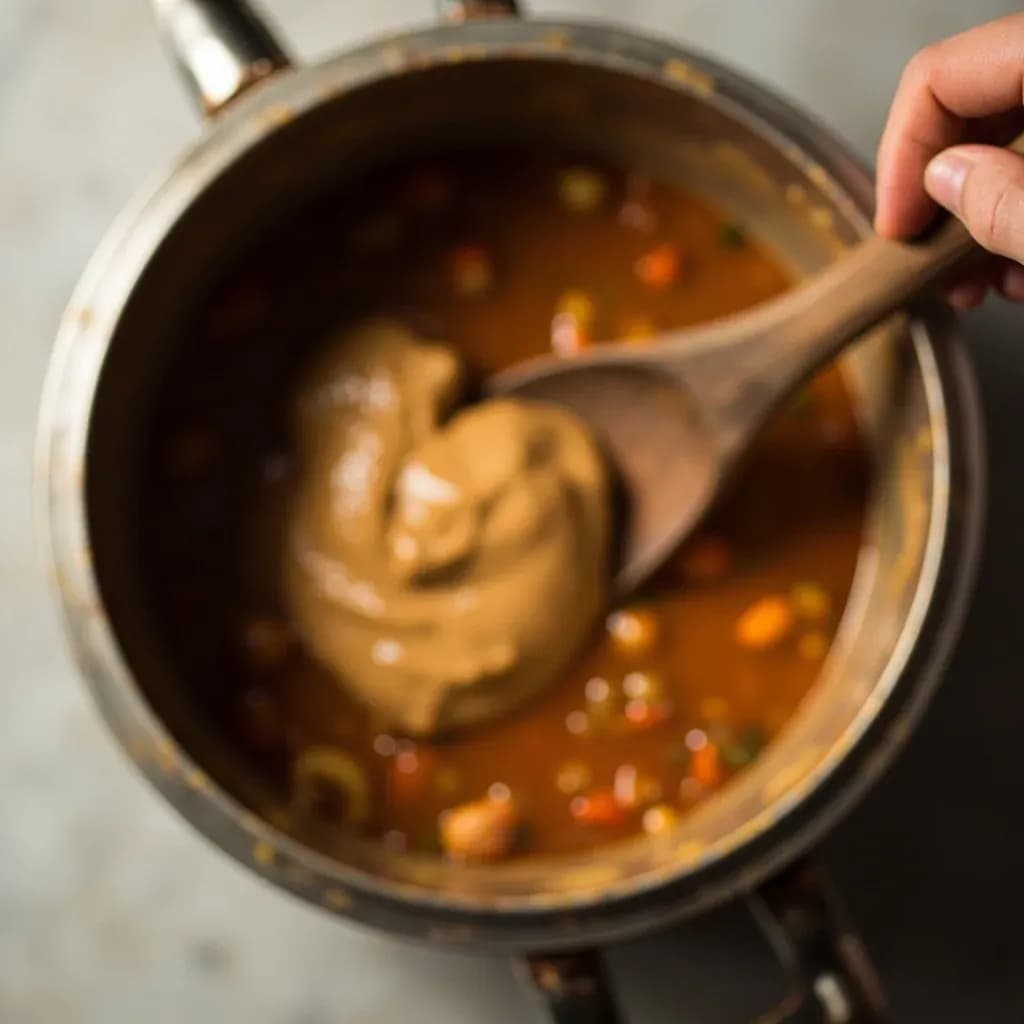
Groundnut thickening stirs ground peanuts or peanut butter into a simmering stew or sauce to lend creamy body and a rich, nutty flavor. It is a defining technique in West African dishes like groundnut soup and maafe, where the peanuts also add fat and protein. The paste is usually loosened with stock before being added so it incorporates smoothly without clumping.
Groundnut thickening is the practice of binding a stew or sauce with ground roasted peanuts, peanut butter, or defatted peanut flour, simultaneously thickening the liquid and pushing it toward a richer, more savory register. Unlike a flour-and-butter roux, which is essentially flavorless ballast, the peanut solids carry their own toasted, faintly sweet, deeply nutty character, so the thickener is doing two jobs at once: suspending fat and water into a stable emulsion, and seasoning the dish from the inside out. This is why the technique sits at the heart of Senegalese Mafé, the groundnut soups of Nigeria and Ghana, Indonesian satay sauce, and Maharashtrian peanut-coconut curries — cuisines that discovered, often independently, that groundnuts do what butter-and-flour does, only with more flavor.
In practice, groundnut thickening behaves as a fragile emulsion. The peanut solids coat fat droplets and hold them in suspension, but the mixture breaks easily: hard boiling, sudden temperature changes, or a cold dollop of paste dropped into a hot pot will all cause the oil to weep out and the sauce to look greasy. The cook's job is to manage that emulsion — toasting the nuts first, tempering the paste with hot liquid, simmering gently, and balancing the richness with acid and chili. Done right, the result is a glossy, full-bodied sauce that clings to meat and rice without feeling heavy.
- Difficulty
- Easy
Types & varieties
Whole peanuts dry-toasted then ground to a paste in a food processor or mortar; deepest, most aromatic result and the traditional choice for West African groundnut soup
Convenient and consistent; choose unsweetened, fully natural brands (peanuts and salt only) for savory dishes
Adds body and bites of nut; common in West African home cooking and casual groundnut stews
Professional pantry staple; high in protein, low in fat; thickens without adding oil, ideal for lighter sauces and gluten-free applications
Coarsely ground, sometimes lightly fermented; used in some Nigerian and Ghanaian groundnut soups for pronounced texture and a faint tang
How to do it
- 1
Choose your form
Decide between freshly ground roasted peanuts (best flavor), natural smooth peanut butter (most convenient), or defatted peanut flour (lightest result). Avoid any peanut butter with added sugar, honey, or partially hydrogenated oils when thickening savory dishes.
- 2
Toast the peanuts (if starting from raw)
Spread raw, skinless peanuts on a sheet pan and toast at 350°F / 175°C for 8–12 minutes, stirring once, until fragrant and a shade darker. Cool slightly before grinding. Skip this step if using pre-roasted peanuts or commercial peanut butter.
- 3
Grind to a paste
Pulse cooled toasted peanuts in a food processor with a pinch of salt, scraping down the sides, until a smooth, fluid paste forms — about 3–6 minutes depending on the machine. Add 1–2 teaspoons of neutral oil only if needed to loosen.
- 4
Build the base and prepare to thicken
Sauté aromatics, build the stew or sauce base with tomatoes, stock, and any meat or vegetables, and bring to a gentle simmer. Season lightly — the peanut will concentrate salt as it reduces.
- 5
Temper the paste
Scoop the peanut paste into a small bowl and whisk in 2–3 ladles of the hot simmering liquid until completely smooth. This step prevents lumps and keeps the paste from seizing on contact with the hot pot.
- 6
Incorporate and simmer gently
Pour the tempered peanut mixture back into the pot while whisking continuously. Reduce heat to low and simmer gently — never boil hard — for 10–20 minutes, stirring occasionally, until the sauce coats the back of a spoon.
- 7
Adjust body, seasoning, and finish
Thin with stock or water if too thick; simmer uncovered to reduce if too thin. Balance with acid (lemon, tamarind, or vinegar) and chili. Taste and adjust salt. Optionally finish with crushed toasted peanuts, fresh herbs, or a small swirl of raw peanut oil for aroma.
Why groundnuts thicken at all
Ground peanut solids are roughly 25–30% protein and 45–50% fat, with a small amount of starch and fiber. When the paste is whisked into a warm liquid, the proteins unfold and surround the fat droplets, while the solid particles swell and trap water between them. The result is a stable suspension that thickens as it simmers and reduces — the same physical process that lets a nut-based sauce hold together without any flour at all. The catch is that peanut proteins, like all nut proteins, denature and clump when shocked by sudden heat or cold, which is why tempering and gentle simmering matter so much.
Regional traditions
The technique is most iconic in West Africa, where groundnuts have been cultivated since Portuguese traders introduced them in the 16th century. Senegalese Mafé, the Nigerian ofe akwu, and Ghanaian groundnut soup all use the same logic — toasting, grinding, simmering into a stew of meat, tomato, and chili — but each tradition tunes the balance differently. The same idea appears independently in Indonesian satay sauce, Maharashtrian shengdana curry, and parts of southern Chinese cookery. In every case the cook has arrived at the same conclusion: groundnuts thicken, enrich, and flavor in a single step.
- West African groundnut soups and Mafé — the canonical example, with meat or fish, tomato, and chili
- Indonesian and Malaysian satay sauce — thinner, sweeter, spicier, often finished with kecap manis and lime
- Maharashtrian shengdana curry — peanut paired with coconut, mustard seed, and tamarind
- Sichuan cold noodle sauces — peanuts as a minor thickener binding chili oil and vinegar
Common uses
Tips & pitfalls
- Always use unsweetened, salt-only peanut butter for savory dishes — added sugar or hydrogenated oils will dull the sauce and may cause it to split
- Dry-toast raw peanuts in a 350°F / 175°C oven for 8–12 minutes before grinding; this drives off moisture and unlocks deeper flavor
- Temper the paste with a ladle of hot cooking liquid in a separate bowl before whisking into the pot — prevents lumps and seizing
- Add the paste near the end of cooking and keep the heat at a bare simmer; prolonged boiling turns the sauce grainy and oily
- If the sauce breaks and looks greasy, blend it with an immersion blender or whisk in a tablespoon of hot broth until it re-emulsifies
- Balance richness with acid (lemon juice, tamarind, vinegar, or tomato) and heat (chili, ginger) — peanut alone can read heavy and flat
- For a lighter, less greasy result, use defatted peanut flour and finish with a small amount of peanut oil for aroma
- Never add cold peanut butter straight from the fridge into boiling liquid; it will clump and may scorch on contact
Good to know
- Also known as
- Peanut thickening, groundnut enrichment, peanut-butter liaison
- Primary cuisines
- West African (Senegalese, Ghanaian, Nigerian, Gambian), Central African, Indonesian, Maharashtrian Indian, Southern Chinese
- Forms used
- Freshly ground roasted peanuts; natural smooth or crunchy peanut butter; defatted peanut flour; stone-ground peanut paste
- Typical ratio
- Light body: 1–2 tbsp peanut butter per cup liquid; medium: 2–3 tbsp; thick stew: 3–4+ tbsp
- Heat tolerance
- Medium-low; scorches over high heat or when added dry to a hot pan
- Behavior in pot
- Acts as both thickener and emulsifier, suspending fats and binding water — essentially a nut-based roux
- Allergen note
- Peanut is a major allergen and cannot be substituted one-to-one with tree nuts
- Skill level
- Beginner to intermediate; the main pitfalls are breaking, scorching, and lumpy incorporation
Also called
groundnut-thickening · thickening-with-peanut-butter · Peanut Thickening
Related

Whisk
Beat ingredients smooth and aerated with a looping wire motion

Sift
Pass dry ingredients through mesh to aerate and remove lumps

Strain
Pour through mesh to separate solids from liquid for a smooth result

Filter
Pass liquid through fine material to clarify out the smallest particles

Rice
Press cooked potatoes through small holes for fluffy, lump-free texture

Mash
Crush soft cooked food into a rustic, creamy purée

Grind
Crush food into a coarse to fine texture, from spices to meat

Grate
Shred food into fine bits against a sharp-toothed surface