Prep & Assembly
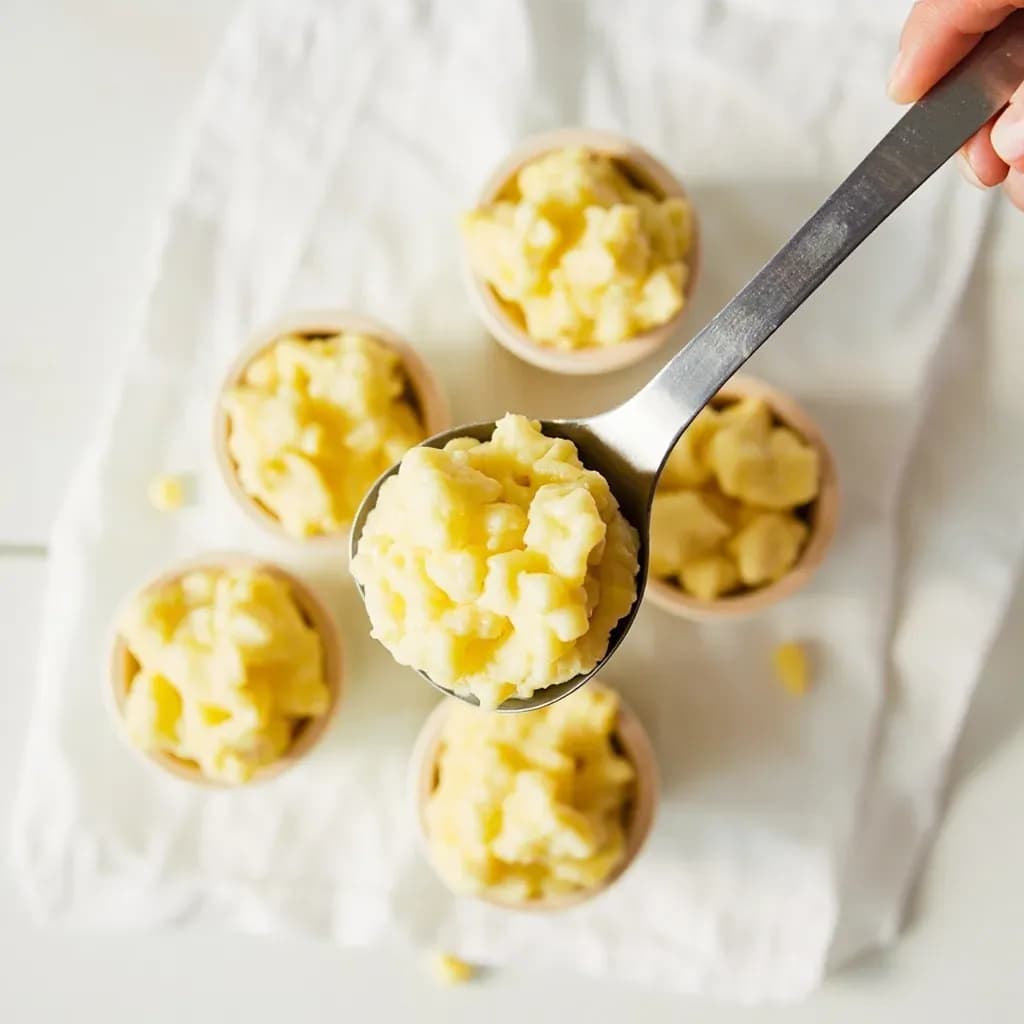
Ladling Curds into Molds
Gently scooping cut cheese curds into molds to drain and shape them.
Ladling curds into molds is the cheesemaking step of carefully transferring delicate curds with a ladle rather than pouring, which preserves their structure for soft and bloomy-rind cheeses. The molds let whey drain off while the curds knit and take their shape. Gentle handling keeps fat and moisture in for a creamy texture.
Ladling is the traditional way cheesemakers move cut, still-warm curds from the vat into their molds without any mechanical pressing. Rather than draining off the whey and packing dry curds into a form — the method used for Cheddar, Gouda, and other hard cheeses — the maker scoops the curd mass while it still floats under whey, lets it settle in a perforated mold, and relies on gravity alone to expel moisture over hours or days. The trade-off is real: more fine curd particles slip away with the whey, costing yield, but the texture that remains is open, irregular, and high in moisture. That texture is exactly what bloomy-rind and lactic cheeses need to ripen into the soft, almost flowing paste under their rinds.
The physical act is gentle and deliberate. A long-handled perforated skimmer — in French, a louche à caillé — slides under the curd raft so the curds float onto the ladle cushioned by whey, then deposits them into the mold in two or three additions. Between additions, the maker pauses so whey can drain and the layer can compact; nothing presses the curds flat, no screw or lever is engaged. The result is a cheese shaped by drainage and time, typically with a slightly mounded top, an open internal structure, and a moisture level that no pressed curd could match.
This single decision — to ladle rather than to press — defines an entire family of cheeses. Camembert, Brie, Chaource, Valençay, Sainte-Maure, faisselle, and most traditional chèvres all begin their lives in this way. Anywhere you cut into a soft, high-moisture cheese and see an irregular, custard-like interior, you are looking at the work of the ladle.
- Difficulty
- Medium
Types & varieties
Camembert, Brie, Chaource — curds ladled very wet to preserve a moist, open paste that will ripen under Penicillium candidum.
Crottin, Valençay, Pouligny-Saint-Pierre, Sainte-Maure de Touraine, Banon — small molds filled with delicate, acid-set curds, often in cone or log shapes.
Fromage frais, faisselle, Petit Suisse — drained in perforated pots with no salting or pressing at this stage.
Maroilles, Munster, Livarot, Langres, Époisses — curds ladled slightly drier than bloomy-rind styles, often into square or cylindrical molds.
Some traditional Bleu des Causses or Fourme d'Ambert styles use a hybrid: ladled for initial shaping, then pierced later for veining.
Greek mizithra, Italian fresh ricotta-style draining, and some French chèvres use perforated baskets (fiscelle) instead of rigid molds — the same ladling action, different container.
How to do it
- 1
Prepare the molds and draining area
Set the perforated molds on a draining rack lined with cheesecloth or a cheese mat, over a catch tray that will receive the whey. Pre-warm the molds with warm water or a ladleful of warm whey so the curds do not chill on contact — a cold mold firms the curds and slows drainage. Have the long-handled perforated skimmer and a second empty pot ready.
- 2
Confirm the curds are ready to ladle
Cut curds should have rested (and, for some styles, been scalded and stirred) until they reach the target firmness. The whey should be at the correct acidity for the cheese (typically pH 4.6–6.2 depending on style), and the curds should feel like soft jelly when pressed, breaking cleanly when broken in two. Keep them submerged under whey in the vat — exposed curds cool, mat together, and shed fines.
- 3
Ladle the first layer of curds
Slide the skimmer flat under the curd raft from below, scooping curds with their surrounding whey so they float up onto the ladle cushioned by liquid — never stab from above or stir aggressively. Gently deposit them into the mold and let whey drain through the perforations as you fill. Aim for roughly one-third to one-half full: a low first layer drains cleanly without sealing over.
- 4
Pause and let the first layer set
Allow 3–5 minutes of drainage. The curds will compact visibly and whey will drip steadily from the bottom of the mold. This pause is what prevents the next layer from sealing the surface and trapping moisture inside the cheese.
- 5
Ladle the second and third layers
Repeat the scoop-and-deposit motion, building the curds in stages until the mold is slightly overfilled — a soft mound above the rim. Do not press the curds down; gravity and whey pressure do the work. A second brief pause between the second and third layers is even better for very wet, soft curds.
- 6
Even the top surface
If needed, lightly smooth the top with the back of the ladle or a clean hand so the surface is roughly level but not compacted. Some makers leave a soft dome intentionally to encourage natural rind formation as the cheese drains.
- 7
Drain, flip, and finish
Let the cheeses drain in their molds at the proper room or cellar temperature for the style. Flip them in their molds (démoulage then remoulage) after a few hours, and again if needed, to even the shape, close the top surface, and release any trapped whey. Salt at the appropriate stage — by dry salting the surface, working salt into the drained paste, or brining the formed cheese — and continue draining until the cheese reaches the target moisture for its style.
Ladling vs. Hooping and Pressing
A hard cheese like Cheddar or Comté is never ladled. After cutting, its curds are stirred, scalded hard to drive out moisture, drained of whey, then either cheddared (matted, sliced, and stacked) or milled before being packed tightly into a mold under a mechanical press that can apply hundreds of pounds of force. The result is a dense, low-moisture cheese with tightly fused curds and very little free whey.
Ladling skips all of that. The curds are barely stirred, never scalded hard, never drained before molding, and never pressed. They coalesce gently under their own weight as whey seeps through the mold's perforations. The trade is straightforward: ladling sacrifices yield (more fines lost to whey) for the open texture and high moisture that soft, bloomy-rind, and lactic cheeses require to ripen properly. A pressed Camembert would never develop the flowing paste that defines it.
Equipment and Regional Terminology
The tools are simple and have changed little in centuries. The perforated skimmer is the maker's primary ladle; the molds are typically round hoops of stainless steel or food-grade plastic, sometimes wicker, with perforations sized to the cheese — wide enough to let whey drain freely, narrow enough to hold small curds.
- Louche à caillé (France): long-handled, perforated stainless skimmer used to lift curds.
- Faisselle (France): small perforated pot for fresh lactic cheeses.
- Hoop (English-speaking tradition): larger cylindrical form, often without a bottom, set on a draining mat.
- Käseform (German tradition): rigid perforated mold for soft cheeses.
- Fiscelle (Italy, Greece): perforated basket, sometimes cloth-lined, for fresh basket-shaped cheeses.
Common uses
Tips & pitfalls
- Slide the skimmer under the curd mass from below, lifting with whey supporting the curds — never scoop from the top down or stir aggressively, which shears the curds and clouds the whey.
- Pre-warm the molds with warm whey or water to prevent thermal shock; a cold mold firms the curds on contact and slows drainage.
- Fill molds in 2–3 stages, pausing 2–5 minutes between each so whey can escape and the mass compacts evenly.
- Mound curds slightly above the rim; they will settle as whey drains, and overfilling slightly guarantees a full final shape.
- Keep the curds submerged under whey in the vat until the very moment of ladling — exposed curds cool, mat together, and lose fines to surface drying.
- For very soft lactic curds, choose a skimmer with wide perforations so the fragile pieces don't shear apart on the way up.
- Discard the first whey that runs off the molds; it is often cloudy with fines. A clear, steady drip is the signal that coalescence is going well.
- Flip the cheeses in their molds (démoulage then remoulage) once or twice during drainage to even the shape and close the top surface.
- Do not press soft cheeses at this stage — pressure expels butterfat and produces a closed, dry texture unsuitable for bloomy-rind or lactic ripening.
- Common mistake: ladling too quickly in one go, which causes curds to bridge and trap pockets of whey that weep out later as slits or holes in the finished cheese.
- Common mistake: pressing or smoothing the top too firmly, which seals the surface and stops drainage from the upper layers.
Good to know
- French term
- Moulage à la louche; décaillage for soft, lactic-set styles
- Stage in cheesemaking
- After cutting and optional scalding, before pressing (or with no pressing at all)
- Primary application
- Soft, high-moisture, bloomy-rind, and lactic-set cheeses
- Curd state at ladling
- Warm (typically 30–40°C / 86–104°F) and floating submerged under whey
- Mold type
- Perforated stainless steel, food-grade plastic, or wicker forms — hoops, faisselles, molds
- Ladle type
- Long-handled, perforated stainless steel skimmer (louche à caillé) or flat-edged curd shovel
- Filling pattern
- 2–3 stages with a brief drainage pause between each
- Draining time before unmolding
- From a few hours (fresh lactic cheeses) to 12–24 hours (Camembert-style)
Also called
Hand-Ladling Curds
Related

Whisk
Beat ingredients smooth and aerated with a looping wire motion

Sift
Pass dry ingredients through mesh to aerate and remove lumps

Strain
Pour through mesh to separate solids from liquid for a smooth result

Filter
Pass liquid through fine material to clarify out the smallest particles

Rice
Press cooked potatoes through small holes for fluffy, lump-free texture

Mash
Crush soft cooked food into a rustic, creamy purée

Grind
Crush food into a coarse to fine texture, from spices to meat

Grate
Shred food into fine bits against a sharp-toothed surface