Prep & Assembly
Layering Bakes
Building a baked dish in alternating layers of pasta, filling, and sauce.
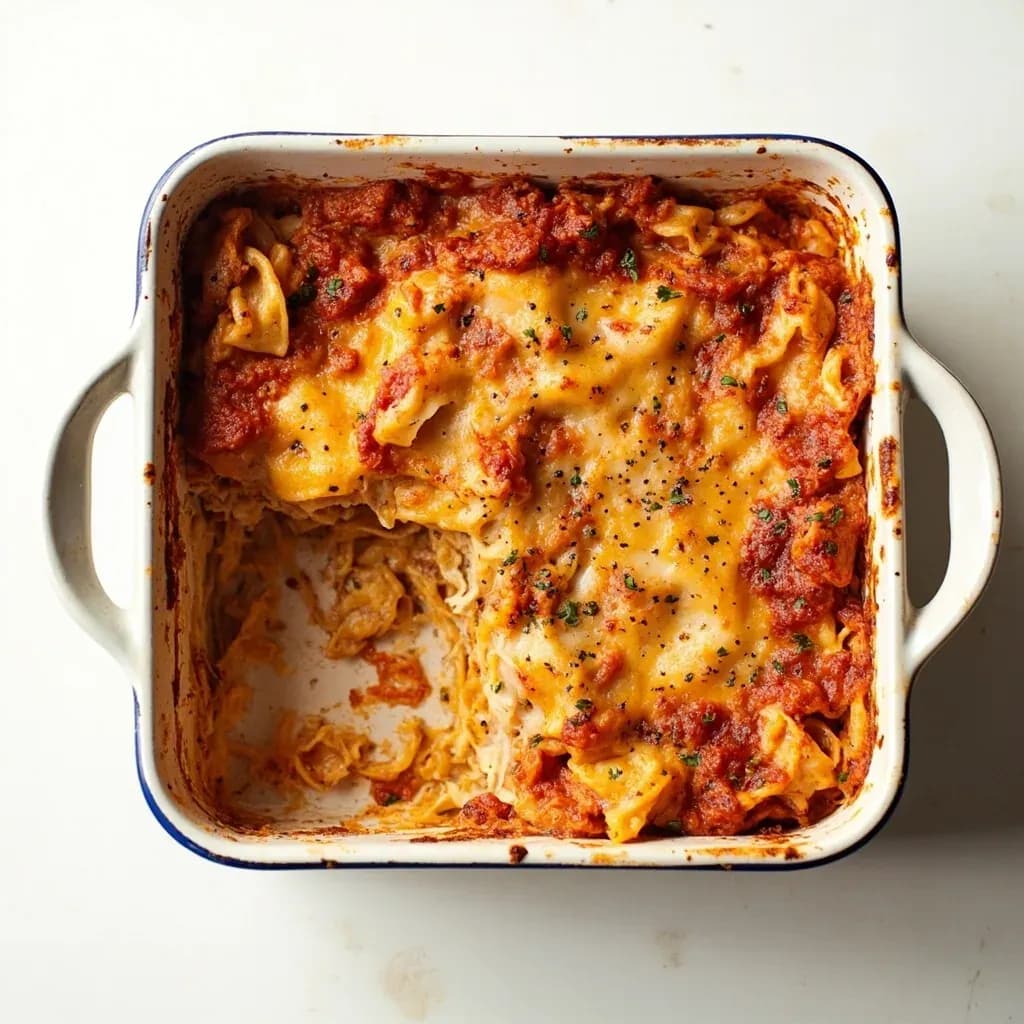
Layering bakes assembles dishes like lasagna, timpana, and moussaka in stacked strata of starch, filling, sauce, and cheese so flavors meld and the structure holds when cut. The order and moisture balance of layers matter, as too much liquid makes it soupy and too little leaves it dry. The top layer is usually cheese or sauce that browns into a crust.
Layering bakes is the assembly technique behind lasagna, moussaka, gratins, and most Tex-Mex casseroles: a dish is built from alternating strata of a starch or vegetable base, a moist filling, sauce, and often cheese, then cooked in a single vessel until the layers meld into a unified whole. The technique is less about stacking ingredients than about managing moisture — the dry components (pasta, potato, tortilla) absorb liquid during baking, so the ratio of sauce to solid determines whether the finished dish is silky or chalky, and whether the corners dry out or the center stays soupy.
What makes the method work is the way heat penetrates from the top down. A covered bake lets the interior come to temperature without browning the surface; uncovering for the final stretch browns and crisps the top while the filling finishes setting. The layers themselves are not just decorative — they create thin, repeating interfaces of starch and sauce that thicken as the bake rests, giving the dish its characteristic sliceable structure. Cut too soon, the same bake collapses into a puddle; rested properly, it lifts cleanly in squares or wedges.
Layering bakes is forgiving enough for beginners but rewards attention to a few details: pre-cooking the starch base just under al dente, drying watery vegetables before assembly, and ending every dish with sauce and cheese on top so the surface browns and protects the layers beneath. Most recipes improve when made a day ahead, because overnight resting lets the sauce redistribute and the flavors round out — which is why this family of dishes has become the backbone of family dinners, potlucks, and make-ahead entertaining.
- Difficulty
- Easy
Types & varieties
Italian; alternating pasta sheets with ragù, béchamel, and cheese. Bolognese style uses green spinach pasta, ragù, and béchamel; southern style often layers ricotta and tomato
Greek; fried or roasted eggplant and potato layered with spiced lamb ragù, topped with thick béchamel. Modern form codified by chef Nikolaos Tselementes in the 1920s
Greek; tubular pasta (often bucatini or penne) bound with egg and cheese, layered with spiced meat ragù and finished with béchamel
Italian drum-shaped pasta pie from southern Italy; concentric layers of sauce, meatballs, hard-boiled eggs, sausage, and multiple pasta shapes baked in a round mold
French; thinly sliced potatoes layered with cream and garlic, no cheese traditionally (Gratin Savoyard adds Gruyère)
Sliced vegetables (tomato, zucchini, eggplant, potato) arranged in overlapping rows in a shallow dish with olive oil, herbs, and sometimes cheese
Tex-Mex; tortillas layered with sauce, shredded meat, beans, and cheese
French; layered white beans, confit duck or pork, and sausages, baked until a crust forms
How to do it
- 1
Choose the pan and calculate depth
Pick a baking dish that holds the volume without overflowing. A 9×13-inch pan is the standard for lasagnas serving 8. The finished bake should sit at least 1 inch below the rim so sauce doesn't bubble over during baking.
- 2
Prepare each component separately
Make the sauce, cook the protein or vegetable filling, and prepare the starch base (pasta, potato slices, tortillas) before you begin assembling. Components should be warm or room temperature, not piping hot, so layers hold their shape rather than melting into one another.
- 3
Adjust the base for the oven's work
Boil pasta sheets or tubes 2–3 minutes under al dente; rinse briefly to stop cooking and toss with a thin film of oil so they don't clump. Slice potatoes or other vegetables to a uniform 2–3 mm on a mandoline. Pre-roast or salt-drain watery vegetables like eggplant, zucchini, and fresh tomato to drive off excess moisture.
- 4
Grease the dish and lay a base coat of sauce
Butter or oil the pan, then spread ½ to 1 cup of sauce across the bottom, reaching the edges. This prevents sticking, keeps the bottom layer moist, and stops bare pasta or potato from scorching against the metal.
- 5
Build the first layer of solid
Lay pasta, potato slices, tortillas, or vegetables in a single, edge-to-edge layer. Overlap flexible sheets slightly; arrange neat, tightly packed rows for gratins so there are no gaps for sauce to pool in.
- 6
Add filling and sauce
Spread roughly one-third of the filling and one-quarter of the sauce over the first base layer, then scatter cheese if the recipe calls for cheese inside (rather than just on top). Aim for even thickness — mounding causes uneven cooking and cold spots in the center.
- 7
Repeat the strata
Continue alternating base, filling, sauce, and cheese until you have 3–5 total layers. Most pasta bakes work best with 4–5 layers; gratins usually have 2–3 because dense vegetable slices take longer to cook through.
- 8
Finish with sauce and cheese on top
The top layer should be sauce so the cheese or breadcrumb finish has something to cling to and brown. A bare cheese-only top tends to crack, separate, and brown unevenly.
- 9
Bake covered, then uncovered
Tent with foil and bake at 350–400°F for about two-thirds of the total time to let heat penetrate to the center. Remove foil to brown the top for the final stretch. A knife or probe thermometer inserted in the center should read at least 165°F (74°C) for meat-containing bakes; 160°F for vegetable-only.
- 10
Rest before cutting
Let the bake stand 15–30 minutes on a wire rack. The sauce thickens as it cools, layers stabilize, and portions will hold their shape when lifted. Cut with a sharp knife dipped in hot water and wiped dry between cuts for clean edges.
Moisture management is the whole game
Every failure of a layered bake traces back to moisture — too little in the corners where the sauce didn't reach, too much in the center where watery vegetables bled during baking. The fix is almost always made before the dish goes in the oven, not after. Sauce must coat the base layer edge-to-edge and the top layer must also be sauce so cheese or crumbs have something to brown against. Vegetables with high water content (eggplant, zucchini, fresh tomato, mushrooms) should be salted, drained, or pre-roasted until they release and reabsorb their liquid. The starch base should be par-cooked so it absorbs rather than resists sauce. Get these three things right and the bake nearly assembles itself.
- Plan ~2.5–3 cups of sauce per 9×13 pan — more for saucy dishes like lasagna, less for dense gratins
- Salt eggplant, zucchini, and fresh tomato slices, let stand 20–30 minutes, then pat dry before layering
- Boil pasta 2–3 minutes under al dente; it finishes cooking and absorbs sauce in the oven
- Spread sauce to the pan's edges every layer; air gaps against the rim harden and dry out
- Always end with sauce and cheese on top — a bare cheese-only crust cracks and browns unevenly
Choosing a pan and depth
Pan choice shapes the final texture. A 9×13-inch (3 L) is the family-size standard for lasagnas and most casseroles; an 8×8-inch (2 L) suits smaller bakes; round 10–12 inch dishes or springforms work for tian-style gratins and timpano. Metal pans conduct heat faster and give crisper edges; glass and ceramic heat more gently and produce softer, more even browning. Finished depth should sit at least 1 inch below the rim — sauce bubbles up as it heats and a too-full pan will overflow and scorch the oven floor.
Common uses
Tips & pitfalls
- Always start with a thin film of sauce on the bottom of the pan; bare pasta or potato will stick and scorch against the metal
- End every bake with sauce and cheese on top so the surface browns evenly and protects inner layers from drying out
- Cook pasta 2–3 minutes under the package's al dente time — it absorbs moisture and finishes cooking in the oven, otherwise the bake turns chalky
- Salt each layer lightly, especially vegetables, since layers don't equilibrate seasoning as much as people expect
- Pat roasted or sautéed vegetables dry before layering; excess water is the leading cause of a weepy, split bake
- Spread sauce to the edges of the pan every layer — air gaps against the rim dry out and harden the corners
- Cover with foil for the first two-thirds of baking to protect the top and let the center heat through, then uncover to brown
- For deep bakes (3 inches or more), lower the oven by 25°F and extend time to keep the center from staying cool while the top burns
- If the top browns too fast, tent loosely with foil rather than lowering heat, which can leave the center underdone
- Use a metal pan for crispier edges; glass and ceramic give gentler, more even browning
- For gratins, slice the base vegetable on a mandoline to a uniform 2–3 mm so every layer cooks at the same rate
Good to know
- Category
- Assembly technique for baked casseroles and gratins
- Core principle
- Alternating strata of starch or vegetable base, moist filling/sauce, and often cheese, baked together so layers meld and the dish sets
- Bake temperature
- 350–400°F (175–200°C) for pasta bakes; 325–375°F (160–190°C) for delicate vegetable gratins
- Bake time
- 30–90 minutes depending on depth and density
- Resting time
- 15–30 minutes before slicing so layers set and sauce reabsorbs
- Standard pan sizes
- 9×13-inch (3 L) for family lasagnas; 8×8-inch (2 L) for smaller bakes; 10–12 inch round or springform for tian-style gratins and timpano
- Pasta prep rule
- Boil sheets or tubes 2–3 minutes under al dente; they finish cooking in the oven and absorb sauce
- Sauce ratio guide
- Plan ~2.5–3 cups sauce per 9×13 pan; too little dries out, too much makes a watery bake
- Origin
- Italian lasagne and Greek layered dishes documented by 13th–14th centuries; older precedents in medieval Arabic cookery and French daube traditions
Also called
Layering (Timpana / Pasta Bakes)
Dishes that rely on it
Related

Whisk
Beat ingredients smooth and aerated with a looping wire motion

Sift
Pass dry ingredients through mesh to aerate and remove lumps

Strain
Pour through mesh to separate solids from liquid for a smooth result

Filter
Pass liquid through fine material to clarify out the smallest particles

Rice
Press cooked potatoes through small holes for fluffy, lump-free texture

Mash
Crush soft cooked food into a rustic, creamy purée

Grind
Crush food into a coarse to fine texture, from spices to meat

Grate
Shred food into fine bits against a sharp-toothed surface