Heat & Fire
Whole-Pig Spit Roasting (Lechon Asado)
Slow-turning a whole pig over coals until skin crackles and meat falls apart.
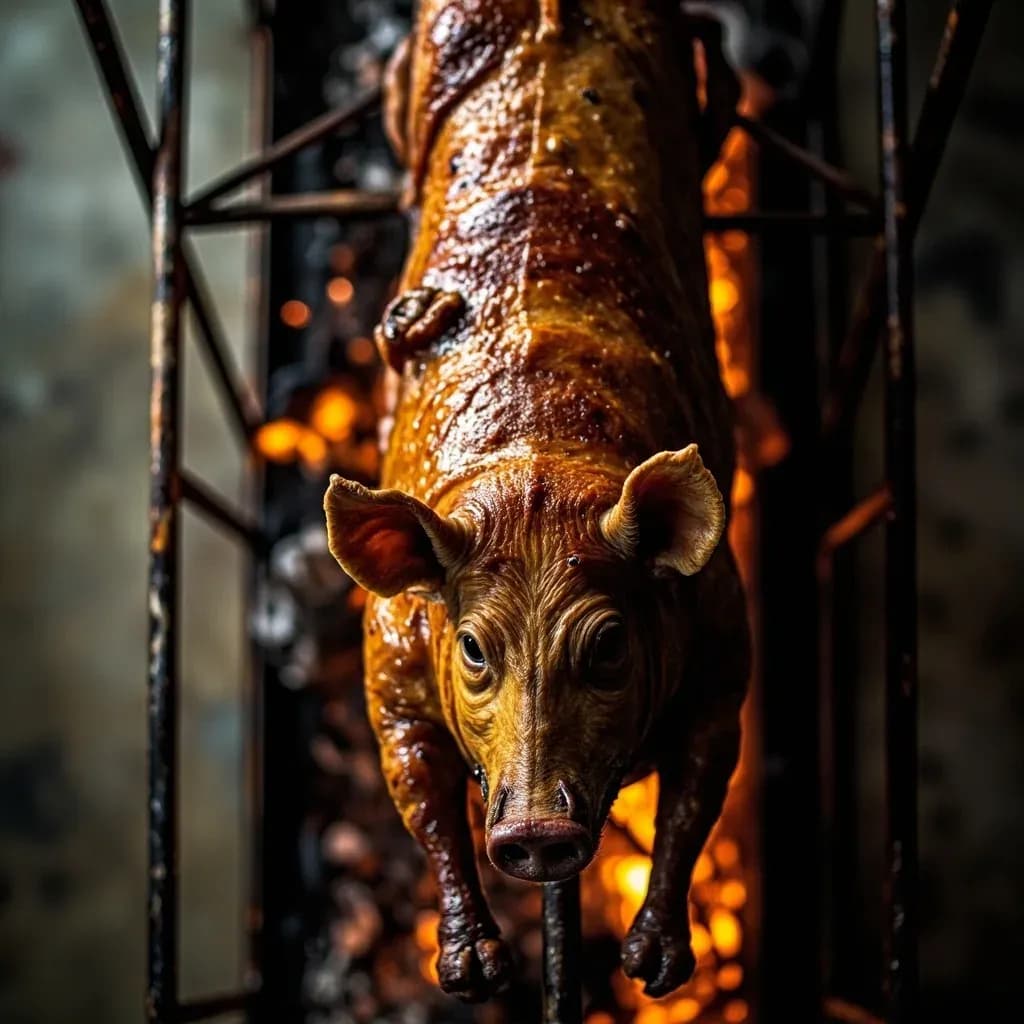
Whole-pig spit roasting skewers a seasoned pig on a long pole and turns it slowly over a bed of coals for hours, basting so the skin crisps to a lacquered crackling while the meat stays moist. Known as lechon across the Philippines and Latin America, it is a centerpiece of festivals and celebrations. Steady rotation and managing the coals away from flare-ups are key to even cooking and unburned skin.
Whole-pig spit roasting is the slow turning of a dressed, head-on pig skewered through the spine on a steel rod, suspended over a hardwood fire and rotated until the skin blisters into chicharrón and the meat pulls cleanly from the bone. It is the outdoor cookery tradition at the root of Cuban lechón asado, Filipino lechon, Puerto Rican lechón asado, Portuguese leitão, and the Andean chancho a la cruz — a method that traveled from Iberia to the Caribbean, the Philippines, and South America with colonization. Unlike pit or oven roasting, the constant rotation exposes every part of the carcass to radiant heat in turn, which is what allows the skin to dry and crackle evenly without burying the meat in its own fat.
What makes the technique distinctive is the dual prize it delivers: a skin that shatters under the tooth, and a deep, slow-rendered meat that comes off the bone in soft, saline shreds. Achieving both at once is the cook's central problem, because the conditions that produce crackling skin (dry heat, a high finishing temperature, no basting) are the opposite of what keeps the loin and shoulder moist. That tension governs everything about the cook — the fire's location, the speed of rotation, the timing of the final blast of heat, and the decision of when to stop basting.
The cook is also a social event. A 50-pound pig runs six to ten hours over a steady 250–300°F (120–150°C) bed of coals, which means the roast is also a gathering: someone tends the fire, someone turns the spit, someone else preps the sides. The regional differences live mostly in the marinade, the stuffing, and the accompanying sauce rather than in the fire management, and it is celebratory cooking at the largest scale a home cook will attempt.
- Difficulty
- Hard
Types & varieties
Marinated overnight in mojo criollo (sour orange, garlic, oregano, cumin); served with yuca con mojo and black beans and rice.
Cavity stuffed with lemongrass, garlic, onions, and bay leaves; served with a liver-and-vinegar-thickened dipping sauce and steamed rice.
Seasoned with adobo and pierced repeatedly to baste from within; traditionally served with arroz con gandules.
Stuffed with seasoned rice, peas, hog's blood (traditional), potatoes, and aromatics before roasting; an Eje Cafetero specialty.
Suckling pig, traditionally oven-roasted on tiles but spit versions exist; salt-and-garlic rub only, no strong marinades.
French-Acadian pit- or spit-roasted suckling pig, often pulled and served on po'boys or with gravy.
Skewered on a heavy cross-shaped stake driven into the ground beside the fire; regional Andean style.
How to do it
- 1
Source and prepare the pig
Order a dressed, head-on pig 24–72 hours ahead. Remove the innards if not already done, rinse the cavity, and pat thoroughly dry inside and out. If brining, submerge in a salt-and-sugar brine for 8–12 hours; if marinating, rub the mojo or adobo paste into the cavity and skin and refrigerate overnight. Bring the pig close to room temperature for 1–2 hours before mounting so it cooks evenly from the start of the long roast.
- 2
Skewer and secure
Lay the pig belly-up. Drive the steel spit rod through the mouth, along the spine, and out between the hind legs. Lock the carcass in place with heavy spit prongs at the shoulders and hams. Bind the legs and any loose flaps tightly to the rod with butcher's twine so nothing flaps in the heat and tears the skin. A through-bolt through the snout end keeps the head from sliding during the long turn.
- 3
Mount on the frame
Set the rod in the spit frame (cajón) with the drip pan positioned beneath the shoulders. Balance the rod so it turns smoothly with one hand; if the pig is lopsided, slide it on the rod until it rotates without dipping. A motor or geared hand crank is strongly recommended for pigs over 30 lb — ten hours of hand-cranking is its own kind of dish.
- 4
Light and settle the fire
Build a hardwood fire downwind of the pig, banked to one side, and let it burn down to a steady bed of glowing coals with no flame licking the carcass. Target 225–250°F (107–121°C) at the surface of the pig. Keep a water sprayer or a shovel of sand at hand to tame flare-ups, and add fuel in small amounts so the fire does not spike.
- 5
Roast and baste
Turn the spit continuously — about one revolution every 2–3 minutes — for even browning. Baste every 30–45 minutes with the collected drippings or a mojo of citrus, garlic, and fat. After 3–4 hours, insert a probe into the thickest part of the ham; expect the shoulder to lag the ham by 10–15°F (5–8°C), and watch the loin — the leanest cut — as it tends to dry out first.
- 6
Crisp the skin
In the last 30–45 minutes, push the coals closer and increase the heat to about 325°F (160°C). Stop basting so the skin can dry and blister into chicharrón. Watch constantly — the line between crackling and burnt is short, and the skin goes from mahogany to charcoal in minutes.
- 7
Test for doneness
Probe both the shoulder and the ham. The pig is ready when both read at least 170°F (77°C), preferably 180°F (82°C) for a shredding texture. The skin should be a deep bronze with large bubbles and sound hollow when tapped with a knuckle.
- 8
Rest and carve
Stop the spit, slide the rod to a resting cradle, and loosely tent with a clean cloth for 20–30 minutes. Strip the skin off in large sheets and set it aside. Pull the meat from the bones with gloved hands or chop into portions with a heavy cleaver or machete (lechoneras). Serve immediately with the skin and a regional dipping sauce — mojo in Cuba, lechon sauce in the Philippines, aji or salsa criolla in Peru, adobo drippings in Puerto Rico.
The crackling problem
The skin is half the dish and the part most cooks get wrong. Chicharrón (called cuerito in parts of Latin America) requires dry heat at the end, no basting, and ideally a small rise in temperature. Baste to the end and the skin stays leathery; crank the heat too early and the fat under the skin renders out before the skin has dried, and it slumps. Wrap the pig in foil at any point — even briefly — and the trapped steam undoes what you have built. The reliable sequence is steady low heat for most of the cook, then a hot blast of 30–45 minutes at the end with no basting, and an immediate carve before the skin can reabsorb moisture.
Fire, smoke, and rotation
The fire is built downwind of the pig and banked to one side, with no flame licking the carcass. Flame-ups scorch the skin and deposit bitter creosote, so plan on small fuel additions and let the logs burn down to a steady bed of coals before the pig goes on. A continuous slow rotation of about one revolution every 2–3 minutes is the target; a hand crank is fine for a 30 lb pig, but anything over 40 lb is much easier with a geared motor. A drip pan under the shoulders and hams catches rendering fat that would otherwise flare, and it gives you a baste to work with for the rest of the cook.
Common uses
Tips & pitfalls
- Source a fresh, not frozen, pig when possible; thaw a frozen pig for 3–4 days in the refrigerator, never at room temperature, and bring it close to room temperature before mounting.
- Weigh the pig with all spit hardware and counterbalance the rod before mounting — a tail-heavy pig spins unevenly and burns lopsided.
- Skewer must pass through the spine, not just the belly, and exit between the hind legs; lock with spit prongs and a through-bolt on the snout end for a stable turn.
- Start at 225–250°F (107–121°C) and finish with a short hot burst around 325°F (160°C) in the last 30–45 minutes to crackle the skin.
- Baste every 30–45 minutes with drippings or a mojo, but stop basting in the final 30 minutes — wet skin stays leathery and never crackles.
- Never wrap the pig in foil at any point; the trapped steam will soften the skin and undo hours of drying.
- Use a remote probe thermometer in the ham and shoulder — clip-on ambient thermometers are nearly useless in radiant heat and read the wrong thing.
- Rest the pig 20–30 minutes standing upright on the spit under a loose cloth before carving; resting keeps juices from running onto the skin and softening it, and lets the carryover heat finish the shoulder.
Good to know
- Origin
- Iberian (Spanish/Portuguese) tradition carried to the Caribbean, Philippines, and Latin America via colonization; national or signature dish in Cuba, the Philippines, Puerto Rico, the Dominican Republic, and the Balearic Islands.
- Typical animal weight
- Suckling pig 15–30 lb (6–14 kg); standard feast pig 40–80 lb (18–36 kg); very large events 100 lb+ (45 kg+).
- Fuel
- Hardwood charcoal or split hardwood logs — oak, hickory, guava, mangrove, fruitwoods; never softwoods or treated lumber.
- Cook time
- Roughly 6–10 hours for a 50 lb pig; allow about 1 hour per 10 lb at a steady 250–300°F (120–150°C) ambient.
- Target internal temperature
- Minimum 170°F (77°C) in the shoulder and ham, ideally 180–190°F (82–88°C) for a shredding texture; skin must blister and crackle.
- Crisped skin
- Called chicharrón (or cuerito in parts of Latin America); prized as much or more than the meat itself.
- Yield
- Roughly 40–50% of live weight as cooked product; a 50 lb pig yields about 20–25 lb of edible meat and skin.
- Difficulty
- High — requires fire management, rigging, and long unattended cooking; not a weeknight project.
Also called
rotisserie · trompo-roasting · lechon
Dishes that rely on it
Related

Sear
Blast the surface hot for a deep-browned, savory crust

Sauté
Cook quickly in a little fat over lively heat, tossing as you go

Stir-Fry
Toss bite-sized pieces over roaring heat for fast, smoky cooking

Pan-Fry
Crisp food in a shallow layer of hot fat, turning once or twice

Deep-Fry
Submerge in hot oil for an all-over crackling crust

Roast
Cook uncovered in dry oven heat for browned edges and tender centers

Bake
Cook with steady, surrounding oven heat — the soul of bread and pastry

Broil
Hit food from directly above with fierce overhead heat