Transform & Preserve
Making Custard
Gently cooking eggs with milk or cream so the proteins thicken into a smooth, set cream.
Making custard combines eggs (or yolks) with milk or cream and gentle heat so the egg proteins coagulate and thicken the mixture into a silky sauce or set cream. Stirred custards like creme anglaise stay pourable, while baked custards like flan set firm. The key is low, controlled heat and constant attention, because overheating curdles the eggs into scrambled lumps.
Custard is a technique as much as a dish: the controlled heating of beaten eggs with milk, cream, or both until the egg proteins unfold, link together, and thicken the liquid into something between a sauce and a pudding. The window between "too loose" and "too curdled" is narrow — often only a few degrees — which is why custard is one of the first things a pastry cook learns to read by feel and by temperature.
Sugar, fat, and starch all slow the proteins' bonding. That single fact is the engine of the entire custard family: a thin crème anglaise made with nothing but yolks, sugar, and milk can only thicken gently before it breaks, while pastry cream, fortified with flour or cornstarch, can be cooked to a heavy, sliceable texture without curdling. Baked custards sit between those poles, set in a water bath so the oven's dry heat never pushes the proteins past their limit.
Mastering custard means learning to listen to it. A wooden spoon, a thermometer, and the discipline to pull the pan off the heat a few seconds before you think it's done are worth more than any recipe. Everything else — the flavourings, the ratio, whether you bake or stir — is a variation on that simple, temperature-driven idea.
- Difficulty
- Medium
Types & varieties
Stirred pouring custard of milk or cream, yolks, and sugar — the foundational French dessert sauce.
Stirred custard thickened with flour or cornstarch, used to fill éclairs, tarts, and layer cakes.
French-style pastry cream made with flour; richer and more opaque than cornstarch versions.
A clearer, glossier set typical of Italian pastry.
Pastry cream lightened with whipped cream and stabilized with gelatin.
Baked custard finished under a blowtorch or broiler with a caramelized sugar crust.
Baked custard unmolded over a layer of soft caramel.
Dense, rich baked custard set in small lidded pots.
A baked open tart filled with a thick egg custard set with starch.
Yolks whisked over a bain-marie with sugar and Marsala, wine, or other alcohol.
Custard set with gelatin and folded with whipped cream for a mousselike texture.
Whole-egg-and-cream custard seasoned with salt, pepper, and nutmeg for savoury tarts and timbales.
Small tart shells filled with a thin baked custard scented with lemon and cinnamon.
How to do it
- 1
Mix the eggs, sugar, and salt
Whisk whole eggs, yolks, or a combination with sugar and a pinch of salt until just combined. Don't whip in air — the goal is a smooth, uniform base, not foam. The sugar should dissolve into the eggs before any heat is applied.
- 2
Infuse and scald the dairy
In a heavy-bottomed saucepan, combine milk and/or cream with any aromatics (vanilla bean, citrus zest, cinnamon stick, herbs). Heat over medium until small bubbles form around the edges and steam rises — about 82°C (180°F). Do not let it boil.
- 3
Temper the eggs
Remove the dairy from the heat. Slowly drizzle a thin stream of the hot dairy into the egg mixture while whisking constantly. Begin with a few spoonfuls to warm the eggs, then increase the flow. This raises the eggs' temperature gradually so they don't scramble.
- 4
Cook gently in the pan
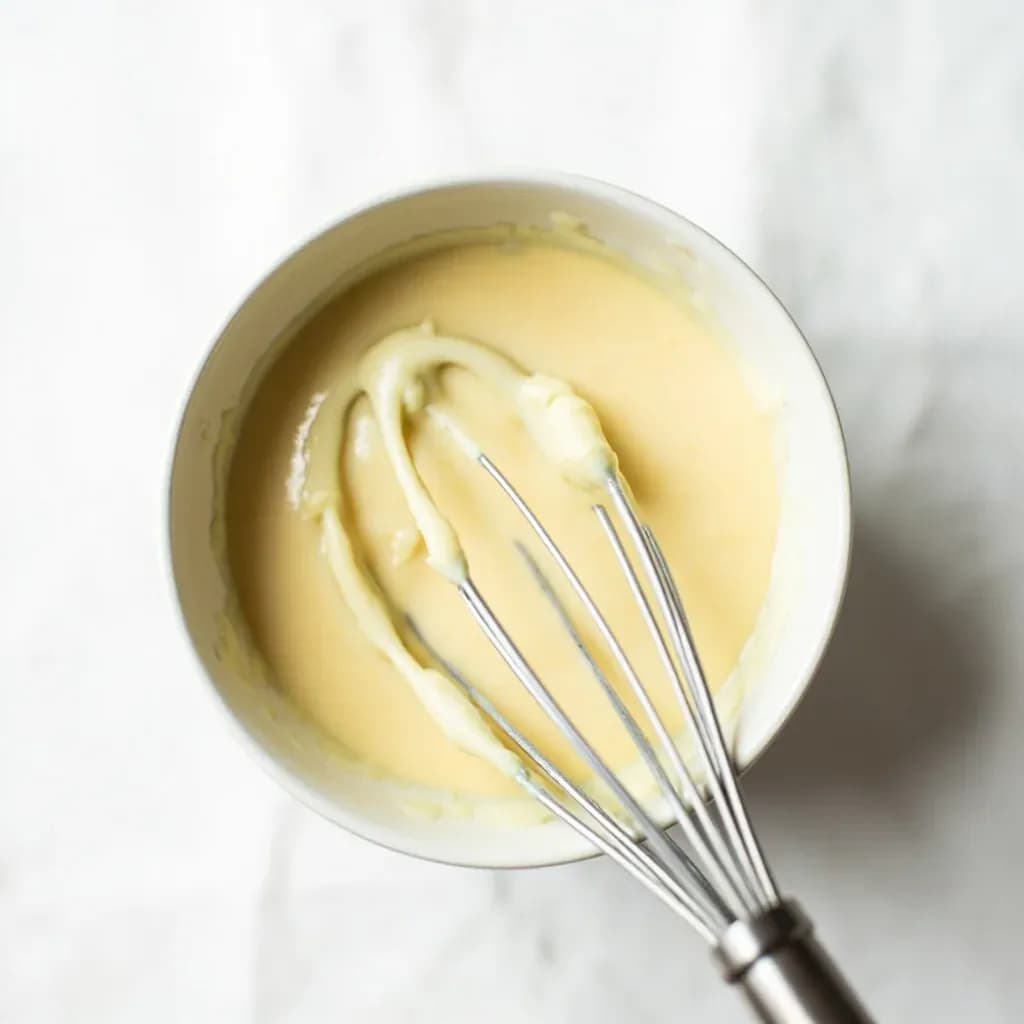
Pour the tempered mixture back into the saucepan. Set over low heat and cook, stirring constantly with a whisk or wooden spoon, scraping the bottom and corners to prevent hot spots. Target 76–80°C (170–176°F) on an instant-read thermometer, then pull the pan off the heat — carryover will finish the job.
- 5
Test for doneness
Dip a wooden spoon or spatula: the custard should coat the back thickly. Draw a clear line through the coating with your finger — if the line holds and the edges don't run back together, it is ready. For a pouring crème anglaise, stop at the thinner end of this range; for pastry cream, cook a little longer.
- 6
Strain immediately
Pour the finished custard through a fine-mesh sieve into a clean bowl. This catches any curds, chalazae (the white cords anchoring the yolk), and foam, leaving the texture silken.
- 7
Cool rapidly
Set the bowl over an ice bath or transfer to a wide, shallow container and chill, stirring every few minutes. For pastry cream, press plastic wrap directly against the surface. Fast cooling stops carryover cooking and keeps the texture smooth.
- 8
For baked custards: assemble in a water bath
Ladle the strained custard into buttered ramekins or a gratin dish. Place in a roasting pan and add hot water to come halfway up the sides. Bake at 150–160°C (300–325°F) until just set at the edges but still trembling in the centre — typically 35–50 minutes. Carryover heat will finish the set.
How custard works
Custard is a temperature problem dressed up as a recipe. The proteins in eggs are long chains that unwind and bond to each other as they warm; the goal is just enough bonding to trap the liquid and create body, without so much that the proteins squeeze the liquid out and the mixture breaks.
Three ingredients moderate that bonding. Sugar physically gets in the way of the protein chains, which is why a sweet custard sets softer and tolerates more heat than a savoury one of the same egg content. Fat, from cream or extra yolks, coats the proteins and slows the network. Starch — flour or cornstarch — physically blocks proteins from touching, which is why pastry cream can be brought to a brief simmer to reach a thick, sliceable texture that a plain egg custard never could.
Treat the thermometer as a guide and the spoon test as the truth. A good custard tells you when it is done, if you watch it.
Common uses
Tips & pitfalls
- Whisk the sugar into the eggs (not the milk) before tempering; sugar buffers the proteins against heat shock and is the single best defence against scrambling.
- Add a pinch of salt and a scraping of vanilla bean to the cold dairy before scalding to deepen flavour with no extra effort.
- Temper slowly — pour the hot dairy in a thin stream while whisking, especially at the start. Rushing this step is the most common cause of scrambled eggs in the custard.
- Use a heavy-bottomed pan and keep the flame low; custard burns in seconds if rushed in a thin pan.
- Pull the pan off the heat a few seconds before the custard looks thick enough — carryover cooking will finish the job, and leaving early is the easiest way to avoid breaking the custard.
- Strain every custard through a fine-mesh sieve to remove chalazae, foam, and any early curds. This is the single biggest upgrade to texture.
- For baked custards, use a water bath at 150–160°C (300–325°F) oven temperature so the eggs set gently and stay silky rather than weeping or cracking.
- If the custard does break, whisk a cold yolk or two in a separate bowl and slowly stream the broken custard in — it can usually be rescued into a smooth sauce.
Good to know
- Protein coagulation range
- Egg yolks thicken at 65–70°C (149–158°F); whole eggs at 63–66°C (145–151°F); whites at 62–65°C (144–149°F).
- Breaking point
- Custard curdles or "breaks" past about 80–85°C (176–185°F), when proteins clump and water separates out.
- Safe hot-hold zone
- 63–71°C (145–160°F) keeps custard above the bacterial danger zone while staying below the curdling point.
- Role of sugar
- Sugar interferes with protein bonding, so sweeter custards tolerate more heat and set softer than unsweetened ones of the same egg content.
- Stabilizer ratios
- Pastry cream uses 20–35 g of flour or cornstarch per 500 ml of milk to give it a sliceable set.
- Egg-to-liquid ratios
- Stirred custards: 4–6 yolks per 250 ml milk. Baked custards: 2–3 whole eggs per 250 ml. Pastry cream: roughly 3 yolks plus 25 g starch per 500 ml.
- Active time
- 15–25 minutes for a stirred custard; 35–60 minutes for a baked custard in a water bath.
- Equipment
- Heavy-bottomed saucepan, balloon whisk, fine-mesh sieve, instant-read thermometer, and a roasting pan for water-bath baking.
- Yield note
- Strained custard loses roughly 5–10% of its volume to foam, chalazae, and any curds caught by the sieve.
Also called
creme anglaise · egg custard
Dishes that rely on it

Related

Confit
Cook slowly submerged in fat for silky tenderness and keeping

Cure
Draw out moisture with salt and time to preserve and concentrate

Pickle
Steep in acidic brine for bright, tangy, crunchy preservation

Ferment
Let friendly microbes transform food into tangy, complex flavor

Marinate
Soak in a seasoned mix to flavor and tenderize before cooking

Brine
Soak in salt water so meat stays juicy and seasoned throughout

Dehydrate
Slowly dry out moisture to concentrate flavor and extend shelf life

Cold-Smoke
Perfume cured food with smoke without cooking it through