Prep & Assembly
Making Pastry Cream (Crème Pâtissière)
Cooking milk, egg yolks, sugar, and starch into a thick, smooth custard for filling pastries.
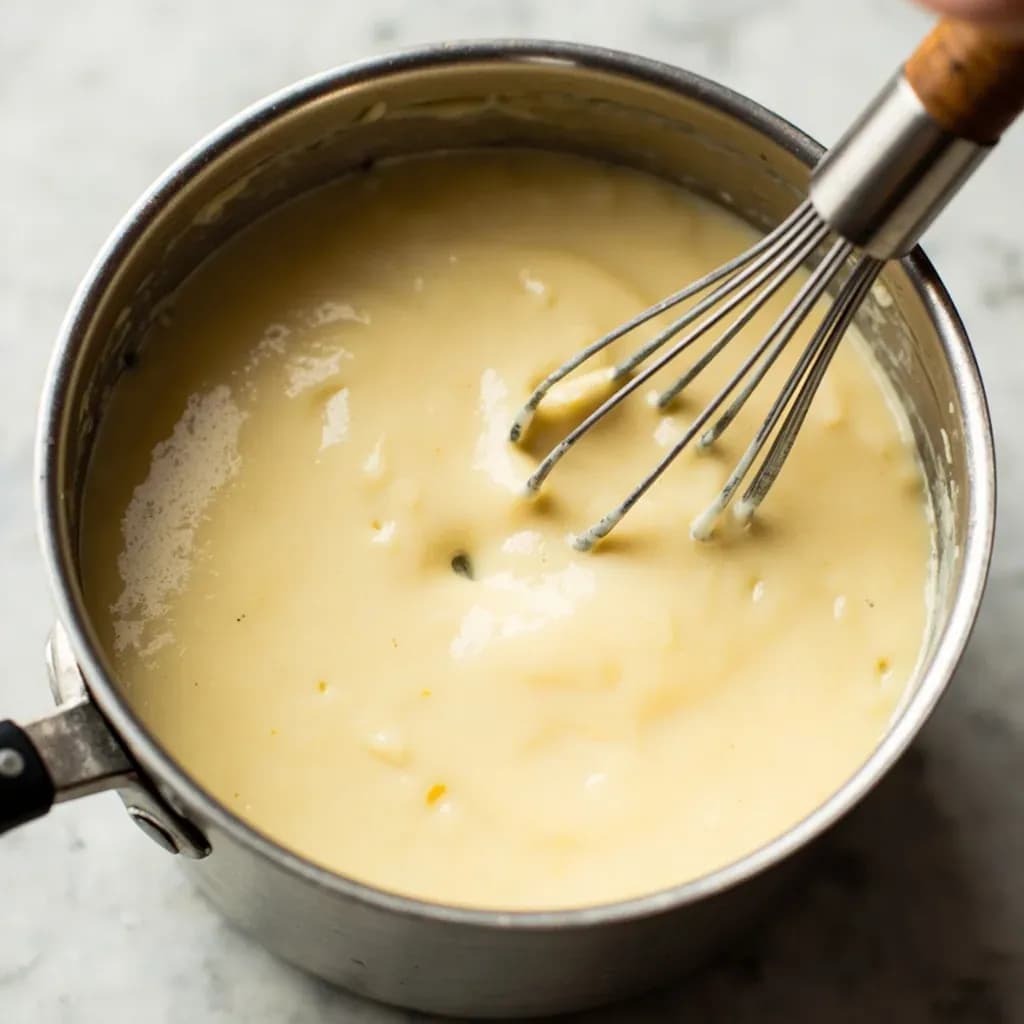
Making pastry cream cooks a base of milk, egg yolks, sugar, and a starch such as cornstarch or flour into a thick, glossy custard. The yolks are tempered with hot milk, then the mixture is brought to a boil while whisking constantly so the starch cooks out and the custard thickens without scrambling. Cooked to a boil and chilled with a film of plastic on its surface, it fills tarts, eclairs, and choux.
Crème pâtissière is the thick, spoonable custard that holds together éclairs, fruit tarts, mille-feuille, and most of the filled French pastries you'd recognize from a pâtisserie window. In classical French training it sits alongside pâte à choux, pâte brisée, and crème anglaise as one of the foundational "mother" preparations — the recipe every pastry cook is expected to have on autopilot. What sets it apart from a stirred custard like crème anglaise is structural: pastry cream is thickened with starch as well as egg yolks, so it can support piping, hold up between layers of puff pastry, and stay put under glazed fruit without soaking the dough around it.
The technique is essentially anglaise with starch bolted on. Whole milk, often infused with vanilla, is brought to a simmer; a sugar-and-yolk mixture is tempered with the hot milk, and the whole thing is returned to the pan and cooked until the starch gelatinizes and the cream thickens. The two non-negotiables are cooking the mixture all the way to a proper boil — starch needs that heat to swell and shed its raw taste — and cooling it quickly with plastic pressed directly onto the surface, or you'll come back to a bowl of cream topped with a rubbery skin and a thin layer of wept whey.
A single batch yields roughly 600–700 ml, more than enough to fill a dozen éclairs or a 25 cm tart. Once you have a reliable base, most of the other creams in the pastry canon — diplomate, mousseline, chiboust, frangipane — are built on top of it, which is why this one technique unlocks such a wide swath of the pâtisserie repertoire.
- Difficulty
- Medium
Types & varieties
The base: milk, yolks, sugar, cornstarch, vanilla.
Finished with 100–150 g melted dark chocolate per 500 ml batch; for éclairs, mocha cakes, Black Forest.
Milk infused with strong espresso or coffee; pairs naturally with hazelnut and chocolate.
Made with pistachio paste or pistachio-infused milk; used in Paris-Brest variants and Saint-Honoré.
Lemon zest infused in the milk, lemon juice stirred in at the end; lighter and tangier, suited to fruit tarts.
Pastry cream lightened with folded-in whipped heavy cream (roughly 1:1 by volume); softer, airier, used in layer cakes and fruit tarts.
Pastry cream lightened with Italian meringue; light yet stable, used in Saint-Honoré cake.
Pastry cream beaten with a large quantity of softened butter (often near 1:1); rich, pipeable, the classic Paris-Brest filling.
Often a 1:1 blend of pastry cream with crème d'amandes; standard in galette des rois and Bostock.
How to do it
- 1
Combine yolks, sugar, and starch
In a heatproof bowl, whisk 6 egg yolks (≈110 g) with 100 g granulated sugar just to combine, then whisk in 50–60 g cornstarch until completely smooth and free of lumps. Scrape down the sides of the bowl. Whisking all three together before any liquid is added keeps the starch from clumping against wet yolks and guarantees an even paste to temper.
- 2
Heat the milk with vanilla
In a heavy-bottomed saucepan, combine 500 ml whole milk with the seeds and pod of 1 vanilla bean (or 1–2 tsp pure vanilla extract, added at the end). Bring just to a simmer over medium heat — small bubbles around the edge, not a rolling boil. A rolling boil at this stage can scorch the milk and drive off moisture you'll want in the finished cream.
- 3
Temper the yolk mixture
Remove the milk from the heat. Slowly ladle about one-third of the hot milk into the yolk mixture in a thin, steady stream, whisking constantly. Once the yolk mixture is smooth and warm, whisk in the remaining milk in two more additions. This raises the yolks' temperature gradually so they don't scramble on contact with the hot milk.
- 4
Cook the cream
Pour the entire mixture back into the saucepan and return it to medium heat. Whisk constantly and thoroughly — reaching into the corners — scraping the bottom and sides. The cream will thin out at first as the cold mixture equilibrates, then suddenly thicken as it nears a boil.
- 5
Bring to a boil and hold
As soon as the cream comes to a full boil with large bubbles breaking on the surface, drop the heat to low and cook, whisking, for 1–2 minutes. This fully gelatinizes the cornstarch and cooks out any raw starch flavor. Do not walk away — overcooking past this point can thin the cream again as the starch network breaks, or scorch the bottom.
- 6
Finish with butter (optional)
Remove from the heat. If using, whisk in 30–50 g cold unsalted butter a few cubes at a time until fully incorporated. This is the 'à la française' finish taught in many pastry schools: glossier, richer, and slightly more stable when cold. Add the butter only after the cream has stopped boiling, or it can split. If you didn't infuse the milk, stir in vanilla extract now.
- 7
Strain
Immediately pour the cream through a fine-mesh sieve into a clean bowl or rimmed tray. The sieve catches any bits of cooked egg, unincorporated starch, or vanilla pod, and produces the satin-smooth texture that defines good pastry cream.
- 8
Cover directly on the surface
Press a sheet of plastic wrap flat against the entire surface of the cream, eliminating any air contact. This is the single most important step to prevent a rubbery skin from forming as the cream cools.
- 9
Cool quickly, then chill
For the fastest, safest cooling, set the bowl over an ice bath and stir occasionally until lukewarm (about 10 minutes), then transfer to the refrigerator. Chill at least 1–2 hours, preferably 4 hours or overnight, until the cream is set and cold throughout. Slow cooling leaves it in the bacterial danger zone too long and tends to over-thicken it from residual heat.
- 10
Rewhisk before using
The cream will firm up significantly in the fridge. Whisk it briefly by hand (or with the paddle attachment) to loosen it back to a smooth, pipeable consistency. If a little whey has wept to the surface, whisking brings it back into a homogeneous cream.
The cream family: how pastry cream relates to its derivatives
Pastry cream is best understood as the dense, structural base from which the airier or richer French creams are derived. Knowing which cream to reach for — and when — saves a cook from over- or under-filling a pastry.
- Crème diplomate = pastry cream + folded whipped cream. Softer, lighter, best for chilled desserts, fruit tarts, and layer cakes where you want the cream to feel less heavy.
- Crème mousseline = pastry cream beaten with a large amount of softened butter. Richer and more stable than plain pastry cream, but the butter must be pliable (not melted, not cold) or the cream will break.
- Crème chiboust = warm pastry cream folded with Italian meringue. Used while still fresh for Saint-Honoré, because the meringue gives body without the heaviness of butter.
- Crème frangipane is technically a 1:1 mix of pastry cream with crème d'amandes (an almond-butter-sugar-egg mixture), and it's the filling of choice for galette des rois and Bostock.
Troubleshooting common failures
Most pastry cream problems come down to three things: heat, tempering, or skin. Recognizing them in the pan is faster than salvaging after chilling.
- Grainy or scrambled texture: the yolks hit the hot milk too fast. Next time, temper more slowly in a thinner stream. The current batch can often be rescued with a brief pass through a fine-mesh sieve or a quick buzz with an immersion blender.
- Thin or runny cream: it never reached a boil, or it boiled and was held too long so the starch thinned back out. Reheat gently and bring it back to a full boil, whisking, then hold 1 minute.
- Greasy or broken cream: usually means butter was whisked in while the cream was still boiling, or the cream was cooked too aggressively. A vigorous whisk off heat, or a brief immersion-blender pulse, often brings it back.
- Rubbery skin and pooled whey after chilling: plastic wrap wasn't pressed directly onto the surface, or the cream sat warm too long. The skin itself is unsalvageable; lift it off, rewhisk the rest, and press new wrap on for storage.
- Piping feels stiff and tears the choux: the cream is over-chilled. Let it sit at room temperature 15–20 minutes and rewhisk before filling.
Common uses
Tips & pitfalls
- Temper the yolks slowly: ladle the hot milk in a thin stream while whisking constantly, or the yolks will scramble on contact and the cream will be grainy no matter how long you cook it.
- Whisk sugar into the yolks before adding starch; cornstarch dumped onto bare yolks clumps. The cleanest path is to whisk yolks, sugar, and cornstarch into a smooth paste before any liquid touches them.
- Bring the cream back to a full boil and hold it there 1–2 minutes — cornstarch must reach roughly 95 °C to thicken properly and shed any raw taste. Undercooking is the most common reason pastry cream stays thin and pasty.
- Strain the finished cream through a fine-mesh sieve. It catches any curdled bits, unincorporated starch, or vanilla pod and is the difference between homemade-looking and pâtisserie-smooth.
- Press plastic wrap directly onto the surface before chilling. A skin forms within minutes in a warm kitchen and pulling it off later leaves a lumpy top and wasted cream.
- For a glossier, richer, more pipeable result, whisk in 30–50 g cold butter off the heat at the end — but only after the cream has stopped boiling, or the butter will split and the cream will break.
- Cool the cream over an ice bath and stir occasionally, or it keeps cooking on residual heat, over-thickens, and spends too much time in the bacterial danger zone.
- Always rewhisk briefly before piping. Chilled pastry cream firms up and often weeps a thin layer of whey; a few strokes brings it back to a smooth, pipeable consistency.
- Cornstarch vs. flour: cornstarch gives a clearer, glossier, more stable cream with a neutral flavor; flour gives a more opaque, slightly heavier result with a faintly cooked-flour note.
Good to know
- Origin
- French pâtisserie; one of the foundational 'crèmes de base' taught in classical culinary training.
- Category
- Thickened egg-yolk custard / starch-set cream.
- Standard ratio (per 500 ml milk)
- 6 egg yolks (≈110 g), 100 g sugar, 50–60 g cornstarch, 1 vanilla bean or 1–2 tsp extract; 30–50 g butter optional.
- Target temperature
- Must return to a brief boil (≈95–100 °C / 203–212 °F) and hold 1–2 minutes to fully gelatinize the starch and eliminate raw flour or cornstarch taste.
- Active / chill time
- 15–20 minutes active; at least 1–2 hours to chill, best after 4 hours or overnight for clean piping.
- Yield
- About 600–700 ml (≈2½–3 cups) per batch.
- Doneness cue
- Coats the back of a spoon; a finger drawn through leaves a clean trail that holds its shape.
- Shelf life
- 2–3 days refrigerated in an airtight container, or up to 1 month frozen (thaw overnight and rewhisk).
Also called
cooking-pastry-cream · Crème Pâtissière · Pastry Cream
Related

Whisk
Beat ingredients smooth and aerated with a looping wire motion

Sift
Pass dry ingredients through mesh to aerate and remove lumps

Strain
Pour through mesh to separate solids from liquid for a smooth result

Filter
Pass liquid through fine material to clarify out the smallest particles

Rice
Press cooked potatoes through small holes for fluffy, lump-free texture

Mash
Crush soft cooked food into a rustic, creamy purée

Grind
Crush food into a coarse to fine texture, from spices to meat

Grate
Shred food into fine bits against a sharp-toothed surface