Water & Steam
Making Dashi / Stock
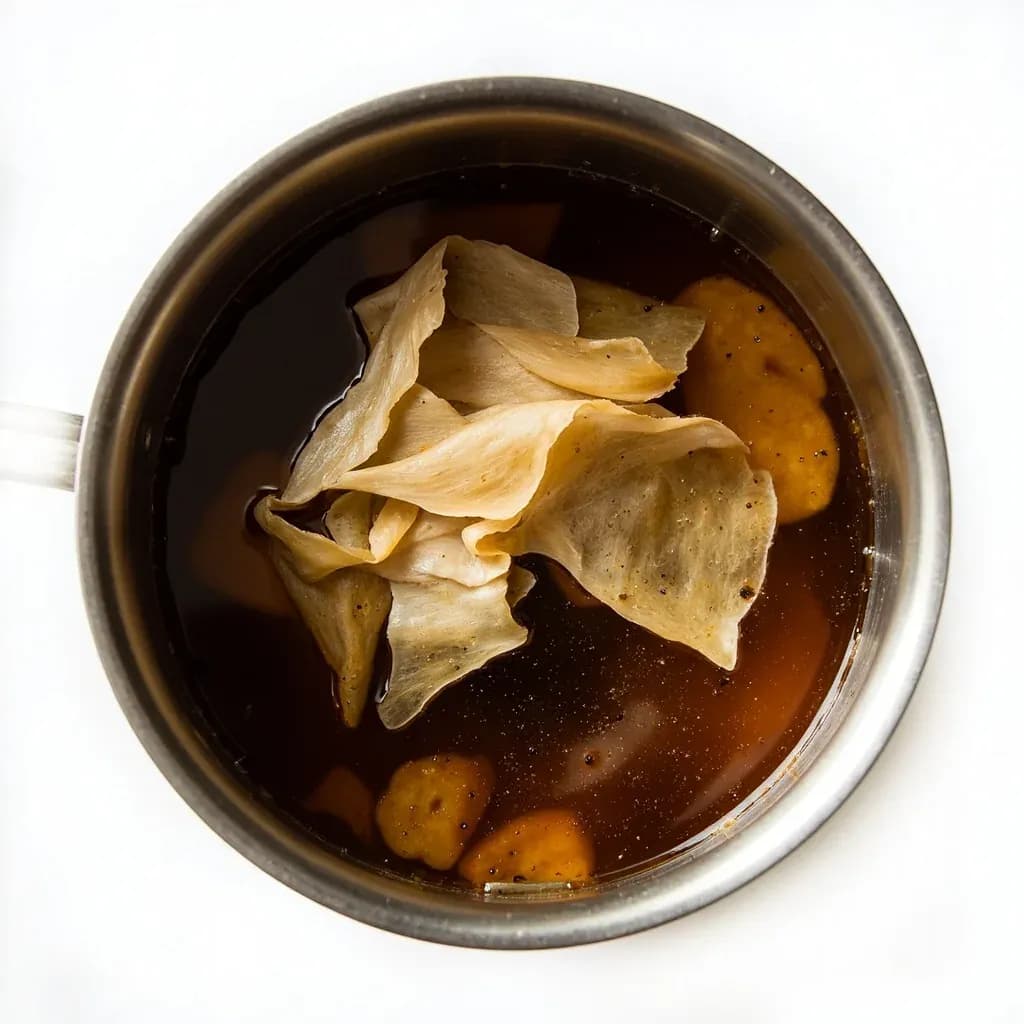
Steeping kelp, bonito, anchovy, or bones in water to draw out a clear, umami-rich base stock.
Making dashi or stock extracts savory depth by gently heating water with ingredients like kombu kelp, bonito flakes, dried anchovies, or simmered bones. Dashi in particular relies on careful temperature so the kombu releases glutamates without turning slimy and the bonito infuses cleanly. The resulting liquid is the umami foundation for soups, sauces, and braises across East Asian cuisines.
Dashi is the quiet, savory backbone of Japanese cooking — a clear, aromatic broth built not by long simmering but by careful, low-temperature extraction of umami-rich ingredients such as kombu (edible kelp) and katsuobushi (shaved, smoke-dried, fermented skipjack tuna). Unlike a Western chicken or beef stock, which rewards hours of gentle simmering and skimming, dashi asks for restraint: gentle heat, short steeping, and respect for the moment the water tells you it is ready. The result is a broth of remarkable clarity and depth, on the table in 30 to 60 minutes (or overnight, by the cold mizudashi method), and the foundation of miso soup, clear soups, noodle broths, dipping sauces, steamed custards, and simmered dishes across the Japanese table.
The magic is in the chemistry. Kombu contributes glutamic acid — pure, free-form glutamate — while katsuobushi delivers inosinates. Alone, each is savory; together they create umami synergy roughly seven times more intense than either could produce singly, which is why the combination (awase dashi) is the everyday default in most Japanese kitchens. Different jobs call for different dashi: the pristine first extraction (ichiban dashi) is reserved for showcase dishes where the broth itself is in the spotlight; the second extraction of the same ingredients (niban dashi) is the workhorse for miso and simmered dishes; and entirely different bases — niboshi, shiitake, or pure kombu — give cooks regional and dietary flexibility.
- Difficulty
- Medium
Types & varieties
The first extraction; clear, pale gold, used where the broth itself is showcased — clear soups, chawanmushi, dipping sauces.
Second extraction of the same kombu and katsuobushi in fresh water; lighter, used in miso soup and nimono.
Kelp only; vegan, slightly sweeter and more vegetal; preferred in Kansai-style cooking.
Bonito flakes only; sharper, smokier, more pronounced fish flavor; more common in Kanto-style cooking.
Kombu and katsuobushi combined; the everyday default for most Japanese home and restaurant cooking.
Made with dried whole or heads-off sardines (niboshi, also called iriko in Kansai); richer and more pungent, used in robust noodle broths and some miso soups.
Cold-soaked dried shiitake mushrooms; the soaking liquid is vegan and deeply savory, often combined with kombu.
Traditional Buddhist monastic dashi — kombu and dried shiitake only, no bonito.
How to do it
- 1
Prepare the kombu
Wipe a 10 cm (about 10 g) piece of kombu per liter of water with a barely damp cloth to remove grit without stripping the white bloom on its surface — that powder is mannitol and glutamic acid, the purest form of kombu's umami. Do not rinse under running water.
- 2
Cold-soak in soft water
Place the kombu in a wide pot or bowl, add cold filtered or rested water, and weight the kombu under the surface with a small plate. Cold-soak 30 minutes to 1 hour to begin extracting glutamate gently.
- 3
Heat slowly and remove the kombu
Heat the pot over low to medium-low heat. Watch the surface closely; the moment small bubbles begin to rise and steam appears, lift the kombu out with chopsticks or tongs. Do not let the water boil — target 60–70 °C (140–160 °F).
- 4
Add katsuobushi and steep off heat
Add 20–30 g of katsuobushi per liter of water, push it under the surface once, then turn off the heat. Steep undisturbed for 1–3 minutes — the flakes will sink as the inosinates release.
- 5
Strain by gravity only
Set a fine-mesh strainer (lined with cheesecloth or a coffee filter for restaurant-clear dashi) over a clean container. Pour slowly and let gravity do the work — never press or squeeze the flakes, or the dashi turns cloudy and bitter.
- 6
Use immediately or cool rapidly
Use the ichiban dashi right away for the clearest flavor, or cool it quickly in an ice bath and refrigerate. Strained, refrigerated dashi keeps 3–4 days; freeze in cubes or jars for months.
- 7
Optional: make niban dashi from the grounds
Return the strained kombu and katsuobushi to the pot with fresh water, simmer 10–15 minutes, and strain. Use this lighter broth for miso soup, nimono, and simmered greens where a delicate backdrop is welcome.
Choosing kombu and katsuobushi
The quality of dashi rises and falls with its two main ingredients, and a little knowledge of varieties pays off in the pot.
- Rishiri-kombu and Rausu-kombu from Hokkaido are the most prized for dashi — both are exceptionally high in glutamate, the source of kombu's sweetness and umami.
- Ma-kombu from Hakodate is the traditional Kyoto choice and is well suited to lighter, more delicate dashi.
- Hon-karebushi (mold-aged, long-fermented katsuobushi) produces the cleanest, sweetest dashi and is the professional standard.
- Arabushi (basic smoked and dried katsuobushi, no mold aging) is sharper and more economical — fine for everyday use, less refined for showcase dishes.
- Ito-katsuobushi (thread-shaved bonito) is a finer cut that extracts quickly; kezuribushi (larger flakes) is the everyday form sold in packets.
Dashi in context: how it differs from Western stocks
Dashi is often called the Japanese stock, but the technique differs from Western stocks in important ways.
- Western meat and bone stocks start in cold water, simmer gently for hours, and are skimmed of impurities; dashi is built in 30–60 minutes by steeping at low temperature, never a rolling boil.
- Western fish stocks (fumet) use raw bones and aromatics and are cooked 20–45 minutes; dashi uses preserved, umami-concentrated ingredients and never simmers long enough to cook them.
- Chinese superior stock (shang tang) shares dashi's low-temperature philosophy but uses dried scallop, Jinhua ham, and old chicken for a richer, more layered result.
- Korean gukmul uses the same kombu-and-dried-seafood logic as dashi — a clear broth built on dried anchovies and kelp — with regional additions like daikon and garlic.
Common uses
Tips & pitfalls
- Wipe kombu with a barely damp cloth — never rinse. The white bloom on its surface is mannitol and glutamic acid, the purest form of its umami, and water washes it away.
- Heat kombu slowly over low heat and remove it the moment small bubbles appear on the surface. Boiling extracts bitter, slimy alginate and clouds the broth — a common mistake is to leave kombu in during the simmer.
- Steep katsuobushi off the heat for 1–3 minutes. Longer steeps make it fishy and cloudy, and boiling the flakes ruins the dashi entirely.
- Strain katsuobushi by gravity only — never press or squeeze. Pressing releases bitter solids and turns a clear dashi into a cloudy, sharp one.
- Make dashi just before using; it loses aromatic top notes within hours even when refrigerated, so the cold mizudashi method (8–12 hours) is reserved for the kombu step, with the katsuobushi added at the end.
- Use soft water when you can. Hard water and chlorinated tap water mute the umami draw from kombu — let tap water sit 30 minutes or use filtered.
- Save the strained kombu (cut into strips) and katsuobushi. Simmer them again with fresh water for niban dashi, or fold them into rice, omelets, and furikake so nothing is wasted.
Good to know
- Origin
- Japan; kombu use documented in the Nara period (8th century), making dashi a foundational element for over a millennium
- Technique type
- Cold or low-temperature extraction (steeping/infusion), not a long simmer
- Standard ratio (awase dashi)
- About 10 g kombu and 20–30 g katsuobushi per 1 L water
- Kombu steep temperature
- 60–70 °C (140–160 °F); remove just before simmer, when fine bubbles appear at the pot's edge
- Katsuobushi steep time
- 1–3 minutes off heat; never boiled
- Umami drivers
- Glutamate (kombu) + inosinate (katsuobushi); together they produce roughly 7× the umami of either alone
- Storage
- Refrigerate up to 3–4 days; freeze in portions for 2–3 months
- Reuse
- Strained kombu and katsuobushi can be re-extracted for niban dashi for miso soup and nimono
Also called
Making Dashi · Making Anchovy-Kelp Stock (Yuksu) · Pork-and-Bonito Dashi Making · Stock Making · Brewing Stock
Dishes that rely on it
Related

Boil
Cook in vigorously bubbling liquid at full rolling heat

Simmer
Hold liquid at a gentle shimmer for tender, unhurried cooking

Poach
Cook gently in barely-trembling liquid for silky, tender results

Steam
Cook in rising vapor to keep color, nutrients, and shape intact

Blanch
Plunge briefly in boiling water, then shock cold to lock color

Braise
Sear, then cook slow in a little liquid until fall-apart tender

Stew
Simmer bite-sized pieces fully submerged into a rich, unified pot

Sous-Vide
Seal and cook in precise warm water for edge-to-edge doneness