Prep & Assembly
Sifting Matcha
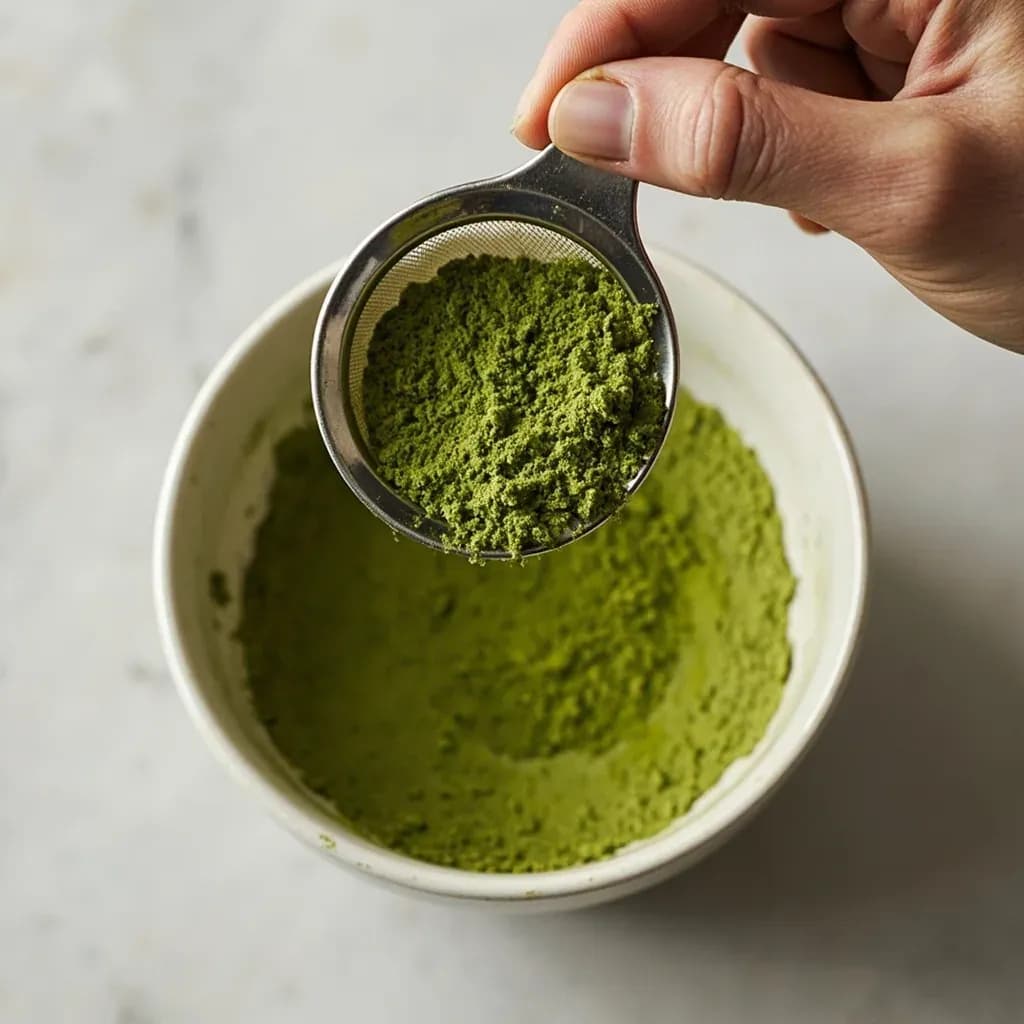
Pushing matcha powder through a fine sieve to break up clumps before whisking.
Sifting matcha presses the fine green tea powder through a small mesh sieve to break up the clumps that form as the delicate powder compacts, ensuring it disperses smoothly. Lump-free matcha whisks into a lush, even froth without gritty bits, which is essential for a proper bowl of usucha or koicha. It is a quick but important first step in the tea ceremony and in matcha baking.
Sifting matcha is the practice of pushing the powdered tea through a fine-mesh sieve or traditional furui before it meets water. Matcha is ground to very fine particles, but those particles are also slightly hygroscopic and electrostatically clingy, so even a fresh tin develops micro-clumps, and an open tin develops visible lumps. Passing the powder through a screen breaks those clumps apart and aerates the mound so it falls into the bowl as a soft, even pile rather than a compacted mass.
The step matters because matcha is consumed largely as a suspension, not a true solution. Any clump that survives sifting will sit stubbornly in the bowl no matter how vigorously you whisk, and it will register as a gritty speck in the mouth. Sifted matcha also foams more readily, because the aerated mound incorporates air faster when the chasen breaks the surface, and it disperses more evenly into cold milk or iced water, where clumps have no thermal energy to break down on their own.
In a Japanese tea ceremony, sifting is a built-in gesture before whisking — typically handled by tipping the chashaku of matcha through a small bamboo-rimmed furui resting across the chawan. Outside the ceremony, the technique is identical in principle: any clean, dry fine-mesh strainer (around 100 mesh, with openings in the 100–150 micron range) will do the job in a few seconds.
- Difficulty
- Easy
Types & varieties
Matcha passed once through a fine-mesh sieve or furui — the everyday approach for usucha and most drinks.
Sifting twice through the same or a progressively finer mesh; reserved for koicha and very refined ceremonial preparations where the paste must be perfectly smooth.
The traditional method using a small bamboo-rimmed tea sieve held over the chawan, tapping gently to drop the powder in.
Sifting a larger quantity at once into an airtight tin so individual servings stay clump-free day to day.
Working stubborn clumps through the mesh with the back of a chashaku, small spoon, or soft brush instead of tapping.
How to do it
- 1
Set up over the vessel
Hold a clean, dry fine-mesh sieve or furui directly over your chawan, mixing bowl, or drinking cup. A furui resting across the rim of a chawan is the traditional setup; a kitchen strainer can be held or rested on a wider vessel.
- 2
Add the matcha
Measure 1–2 scoops (about 2–4 g) of matcha powder and place it into the sieve. Use a chashaku, small spoon, or the scoop that came with your tin. If sifting into a storage tin, add the full quantity you want to pre-batch.
- 3
Sift with a gentle tap or brush
Tap the side of the sieve lightly with your finger or the handle of a spoon, or use the back of a chashaku or a soft brush to guide the powder through in a soft, even shower. Work the powder from the edges toward the center so the sieve clears evenly.
- 4
Deal with stubborn clumps
If lumps remain on top, press them gently against the mesh with the back of a spoon to break them up, or tap a little harder. Discard any hard, pebble-like pieces that refuse to break down — they are moisture-hardened and will not dissolve in the cup.
- 5
Optional second sift for ceremonial use
For koicha or a particularly refined usucha, sift the powder a second time through the same or a finer sieve. The result should look like a fine, even mound of velvet-textured powder with no visible granules.
- 6
Proceed immediately to whisking
Whisk or stir the sifted matcha right away so it does not reabsorb moisture from the air. Add your water (or milk) and whisk in the usual manner — you will notice smoother dispersion and a more stable layer of crema on top.
Why matcha clumps in the first place
Even premium ceremonial matcha is sold with a small portion of inevitable micro-clumps. The powder is produced by stone-milling tencha leaves into particles typically in the 5–15 micron range, and those particles carry trace moisture and a slight static charge. In a sealed tin this is mostly invisible; once the tin is opened and exposed to ambient humidity, the clumps grow and harden. Sifting is the fix because there is no other step downstream — not whisking, not adding hot water, not blending — that reliably breaks a moisture-hardened lump back down. The sifter also aerates the powder, lightening the mound so it dissolves faster.
- Matcha particles are hygroscopic — they pull moisture from the air and clump readily once a tin is opened.
- Hard, pebble-like lumps are usually moisture-hardened and will not dissolve even with vigorous whisking; they should be discarded.
- Sifting is the only step in matcha prep that addresses clumps directly; whisking addresses dispersion of already-fine powder.
Furui vs. kitchen fine-mesh strainer
A traditional furui is a small, shallow sieve (roughly 7–9 cm across) with a bamboo or wooden rim and a fine stainless-steel mesh. It is sized to rest comfortably across the rim of a chawan and to hold a single serving of matcha without spillage. A kitchen fine-mesh strainer is larger and deeper, which means more powder can be processed at once but also more chance of spillage over a small bowl. Functionally, for everyday use — including most barista work — a standard kitchen strainer of roughly 100 mesh (about 100–150 micron openings) performs identically. The furui is a nicety for ceremony and for cooks who appreciate the unbroken visual flow of the tradition.
- Furui: 7–9 cm wide, shallow, designed to sit on a chawan rim — best for single servings and ceremony.
- Fine-mesh kitchen strainer: larger and deeper, more efficient for batch sifting into a tin.
- Mesh specification matters more than the tool itself — anything coarser than about 100 mesh will let small clumps pass through.
- Keep whichever you use dedicated to dry powders; residual coffee or cocoa will muddy matcha's flavor.
Common uses
Tips & pitfalls
- Always sift ceremonial- and premium-grade matcha; culinary-grade can sometimes be skipped when it is going straight into a wet batter.
- Tap the side of the sieve gently — pressing clumps through with your finger compacts them rather than breaking them up.
- Discard hard, pebble-like clumps rather than forcing them through; they will not dissolve in the cup and will register as grit.
- Sift directly into the chawan or mixing cup to avoid losing powder on the counter.
- For lattes, sift into the dry cup before adding milk — once liquid is in, surface clumps are very hard to fix.
- Pre-sift a week's worth into a small airtight tin if you drink matcha daily; it pays for itself in time saved and consistency gained.
- Avoid sifters with coarse or decorative mesh — they let clumps pass straight through and give you no benefit.
- If your matcha has been stored for a while or exposed to humidity, sift even if the brand claims it is clump-free.
- Use a dry sieve — any moisture will cause the matcha to stick to the mesh and clog it.
Good to know
- Technique type
- Dry preparation step performed immediately before whisking
- Traditional tool
- Furui — a small bamboo- or wooden-rimmed sieve with fine stainless-steel mesh
- Common substitute tool
- Fine-mesh stainless-steel strainer, roughly 100 mesh (about 100–150 micron openings)
- Typical time
- 10–20 seconds per serving
- Standard quantity
- 1–2 scoops (chashaku), about 2–4 g of matcha (≈2 g per scoop)
- Effect on the drink
- Smoother texture, better crema/foam, more uniform color and flavor
- Origin
- Japanese tea ceremony (chanoyu) practice, paralleled by broader East Asian powder-sifting traditions
- Where it matters most
- Usucha, koicha, lattes, iced matcha, and any drink where texture is on display
- Where it matters less
- Wet batters and baked goods where matcha is bloomed in liquid and cooked
Also called
Matcha Sieving
Related

Whisk
Beat ingredients smooth and aerated with a looping wire motion

Sift
Pass dry ingredients through mesh to aerate and remove lumps

Strain
Pour through mesh to separate solids from liquid for a smooth result

Filter
Pass liquid through fine material to clarify out the smallest particles

Rice
Press cooked potatoes through small holes for fluffy, lump-free texture

Mash
Crush soft cooked food into a rustic, creamy purée

Grind
Crush food into a coarse to fine texture, from spices to meat

Grate
Shred food into fine bits against a sharp-toothed surface