Prep & Assembly
Meatball Rolling
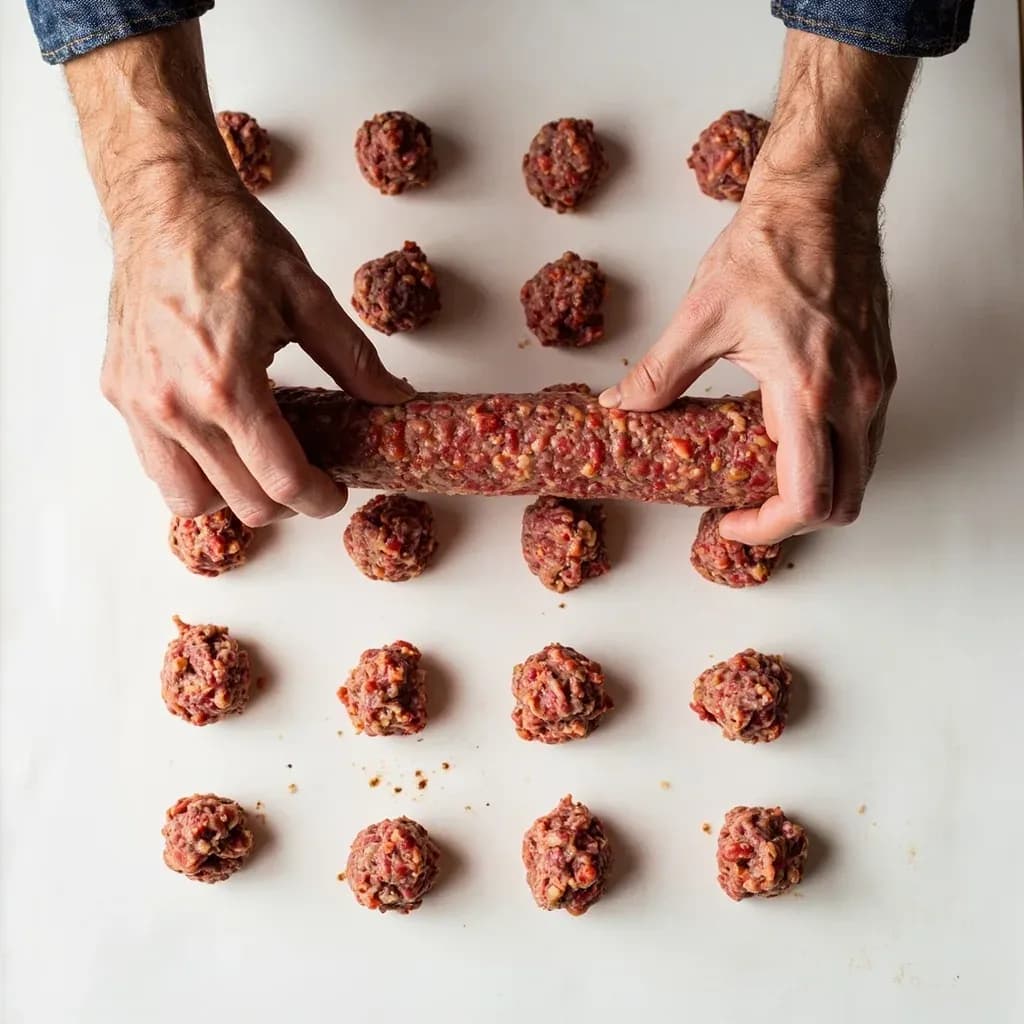
Shaping seasoned ground meat into uniform balls or onto skewers by hand.
Meatball rolling forms a bound, seasoned meat mixture into even spheres (or molds it onto skewers as for koobideh) so they cook uniformly and hold together. Gentle handling keeps them tender, while wet hands prevent sticking. Consistent size ensures every piece reaches doneness at the same time.
Meatball rolling is the hand-shaping step that turns a bowl of seasoned ground meat into a tray of uniform spheres (or, in the kofta tradition, smooth cylinders on a skewer). It is the bridge between mixing and cooking, and it decides more about the final result than most cooks realize: a uniformly portioned, gently rolled ball cooks through at the same rate, sears evenly, and presents identically from the first plate to the last. A batch of lopsided, over-compressed balls will brown on one side, stay raw in the center, and break apart when the pan is jostled — failures that almost always trace back to the rolling stage rather than the recipe.
The craft rests on three simple principles. Cold fat and a hydrated binder (egg, panade, or soaked bread) make the mixture firm and cooperative; warm, loose meat sticks to the hands and refuses to close up. Uniform portioning — by scoop or scale — is the single biggest predictor of even cooking, far more important than how pretty each ball looks. And a light touch preserves the air you've already incorporated: over-rolling drives that air out and produces the dense, rubbery texture that gives meatballs a bad name. Get those three things right and the rolling itself is fast, clean, and forgiving.
The same hand motion travels across cuisines almost without change. Italian polpette, Swedish köttbullar, Greek keftedes, Chinese lion's head, and Dutch bitterballen all begin with the same gesture — portion, wet hands, cup, rotate — and differ mainly in size, binder, and what happens after the ball leaves the palm.
- Difficulty
- Easy
Types & varieties
1.5–2 in / 40–55 g; bound with bread soaked in milk, Parmigiano, parsley, and egg; often pan-fried then finished in sauce.
Small, about 1 in / 25 g; bound with breadcrumbs and cream, pan-fried in butter until deeply browned.
15–20 g; baked or simmered in sauce for buffets, often glazed with combinations like grape jelly and ketchup or Swedish-style lingonberry sauce.
Seasoned with mint and oregano, sometimes crumbled with feta; rolled and shallow-fried in olive oil.
Rolled into small balls or, more traditionally, shaped onto skewers as elongated cylinders using the same hand motion.
Oversized at 100–170 g; made from coarse-chopped pork rather than finely ground, rolled loosely so they stay tender through long braising.
Spanish and Latin American versions, typically rice- or bread-bound, simmered in a tomato or broth-based sauce.
After shaping, the meat is chilled, rolled in flour, egg, and breadcrumbs, then deep-fried until the crust shatters.
How to do it
- 1
Mix and chill the base
Combine ground meat with binder, aromatics, and seasoning only until the ingredients are evenly distributed — overmixing develops myosin and toughens the result. Cover and refrigerate 15–30 minutes, until the mixture firms to about 35–40 °F / 2–4 °C. Cold mixture is far easier to portion and far less sticky on the hands.
- 2
Set up your portioning station
Line a rimmed sheet pan with parchment. Place a kitchen scale, portion scoop, or measuring spoon beside the mixing bowl. Fill a second small bowl with cold water for dipping hands, or set out a small dish of neutral oil. Decide on a target weight (e.g., 30 g for standard, 15 g for cocktail) and stick to it.
- 3
Portion the mixture
Scoop or weigh each piece so every ball starts the same size; this is the single biggest factor in even cooking. Place portions on the parchment in rows rather than shaping as you go — uniform blanks are faster to roll and easier to count.
- 4
Wet or oil your hands
Dip your palms in the cold water and shake off the excess, or rub a thin film of neutral oil across both hands. Rewet every 3–4 balls, or whenever the meat begins grabbing at your skin.
- 5
Roll between cupped palms
Pick up one portion. Cup both hands together and rotate gently, using light pressure — think of polishing a marble, not squeezing a stress ball. The motion should be 4–6 quick rotations. The ball is ready when the surface is smooth and free of cracks.
- 6
Check for cracks and seams
Inspect each ball. If you see fissures, press gently to close them — cracks open further during cooking and let fat escape. Set finished balls on the parchment in a single layer, not touching.
- 7
Rest before cooking
Let the rolled balls rest in the refrigerator for 10–15 minutes (or freeze 15–20 minutes for very soft mixtures). This firms the surface so they hold their shape during searing or transfer to sauce.
- 8
Cook or store
Pan-sear, bake at 400 °F / 200 °C for 12–18 minutes depending on size, or simmer directly in sauce. To freeze, arrange raw balls on the parchment-lined pan, freeze until solid (about 1 hour), then transfer to a freezer bag; cook from frozen, adding a few extra minutes.
Sizing and yield logic
Size is a design decision, not a default. Smaller balls (15–25 g) sear fast, are easy to portion for buffets, and stay tender without long cooking — ideal for party service or Swedish-style plating with cream sauce. Medium balls (30–45 g) are the workhorse: they brown in a pan in about 8 minutes, finish in sauce without drying out, and fit cleanly on a sub roll or nest of pasta. Large balls (100 g and up) are built for slow, wet cooking — braising or simmering in covered sauce — and should be rolled loosely, almost patty-style, so the interior stays silky rather than compacted.
- Choose cocktail size (15–20 g) for sauces that glaze or for skewered service.
- Choose medium (30–45 g) for pan-fry or bake-and-serve applications.
- Choose large (100 g+) only when the ball will braise or simmer for 20+ minutes.
- If a recipe doesn't specify size, weigh your first ball and scale the rest from that reference.
Shaping onto skewers (kofta and seekh)
The rolling motion is identical to ball-shaping, but the geometry is cylindrical and the skewer runs through the center. Portion slightly larger pieces (50–60 g) so the meat has enough bulk to grip the skewer. Wet hands, then roll the portion between cupped palms into a smooth log. Thread the skewer through the center and smooth the seam where the meat meets the metal with damp fingertips; this prevents the kofta from splitting along the length during grilling.
- Soak wooden skewers for 30 minutes before shaping to prevent splitting.
- Press the meat firmly enough to adhere to the skewer but lightly enough to stay tender.
- Leave 1 in / 2.5 cm of skewer exposed at each end for handling on the grill.
- Rest shaped kofta in the refrigerator for 15 minutes so they hold their form over open flame.
Common uses
Tips & pitfalls
- Portion first, shape second: use a #24 scoop (about 30 g) or weigh on a scale so every ball cooks in the same time.
- Chill the mixture for 15–30 minutes before rolling; cold fat and hydrated binder make the meat less sticky and more cooperative.
- Keep a bowl of cold water beside you and dip your hands between every few balls; dry hands drag meat off the surface, one of the most common shaping mistakes.
- Use a light touch: over-compressing drives out air and yields tough, rubbery meatballs. Toss gently between cupped palms rather than squeezing.
- Test-cook one meatball before committing the batch — adjust salt, binder, or seasoning while the pan is hot.
- Overworking the mixture during mixing is the single biggest cause of dense meatballs; combine only until the ingredients are evenly distributed.
- For uniform browning, space balls at least 1 in / 2.5 cm apart on the sheet pan; crowding steams instead of sears.
- If the mixture is too soft to hold shape, the binder is short; add a tablespoon of fine breadcrumbs, re-chill for 10 minutes, then resume rolling.
Good to know
- Technique family
- Hand-shaping portioned ground meat mixtures into uniform spheres or ovals for even cooking and presentation.
- Typical portion sizes
- Cocktail/party: 15–20 g (about 1 in / 2.5 cm); standard Italian or Swedish: 30–45 g (1.5–2 in / 4–5 cm); large braised (e.g., Chinese lion's head): 115–170 g (3–4 in / 7–10 cm).
- Yield rule of thumb
- 1 lb / 450 g raw ground meat yields roughly 12–20 medium meatballs or 30–40 cocktail-size ones, depending on binder and density.
- Core tools
- Portion scoop (size #20, #24, or #30), kitchen scale, damp or lightly oiled hands, two forks or a melon baller, parchment-lined sheet pan.
- Mixture temperature
- Best rolled at 35–40 °F / 2–4 °C after mixing; chilling firms the fat and binder so balls hold their shape.
- Active time
- 5–10 minutes of rolling per pound once the mixture is mixed and chilled, plus 15–30 minutes of rest before cooking.
- Skill level
- Beginner; consistency comes from portioning first and shaping second, not from hand skill.
- Cultural scope
- Practiced in nearly every cuisine with ground meat — Italian polpette, Swedish köttbullar, Greek keftedes, Middle Eastern kofta, Chinese lion's head, Spanish and Latin American albóndigas, Dutch bitterballen, and the American meatball.
Also called
Meatball Rolling (Rista Shaping) · Molding Ground Meat onto Skewers (Koobideh)
Related

Whisk
Beat ingredients smooth and aerated with a looping wire motion

Sift
Pass dry ingredients through mesh to aerate and remove lumps

Strain
Pour through mesh to separate solids from liquid for a smooth result

Filter
Pass liquid through fine material to clarify out the smallest particles

Rice
Press cooked potatoes through small holes for fluffy, lump-free texture

Mash
Crush soft cooked food into a rustic, creamy purée

Grind
Crush food into a coarse to fine texture, from spices to meat

Grate
Shred food into fine bits against a sharp-toothed surface