Heat & Fire
Oven Turning
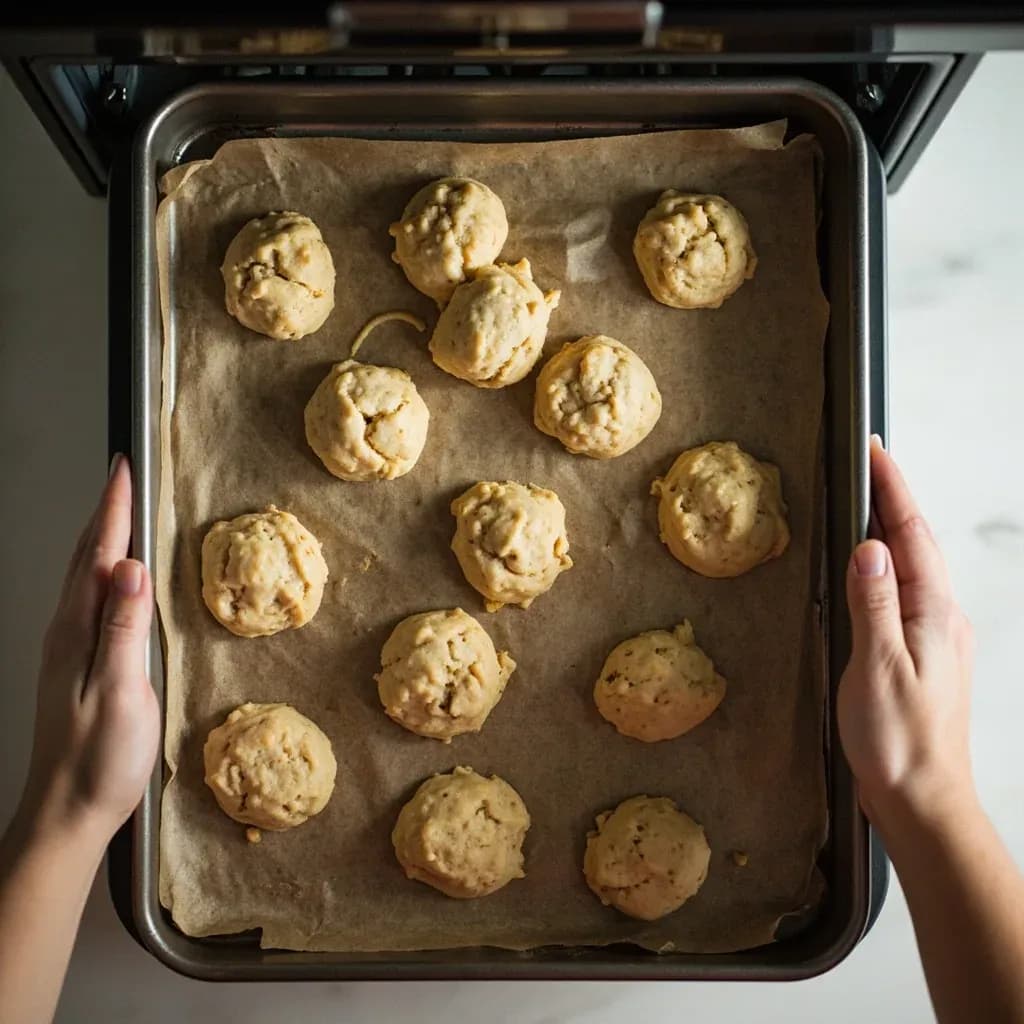
Rotating trays and racks midway through baking to counter oven hot spots for even results.
Oven turning is the routine of rotating pans front-to-back and swapping rack positions partway through baking so all items receive equal heat. Home ovens heat unevenly, so without turning, cookies, cakes and breads brown faster on one side. It is a simple habit that makes batch baking far more consistent.
Oven turning is the practice of rotating sheet pans, cake pans, or rack positions partway through baking to compensate for the uneven heat distribution that plagues conventional ovens. In a typical home oven, the back wall runs hotter than the front, the top rack browns faster than the bottom, and the corners nearest the bake element can scorch while the opposite side stays pale. A 180-degree turn at the halfway mark puts every edge of the pan through the same thermal journey, evening out color, rise, and doneness without changing the recipe or the oven itself.
The technique is essentially a manual version of what a convection fan does mechanically. In a fan oven, moving air smooths out the temperature map; in a still oven, the only way to neutralize a hot spot is to physically move the food through it. It costs nothing, requires no equipment beyond an oven mitt and a sense of timing, and is the single most effective fix for an oven that browns unevenly. Bakers have done it for centuries, long before the invention of the fan, and professional pastry shops still rotate sheet pans even in high-end deck ovens.
The one thing rotation does not do is correct a miscalibrated thermostat. If your oven reads 25°F off the dial, fix that with an oven thermometer first; rotation is a spatial correction, not a temperature correction. Used alongside proper rack placement and a quick test bake to map the hot zones, it transforms the most uneven home oven into a reliably consistent baking environment.
- Difficulty
- Easy
Types & varieties
Spinning or turning a single sheet pan 180° in place on the same rack — the most common form.
Moving trays between upper and lower racks, front to back, for two-tray bakes where both pans need to spend equal time in the hot top and cooler bottom zones.
Some bakers rotate 90° at every check-in to even out hot corners, useful in small countertop ovens with strong side-wall heat.
In true convection or fan ovens, the moving air largely neutralizes hot spots, so the turn is often unnecessary — though still helpful for thin sheet-pan bakes.
How to do it
- 1
Map your oven's hot spots
Before relying on rotation, find where your oven actually runs hot. Lay a sheet pan covered with slices of plain white bread at 350°F/175°C and watch how it browns. The darkest patches reveal the hot zones. Mark them mentally, or stick a small piece of tape on the oven wall as a reminder, so you can plan tray placement and know which way to turn.
- 2
Position trays for the bake
Set racks to the upper-middle and lower-middle thirds for two-tray bakes, or to the center for a single tray. Center the pan on the rack and leave at least an inch of clearance on all sides so air can circulate. Avoid pushing pans flush against the walls or the very back of the oven, where radiant heat is strongest.
- 3
Bake to the halfway mark
Run the bake as written until the timer hits roughly 50% of total time. Resist the urge to open the door for a peek before that point — cold air drops oven temperature fast and can sink cake batters, deflate soufflés, and set back the rise of delicate sponges.
- 4
Pull and rotate
Open the door, pull the rack out 3–4 inches, and turn the pan 180° so the front edge becomes the back. For two trays, also swap the upper tray to the lower rack and vice versa, and turn each pan front to back. Move deliberately and close the door gently — a hard slam can deflate a génoise or a risen cake.
- 5
Finish and check doneness
Return to the recipe's original doneness test at the end of the bake: color, touch, or internal temperature. One turn is usually enough, though very large half-sheet pans in a small oven can benefit from a second quarter-turn near the end. If the bake still looks lopsided, the oven is telling you it needs an oven-thermometer check, not another rotation.
Why Ovens Run Uneven
A conventional oven is heated by a single bake element at the bottom and a broiler at the top, both of which radiate more heat to the surfaces closest to them. The back wall, which sits nearest the element housing and the rear of the cavity, typically runs hotter than the front. The door, opened repeatedly during preheat and loading, stays cooler and radiates chill back onto whatever sits in front of it. Sheet pans placed against the side walls catch reflected heat; pans near the center sit in cooler, stiller air. The result is a thermal map, not a uniform temperature, and a cookie sheet parked in the back-left corner will brown faster in that corner than in the front-right. A 180° turn at the halfway mark swaps those corners and lets the slower side catch up.
Rotation vs. Convection
A convection oven's fan circulates hot air across the cavity, smoothing the thermal map so that any point on a pan sees roughly the same temperature as any other. That mechanical mixing makes a mid-bake turn less critical, though not always unnecessary for sheet-pan items. In a still oven, you are the fan: every rotation is a small dose of the even coverage that convection provides automatically. The two are not perfectly equivalent — a true fan also strips heat from the food surface, which is why most recipes drop the temperature 25°F in convection mode — but they address the same underlying problem from opposite sides. Bake often in a still oven and rotation becomes reflex; bake in convection and you can rotate less, but still do it for thin, fast items where the door-open time costs you heat.
Common uses
Tips & pitfalls
- Map your oven once with a test bake of white bread slices at 350°F/175°C — the brown pattern shows you exactly which way to turn and where to place the pan.
- Rotate at the halfway mark, not the start. Opening the door in the first third of the bake can sink cakes and deflate batters, and you will not have gathered enough heat for the cold air to even out.
- Front-to-back is usually the most important axis; the back wall runs hotter in most ovens, so a 180° turn does more work than a 90° quarter-turn.
- For two-tray bakes, stagger the pans on the upper and lower thirds rather than crowding one rack, then rotate and swap at the halfway mark so each tray spends equal time in the hot top and the cooler bottom.
- Keep the door open as briefly as possible — pull the rack out a few inches, turn, and slide it back in under 10 seconds. Holding the door open past 20–30 seconds can drop cavity temperature noticeably.
- Calibrate with an oven thermometer before relying on rotation timing; a 25°F thermostat error will not be fixed by turning the pan, only by adjusting the dial.
- Do not slam the oven door on rotation. A hard close sends a pressure pulse into the cavity that can deflate génoise, soufflés, and other delicate batters mid-rise.
- For thin, fast bakes such as tuiles, lace cookies, and crackers, rotate at the one-third mark rather than halfway — by the two-thirds mark the hot side is already overbrowned.
Good to know
- Also called
- Rotating the pan, halfway rotation, mid-bake turn
- Purpose
- Counteract oven hot spots for even browning and consistent bake
- When to apply
- Roughly halfway through the bake time
- Typical motion
- 180° pan turn; swap top-to-bottom for two-tray bakes
- Door-open time
- Keep under 20–30 seconds to avoid losing oven temperature
- Best for
- Cookies, sheet cakes, pastry, flatbreads, sheet-pan vegetables
- Less needed for
- Long braises, deep Dutch-oven roasts, true convection bakes
- Difficulty
- Beginner — attentiveness over skill
Also called
rotating the oven · tray turning
Related

Sear
Blast the surface hot for a deep-browned, savory crust

Sauté
Cook quickly in a little fat over lively heat, tossing as you go

Stir-Fry
Toss bite-sized pieces over roaring heat for fast, smoky cooking

Pan-Fry
Crisp food in a shallow layer of hot fat, turning once or twice

Deep-Fry
Submerge in hot oil for an all-over crackling crust

Roast
Cook uncovered in dry oven heat for browned edges and tender centers

Bake
Cook with steady, surrounding oven heat — the soul of bread and pastry

Broil
Hit food from directly above with fierce overhead heat