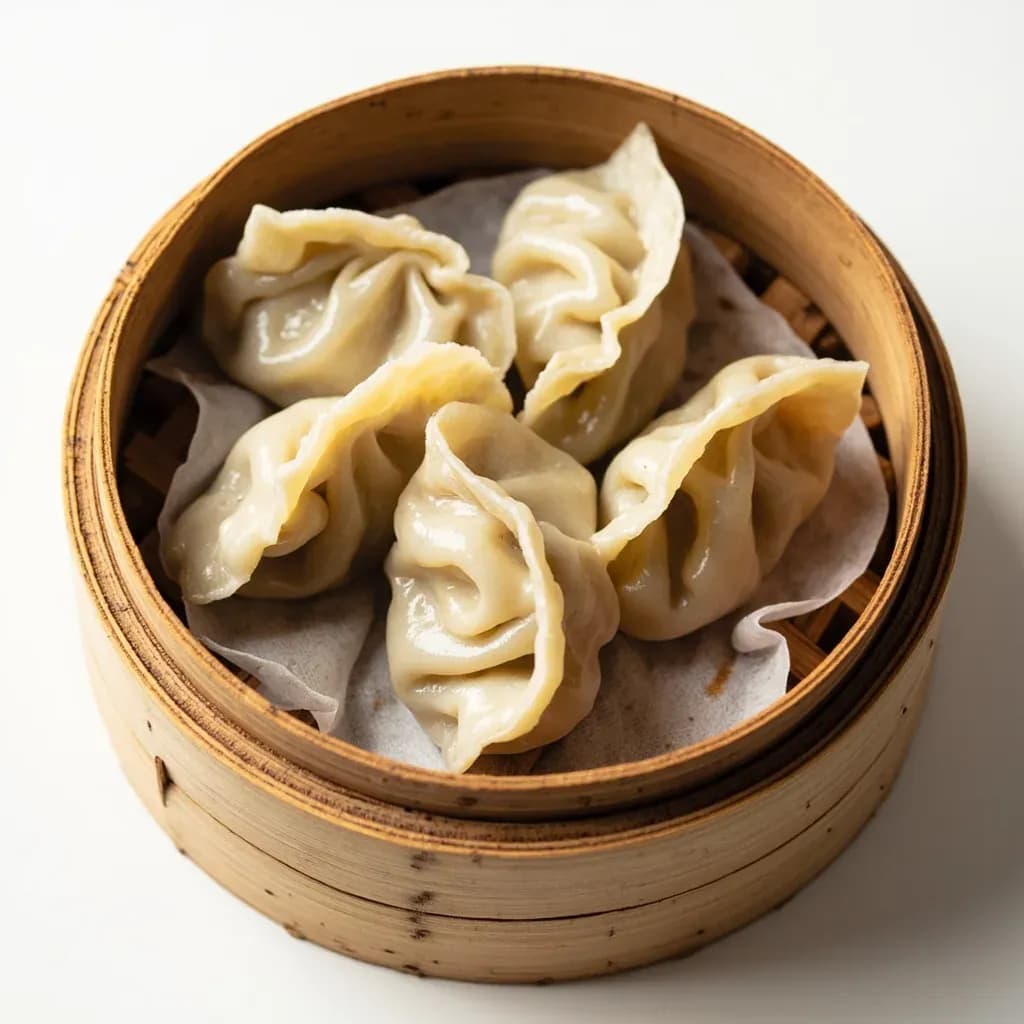
Water & Steam
Par-Steaming (Hold and Re-Steam)
Steaming food partway, holding it, then finishing with a second steam to cook to order.
Par-steaming steams dumplings, buns or vegetables until partly cooked, then cools and holds them so a quick second steam can finish them fresh on demand. It is a prep technique used in busy kitchens and dim sum service to keep items ready without overcooking. The two-stage steam preserves texture and lets a station serve hot, just-finished food quickly.
Par-steaming is a two-stage steam cook that decouples production from service. Food is steamed partway to set structure, cooled fast, held (cold or hot), then given a short finishing steam before it goes out. It is the workflow behind the dim sum cart, the synchronized banquet "all tables up" moment, and any high-volume kitchen that has to turn out identical plates of steamed food on demand.
The technique matters because steam is unforgiving of timing — most filled or starch-bound items go from perfect to overdone in a window of one to three minutes. Par-steaming widens that window to hours, letting a small kitchen produce the volume of a large one. The trade-off is that the item takes two heat cycles, so the first steam must be deliberately incomplete (roughly 70–80% done) and the cooling fast enough to stop carryover cooking. Get either variable wrong and the re-steam cannot rescue a soggy wrapper, a gummy dumpling skin, or a collapsed bun.
Behavior on the second pass is predictable once you understand it. Starches and proteins keep setting from residual heat during cooling, so a par-steamed item almost always finishes a little further along than the cook measured at the end of stage one. Translucent starch wrappers — har gow (wheat-starch) and cheung fun (rice-flour) — are the most sensitive; they gelatinize and turn gummy if held warm and wet. Wheat-flour wrappers (bao, siu mai) tolerate holding better. Leafy greens benefit most because the first steam sets the color and the second is short enough to keep the stem crisp.
- Difficulty
- Medium
Types & varieties
Classic Chinese banquet and cart service: bao, har gow, siu mai, lo mai gai, and cheung fun steamed about 70–80% done in batch, then finished à la minute as orders come in.
Tough greens (choy sum, gai lan, Chinese broccoli) or roots (lotus root, taro) partially steamed, shocked, and finished to order to retain vivid color and crisp stem.
Stuffed peppers, tofu, eggplant, and mushroom caps filled and pre-steamed, then re-steamed with sauce at service to meld flavors and reheat through.
Sticky rice and rice-flour cakes (nian gao, lo bak go / turnip cake) steamed until set, chilled to slice cleanly, then re-steamed or pan-fried before serving.
Wedding and banquet halls pre-cook proteins, dumplings, and starches in steam, hold on sheet pans, and finish in stacked steamers for synchronized plating across dozens of tables.
Modernist hybrid: vacuum-sealed protein cooked low-temperature, then finished with a short steam to reheat, set the skin, or revive a glaze.
How to do it
- 1
Stage and portion
Portion the item (filling weight, dough size, vegetable cut) exactly as it will be served. Uniform size is the single biggest factor in a clean re-steam finish — a mixed batch will have some pieces ready and some still cool in the center.
- 2
First steam (par-cook)
Steam over a rolling boil until the item is about 70–80% done: wrappers set and turn translucent, fillings firm up, starches gelatinize, but the center is still slightly underdone. Typical times: bao 8–10 min, har gow 3–4 min, siu mai 5–6 min, stuffed vegetables 6–10 min, rice cakes 30–40 min. Pull by feel and by internal temperature, not by the clock.
- 3
Rapid cool
Pull trays and cool on a rack, blast-chill, or pass through an ice bath for items that will be held cold. Spread in a single layer; do not stack while hot. Target an internal temperature below 4 °C / 40 °F within about 90 minutes — a tightened version of the two-stage cooling rule, used to halt carryover cooking as well as meet food-safety guidelines.
- 4
Hold
Cover with parchment or a clean dry towel (not sealed plastic touching the food) and refrigerate, or transfer to a hot-hold cabinet at 63 °C / 145 °F. Most filled dim sum holds 24 h cold; rice cakes and dense starches hold 2–3 days.
- 5
Order and portion for service
Pull only what is needed for the next service window. Cold-held dumplings can be spaced on a lightly oiled perforated tray; bring to room temperature for 10–15 min if very cold, so the re-steam heats evenly and the wrappers do not stay gummy in the center.
- 6
Re-steam to finish
Steam over a hard boil, lid on, until the item is piping hot (at least 75 °C / 165 °F at the center) and the wrapper is glossy and pliable. Expect 2–4 min for dumplings, 4–6 min for stuffed buns, 6–8 min for stuffed vegetables. Test one piece before committing the whole batch.
- 7
Serve immediately
Plate and serve within 1–2 min. A finished re-steamed bun left sitting in the steamer continues to cook and will collapse; pull the entire tray the moment the test piece reads ready.
Where par-steaming fails
Two variables decide success more than any other, and both are easy to underestimate in a busy service. The first is the doneness target of the par-steam. A cook who treats the first pass as a complete cook will hand the re-steam a finished item, and finished items cannot survive a second heat cycle without turning soft, gummy, or collapsed. The second is the speed of cooling. Steam-set starches and proteins keep cooking from residual heat for several minutes after the tray comes out; a stacked, covered tray continues to set the center long after the wrapper looks right, so the item arrives at the holding cabinet more cooked than the cook intended.
Both failures share a single fix: measure the center temperature at the end of stage one, not the appearance of the wrapper, and pull the tray the moment the interior reaches roughly 80% of its final target. Then cool in a single layer on a rack, with a blast chiller or ice bath for filled dumplings whose center must drop below 4 °C / 40 °F within about 90 minutes — a tightened version of the standard two-stage cooling rule, used here to halt carryover cooking as well as control pathogens.
- Treat the first steam as 70–80% of total cook time; the re-steam is finish, not rescue.
- Pull by internal temperature when possible — typically 80–85 °C / 175–185 °F at the center for filled buns, lower for small dumplings.
- Cool in a single layer on a rack; never stack hot trays or the centers overcook from retained heat.
- Cold-hold covered with parchment or a clean towel, not sealed plastic, which traps condensation and wets dumpling skins.
- Hot-hold at 63 °C / 145 °F minimum, and keep the hold window short — long hot-hold dries out bao and toughens dumpling skins.
Common uses
Tips & pitfalls
- Undercook the first steam by 20–30% — the re-steam finishes the job. A fully cooked first pass turns to mush on round two.
- Cool the par-steamed item fast (blast chill or ice bath, especially for filled dumplings) so residual heat does not overcook the wrapper or the center of the filling.
- Hold covered with parchment or a dry towel, not plastic wrap touching the food — trapped condensation wets dumpling skins and ruins pleating.
- Keep hot holds above 63 °C / 145 °F and re-steam only briefly; long hot-hold dries out buns and toughens dumpling skins.
- Re-steam over rapidly boiling water, not a gentle simmer, so the second pass takes only 2–4 min for most filled items.
- Work fast between stages for translucent starch wrappers — har gow (wheat-starch) and cheung fun (rice-flour) gelatinize and turn gummy if held warm and wet too long.
- Do not par-steam leafy herbs (cilantro, Thai basil) or delicate fish — they cannot survive two heat cycles and will turn to mush.
- Brush bao and buns lightly with neutral oil or a thin starch glaze before the second steam to restore the glossy, just-made sheen.
Good to know
- Also called
- Par-cooking by steam; hold-and-resteam; blanch-steam; dim sum pre-steam
- Primary cuisines
- Chinese (dim sum and banquet), South Indian tiffin, modern banquet and catering production
- Typical cold hold
- 0–4 °C / 32–40 °F, covered, up to 24–48 h for most filled items
- Typical hot hold
- 63 °C / 145 °F or above (HACCP hot-hold minimum)
- Re-steam time
- 2–8 min depending on size and density; 2–4 min for dumplings, 4–6 min for stuffed buns
- Best for
- Stuffed buns (bao), dumplings (har gow, siu mai), rice rolls (cheung fun), stuffed vegetables, rice-flour cakes, blanch-then-finish greens
- Equipment
- Bamboo or metal steamer, perforated tray, blast chiller or ice bath, low-temp holding cabinet
- Difficulty
- Intermediate — timing and cooling speed are the deciding variables
Also called
pre-steaming · two-stage steaming · re-steaming
Dishes that rely on it
Related

Boil
Cook in vigorously bubbling liquid at full rolling heat

Simmer
Hold liquid at a gentle shimmer for tender, unhurried cooking

Poach
Cook gently in barely-trembling liquid for silky, tender results

Steam
Cook in rising vapor to keep color, nutrients, and shape intact

Blanch
Plunge briefly in boiling water, then shock cold to lock color

Braise
Sear, then cook slow in a little liquid until fall-apart tender

Stew
Simmer bite-sized pieces fully submerged into a rich, unified pot

Sous-Vide
Seal and cook in precise warm water for edge-to-edge doneness