Prep & Assembly
Pâté & Terrine Building
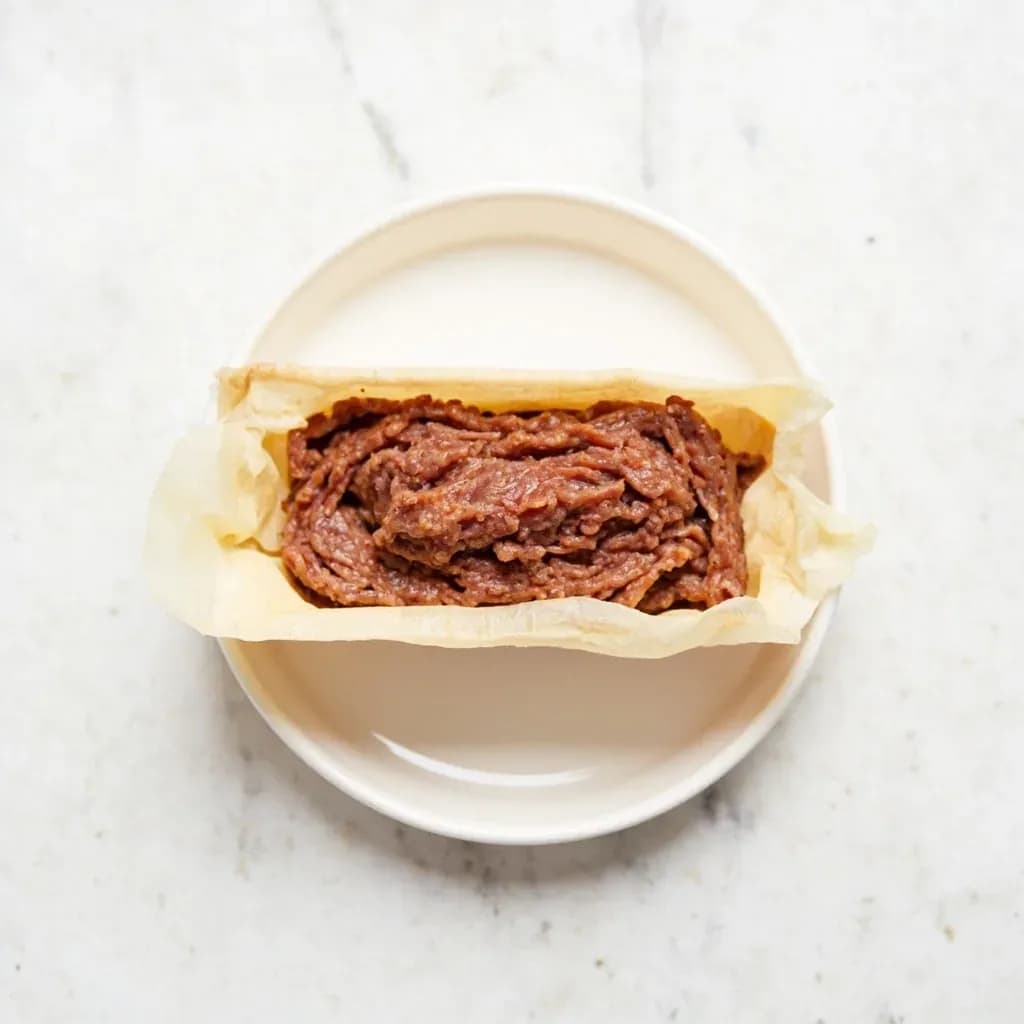
Layering and packing seasoned forcemeat into a mold for sliceable charcuterie.
Pâté and terrine building combines ground or chopped meats, fat, seasonings, and often a panade or garnish into a forcemeat, then packs it into a lined mold and cooks it gently, usually in a water bath. The mixture sets as it cools, yielding a firm, sliceable loaf. Careful fat ratio and even layering give a smooth bind and an attractive cross-section.
Pâté and terrine building is the craft of turning raw seasoned meat — typically a balance of liver, lean muscle, and fat — into a dense, sliceable cold loaf that holds together on the plate and develops deep flavor over several days in the refrigerator.
The work happens in three phases: assembling a well-seasoned forcemeat, packing it firmly into a lined mold with any desired internal garnishes, and cooking it gently in a water bath before pressing and resting it under weight. Done properly, the technique rewards patience: the proteins relax, the fat sets, and what began as a loose raw mixture becomes a unified, cleanly slicing centerpiece of the cold table.
The method is one of the more forgiving entries in classical charcuterie because temperature and timing, rather than knife work or hand-skills, govern success — a probe thermometer and an overnight rest will carry most cooks further than any specialized equipment.
- Difficulty
- Hard
Types & varieties
Coarse country-style forcemeat of pork shoulder, belly, and liver, often studded with green peppercorns, pistachios, and a splash of brandy or wine.
Forcemeat encased in a hot-water pastry crust, traditionally with a decorative interior pattern visible when sliced; served cold.
Whole or roughly chopped duck or goose liver layered with seasoning and Armagnac, gently baked and pressed; the luxury end of the family.
Rabbit, hare, pheasant, or venison versions, often marinated in red wine with juniper, thyme, and bay before grinding.
Stuffed, rolled, poached in stock, and served cold with aspic; classically made with poultry or game.
Boned and stuffed leg or shoulder, tied and braised or roasted; served hot or cold.
Head cheese: whole pieces of pork head meat set in aspic, sliced cold.
Rustic sibling: pork slowly cooked in its own fat until it shreds, then potted; produced by a different method but often grouped with pâté on the board.
How to do it
- 1
Prepare and chill the meats
Cut pork shoulder, belly, fatback, and liver into 1–2 cm cubes. Spread on a tray, cover, and chill until firm-frozen at the edges (about 1–2 hours). Chill the grinder parts, food processor bowl, and terrine mold as well.
- 2
Make the forcemeat
Grind the cubed meat and fat through the coarse die of a meat grinder, or pulse in small batches in a food processor to a coarse paste. Pass the liver separately so it distributes evenly without overworking. Combine in a bowl set over ice, season with salt (around 18 g per kg of meat), pepper, quatre-épices or nutmeg, minced shallot, garlic, and a small measure of brandy, Madeira, or port. For a finer pâté, pass once more through a fine die, or work briefly on an ice-packed bench.
- 3
Test the seasoning and texture
Cook a small quenelle of the forcemeat in a dry pan for about 30 seconds per side and taste. The cold mix should taste slightly more seasoned than you want the final pâté to be — chill dulls salt perception. Adjust salt, spice, and alcohol. The mixture should hold together when pressed but remain loose, never pasty or purée-like.
- 4
Line the mold
Lay thin slices of back bacon or caul fat across the bottom of the terrine mold, then up the long sides, letting the ends overhang so they can fold over the top. Alternatively, line with a strip of parchment for easier unmolding if you are not using a fatty liner.
- 5
Layer the forcemeat and garnishes
Pack a layer of forcemeat into the bottom and corners, then add a row of garnishes — green peppercorns, blanched pistachios, cubes of foie gras, dried apricots, Madeira-soaked strips of truffle, or julienned ham. Cover with another layer of forcemeat and repeat, finishing with a domed top of forcemeat that the overhanging bacon or fat can fold over.
- 6
Cover and prepare the bain-marie
Cover the terrine with its lid, or a double layer of foil if the mold is uncovered. Place in a deep roasting pan and pour in hot water to come halfway up the sides of the mold.
- 7
Bake to target internal temperature
Cook in a preheated oven at 150–160 °C / 300–325 °F until the center reads 68–72 °C / 155–160 °F on a probe thermometer — roughly 1 to 1.5 hours per kilogram. Keep the water bath at a bare simmer; a rolling boil will overcook the edges and crack the mold.
- 8
Press and cool
Remove from the bain-marie, blot any surface fat, replace the lid, and weight the top of the terrine with 2–3 kg of cans or a foil-wrapped brick. Refrigerate under this weight for at least 12 hours, ideally overnight.
- 9
Mature, unmold, and serve
Rest the terrine in the fridge for a further 1–4 days for best flavor. To unmold, run a thin knife around the edges, invert onto a board, peel off the bacon liner, and slice with a hot, wiped knife. Serve with cornichons, mustard, pickled shallots, and toasted country bread.
The logic of the ratio
Country-style forcemeats are built on a 1:3:1 ratio of liver, lean meat, and fat, and that ratio is not arbitrary. Liver supplies deep color, dense mineral flavor, and a small amount of binding protein; lean meat gives structure and the dominant meat taste; fat carries flavor, keeps the texture tender, and provides the moisture that prevents the loaf from drying out in the long cook. Skewing the balance — too much liver and the pâté tastes metallic and crumbly, too little fat and it sets up dry and chalky, too much lean and it slices tough — is the single most common reason a homemade pâté disappoints. Finer pâtés shift the ratio toward lean meat and add a panada (bread soaked in milk or a thick béchamel) or whole eggs as binder, which produces a smoother, almost mousse-like texture suited to small toasts rather than center-of-board slices.
Why pressing and resting matter
Two stages of the process look passive but do most of the structural work. Pressing under weight while the terrine cools squeezes trapped air pockets, compacts the forcemeat against the lining, and forces excess fat and juices to reabsorb rather than pool at the surface. The result is a tight, dense texture that slices cleanly instead of crumbling. The subsequent 2 to 5 days of refrigerated rest allow the salt to fully penetrate, the alcohol and aromatics to mellow and integrate, and the proteins to relax into a firmer, more cohesive set. A pâté eaten the day it is made is edible but flat; the same pâté on day four tastes seasoned, balanced, and finished.
Common uses
Tips & pitfalls
- Chill the meat, grinder, and bowl thoroughly before processing — partially frozen meat cuts cleanly and the forcemeat emulsifies better when cold throughout.
- Season forcemeat on the salty, slightly over-seasoned side before cooking: chill dilutes flavor perception, and a properly seasoned cold mixture guarantees a flat, well-salted final pâté.
- Use a probe thermometer rather than guessing time; overcooking forces out fat and makes the terrine grainy, while undercooking leaves a soft, unstable center that will not slice.
- Line the mold with thin strips of back bacon or caul fat, overlapping the bottom and sides with at least 2–3 cm overhang to drape over the top — this both flavors the pâté and helps release it cleanly from the mold.
- Press the cooked terrine overnight with a weighted board (2–3 kg) in the refrigerator to compact the texture, set the aspic, and make clean slicing possible.
- Allow a true rest of at least 48 hours, ideally 4–5 days, before slicing country-style pâté — the proteins relax, the spices bloom, and the texture firms up considerably.
- Wet a thin knife with hot water and wipe between cuts for clean, non-crushed slices; serve slightly chilled but not ice-cold so the fat softens and the flavor opens.
- Do not pack the forcemeat into a pâté en croûte as densely as a terrine: leave small air pockets so the pastry cooks through without the meat expanding and cracking the crust.
- For a glossy professional finish, pour a thin layer of clarified aspic or reduced stock-gelatin over the top of the cooked terrine before pressing and chilling.
Good to know
- Etymology
- Terrine derives from the French word for the earthenware vessel (terre) in which the forcemeat is cooked; pâté refers to the pasty consistency (pâte) or the pastry crust in which some versions are encased.
- Definition
- A terrine is a seasoned forcemeat cooked in a mold and served cold, sliced. A pâté is a broader category that includes terrines plus preparations wrapped in pastry (pâté en croûte) or simply molded and unmolded.
- Classic forcemeat ratio
- Roughly 1 part liver to 3 parts lean meat to 1 part fatback or pork belly for country-style pâtés; finer pâtés shift toward more lean meat and add a panada or eggs as binder.
- Core equipment
- Terrine mold (earthenware, enameled cast iron, or metal loaf pan), meat grinder or food processor, probe thermometer, bain-marie pan, terrine press or weighted board, and caul fat or thinly sliced back bacon for lining.
- Standard cook temperature
- Oven 150–160 °C / 300–325 °F, in a water bath reaching halfway up the mold; internal target 68–72 °C / 155–160 °F.
- Cooking time
- Approximately 1 to 1.5 hours per kilogram of forcemeat, until the center is just set and a probe reads the target temperature.
- Resting and maturation
- Pressed under weight overnight, then refrigerated a minimum of 24–48 hours; country-style pâtés and pâté en croûte improve markedly after 3–5 days of curing/aging.
- Yield
- A 1.2 kg forcemeat in a standard 1.5 L terrine yields about 10–12 starter portions or 8 main-course slices.
- Storage
- Refrigerated, tightly pressed and wrapped, 7–10 days for cooked pork/liver pâtés; longer for salt-cured country pâtés; can be frozen 2–3 months once fully chilled.
- Difficulty
- Intermediate to advanced. A basic country pâté is accessible; pâté en croûte with a decorative internal pattern is among the more demanding cold-table crafts.
Also called
Terrine Building / Layering
Related

Whisk
Beat ingredients smooth and aerated with a looping wire motion

Sift
Pass dry ingredients through mesh to aerate and remove lumps

Strain
Pour through mesh to separate solids from liquid for a smooth result

Filter
Pass liquid through fine material to clarify out the smallest particles

Rice
Press cooked potatoes through small holes for fluffy, lump-free texture

Mash
Crush soft cooked food into a rustic, creamy purée

Grind
Crush food into a coarse to fine texture, from spices to meat

Grate
Shred food into fine bits against a sharp-toothed surface