Heat & Fire
Slow-Roasting Pernil
Roasting a marinated pork shoulder for hours until the meat is falling-apart tender with crisp skin.
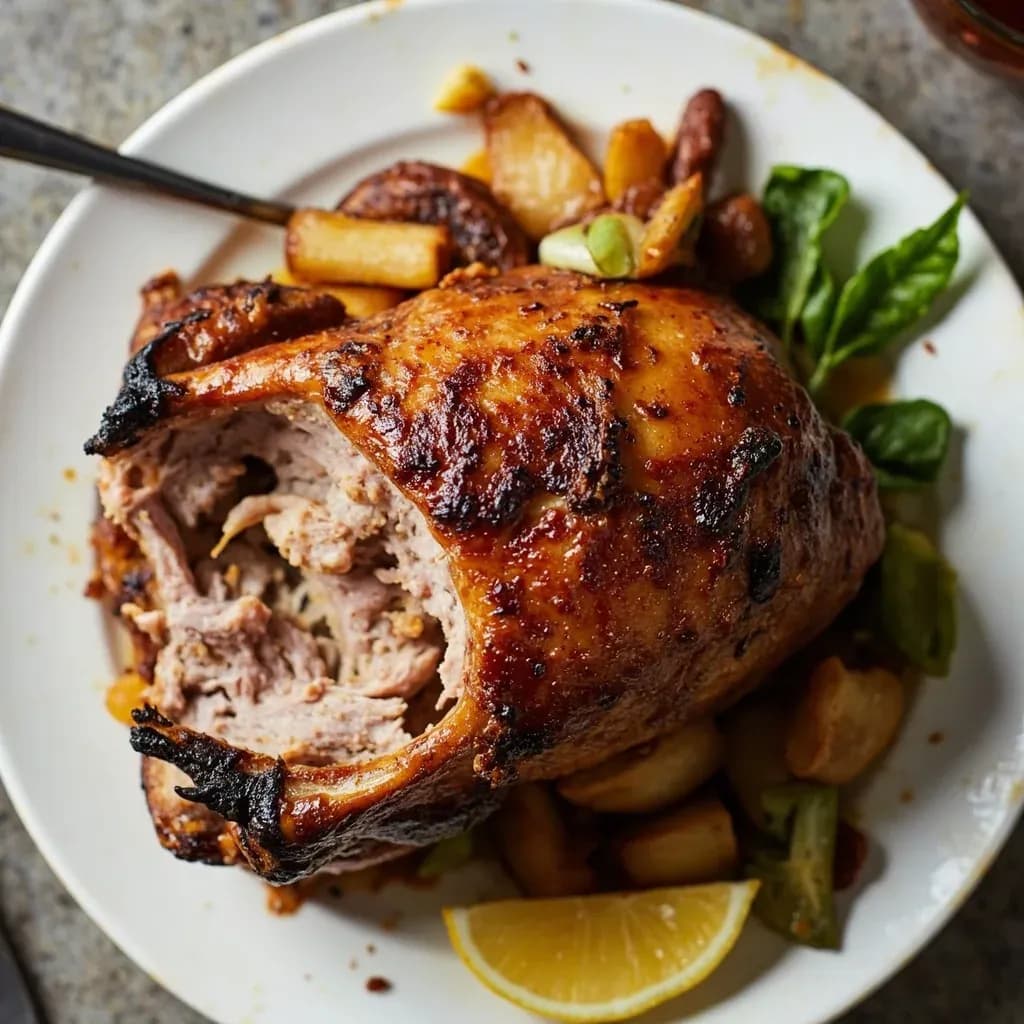
Pernil is a Puerto Rican pork shoulder marinated in garlic, oregano, and citrus adobo, then roasted low for many hours until the meat shreds easily. Late in the cook the oven is cranked up so the skin blisters into cuerito, the prized crackling. The long roast renders the fat and collagen, and the overnight marinade is what drives the deep seasoning through the joint.
Pernil is less a recipe than a method: a bone-in, skin-on pork shoulder is buried under a pungent adobo of garlic, oregano, and bitter orange, left to marinate for a day or two, then roasted at low oven heat for the better part of an afternoon. The technique, born in Puerto Rico and shared across the wider Caribbean and Latin American diaspora, is built around one central trick — giving collagen enough time at gentle heat to dissolve into gelatin while the skin slowly dehydrates into shatter-crisp chicharrón.
The signature payoff is a dramatic textural contrast: meat so tender it pulls apart with a fork, sitting beneath a cap of crackling that snaps when you cut into it. Almost every decision in the method — the long marinade, the scored skin, the low initial temperature, the hot finish — exists to widen that gap between unctuous and crisp, and most failures can be traced to shorting one of those steps.
Pernil is forgiving in timing (an extra thirty minutes in the oven rarely hurts) but exacting in temperature control, which is why an instant-read thermometer and a roasting rack matter more than any specialty equipment. A 7-pound shoulder will feed a crowd, but the active work fits comfortably into one short evening of prep followed by a long, mostly unattended morning of roasting.
- Difficulty
- Medium
Types & varieties
The Puerto Rican benchmark: skin-on picnic shoulder, garlic-oregano-bitter orange adobo, slow-roasted until falling apart, with crisp chicharrón-style skin.
Often marinated with a brighter citrus profile (Seville orange or lime), sometimes brushed with a cane sugar or piloncillo glaze near the end, and frequently finished over wood or charcoal.
Marinade may include cumin and lime, sometimes stuffed with a mojo of onion, garlic, and sour orange; typically served with yuca and mojo.
The same low-and-slow philosophy applied to a whole suckling pig, traditionally roasted on a spit over coals.
Yucatán-influenced variant using achiote and bitter orange, wrapped in banana leaves for part of the cook.
How to do it
- 1
Select and trim the shoulder
Buy a bone-in, skin-on picnic shoulder (or Boston butt if that's what's available). Pat dry, then with a sharp knife remove any loose hanging fat, leaving a uniform 1/4-inch fat cap. Leave the skin attached and the bone in.
- 2
Score the skin and fat
Pat the skin completely dry. Using a sharp paring or boning knife, score the skin and underlying fat in a 1-inch crosshatch or diamond pattern, cutting just down to the meat but not into it. Season generously with salt, working it into the cuts.
- 3
Make the adobo
Pound or process a whole head of garlic with 2 tablespoons dried oregano, 1 tablespoon kosher salt, 1 tablespoon black pepper, 1/3 cup olive oil, and 1/2 cup bitter orange juice (or 1/3 cup fresh orange juice plus 2 tablespoons fresh lime juice). The paste should be thick, wet, and aromatic.
- 4
Marinate
Place the shoulder in a non-reactive dish or large resealable bag. Rub the adobo thoroughly over the scored skin, into the cuts, and all around the meat. Reserve about 1/3 cup of the marinade in the refrigerator for finishing. Cover and refrigerate 24–48 hours, flipping once halfway through so both sides absorb the flavor.
- 5
Prepare for roasting
Remove the shoulder from the fridge 1 to 1.5 hours before cooking to take the chill off. Pat the skin again thoroughly with paper towels — this is the single biggest factor in crisp skin. Preheat the oven to 300°F (150°C). Set a rack inside a deep roasting pan and lightly oil the rack.
- 6
Roast low and slow
Place the shoulder skin-side up on the rack. Roast at 300°F, allowing roughly 1 hour per pound. Baste every 60–90 minutes with the pan juices, spooning them over the exposed fat. After about 4 hours, begin checking internal temperature in the thickest part of the meat, taking care to avoid the bone.
- 7
Finish for crisp skin
When the meat reads 170°F and the cook is clearly progressing, check the skin. If it is not yet crackling, increase the oven to 400–450°F for the final 10–20 minutes, watching closely so the chicharrón doesn't burn. The skin should puff, blister, and shatter when tapped with a spoon.
- 8
Confirm doneness for shredding
For sliced service, pull the shoulder at 170–175°F. For classic falling-apart pernil, continue until the thickest part reads 195–205°F; the meat should yield easily to a fork and the bone will wiggle loose in its socket.
- 9
Rest
Transfer the shoulder to a cutting board. Loosely tent with foil and rest 20–30 minutes. Do not wrap tightly or the trapped steam will soften the crisp skin.
- 10
Carve, de-bone, and serve
Remove the bone (it should slide free). Slice with a serrated knife against the grain for plated service, or pull apart with tongs and forks for sandwiches. Spoon the strained pan juices over the meat and crumble the crisp skin over the top, or serve it alongside for guests to grab.
Two ways to finish: sliced or shredded
The same shoulder can be served two different ways, and the cook time determines which. Pulling the roast when the thickest part of the meat reads 170–175°F gives you a pernil that holds together for slicing into neat medallions — the meat is tender but structured, with juices that run clear. Continuing on to 195–205°F is the classic Nochebuena finish: the bone slides cleanly from its socket, the muscle pulls apart with tongs and forks, and the meat has the soft, almost paste-like texture that makes the next day's sandwiches and mofongo relleno so good. Pick your target internal temperature based on how you plan to serve it, not on guesswork — an instant-read thermometer inserted into the thickest part of the shoulder, away from the bone, is the only reliable signal.
Bitter orange and its substitutes
Naranja agria — the small, sour bitter orange — is the signature acid in the marinade and is what gives pernil its characteristic tang. In Puerto Rico and much of the Caribbean it is sold in bottles (such as Goya's Naranja Agria) in the Latin foods section of most U.S. supermarkets. When you can't find it, the standard substitute is 2 parts fresh orange juice to 1 part fresh lime juice, which approximates the sweet-sour balance. Seville oranges (available in winter) are a closer match if you can find them. The acid is doing real work: it tenderizes the surface of the meat, brightens the garlic and oregano, and helps the salt penetrate the fat cap during the long marinade.
Common uses
Tips & pitfalls
- Marinate skin-side down for 24–48 hours and flip the shoulder once halfway through so both sides absorb the adobo evenly; an overnight rest is the minimum, but a full two days is better.
- Score the skin and fat cap in a 1-inch crosshatch, cutting just through the fat to the meat. This is what allows the rendered fat to escape and the chicharrón to crisp, and gives the salt somewhere to penetrate.
- Reserve a portion of the marinade before it touches the raw pork so you can use it as a finishing sauce or for basting. Never reuse marinade that has touched raw meat without boiling it first.
- Pat the scored skin completely dry with paper towels before the roast goes in. Moisture is the single biggest obstacle to crisp skin — a wet surface will steam back into flabby fat no matter how hot the oven gets.
- Roast on a rack set inside a deep pan so air circulates beneath the shoulder and the drippings don't scorch on the pan bottom, where they would turn acrid and smoke the meat.
- Start low (275–300°F) for the long, collagen-breaking cook, then finish hot (400–450°F) for the last 10–20 minutes if the skin has not yet crackled. Common mistake: cooking at 350°F+ the entire time — the outside dries and toughens before the connective tissue has a chance to melt.
- Common mistake: pulling the roast at 160°F and expecting carryover to finish the job. For shreddable pernil, the meat needs to reach 195–205°F; the collagen only fully breaks down in that range.
- Save the rendered fat and strained pan juices. Spoon them over sliced meat at the table, or use them the next day to cook rice, beans, or potatoes — they carry a remarkable amount of garlic and oregano flavor.
Good to know
- Origin
- Puerto Rico; the technique is also a staple across the wider Caribbean and Latin American diaspora (Dominican Republic, Cuba, Venezuela, Colombia) and in U.S. communities in New York and New Jersey.
- Cut of meat
- Bone-in, skin-on fresh pork shoulder, traditionally the picnic shoulder for its fat cap and skin, though Boston butt is also used.
- Marinating time
- Minimum 12 hours, ideally 24–48 hours in the refrigerator.
- Oven temperature
- 275–300°F (135–150°C) for the bulk of the cook; finish at 400–450°F (200–230°C) for 10–20 minutes to crisp the skin if needed.
- Approximate cook time
- Roughly 1 hour per pound at 275–300°F, so a 7 lb shoulder needs 6–7 hours, plus rest.
- Target internal temperature
- 170°F (77°C) minimum for slicing; 195–205°F (90–96°C) for true pull-apart, shreddable pernil.
- Resting time
- At least 20–30 minutes, loosely tented with foil so the skin stays relatively crisp.
- Cultural context
- Centerpiece of Nochebuena (Christmas Eve), New Year's, and Día de Reyes; also served at christenings, baptisms, and large family gatherings.
Also called
pernil · roast pork shoulder
Related

Sear
Blast the surface hot for a deep-browned, savory crust

Sauté
Cook quickly in a little fat over lively heat, tossing as you go

Stir-Fry
Toss bite-sized pieces over roaring heat for fast, smoky cooking

Pan-Fry
Crisp food in a shallow layer of hot fat, turning once or twice

Deep-Fry
Submerge in hot oil for an all-over crackling crust

Roast
Cook uncovered in dry oven heat for browned edges and tender centers

Bake
Cook with steady, surrounding oven heat — the soul of bread and pastry

Broil
Hit food from directly above with fierce overhead heat