Prep & Assembly
Pre-Shaping (Boulage)
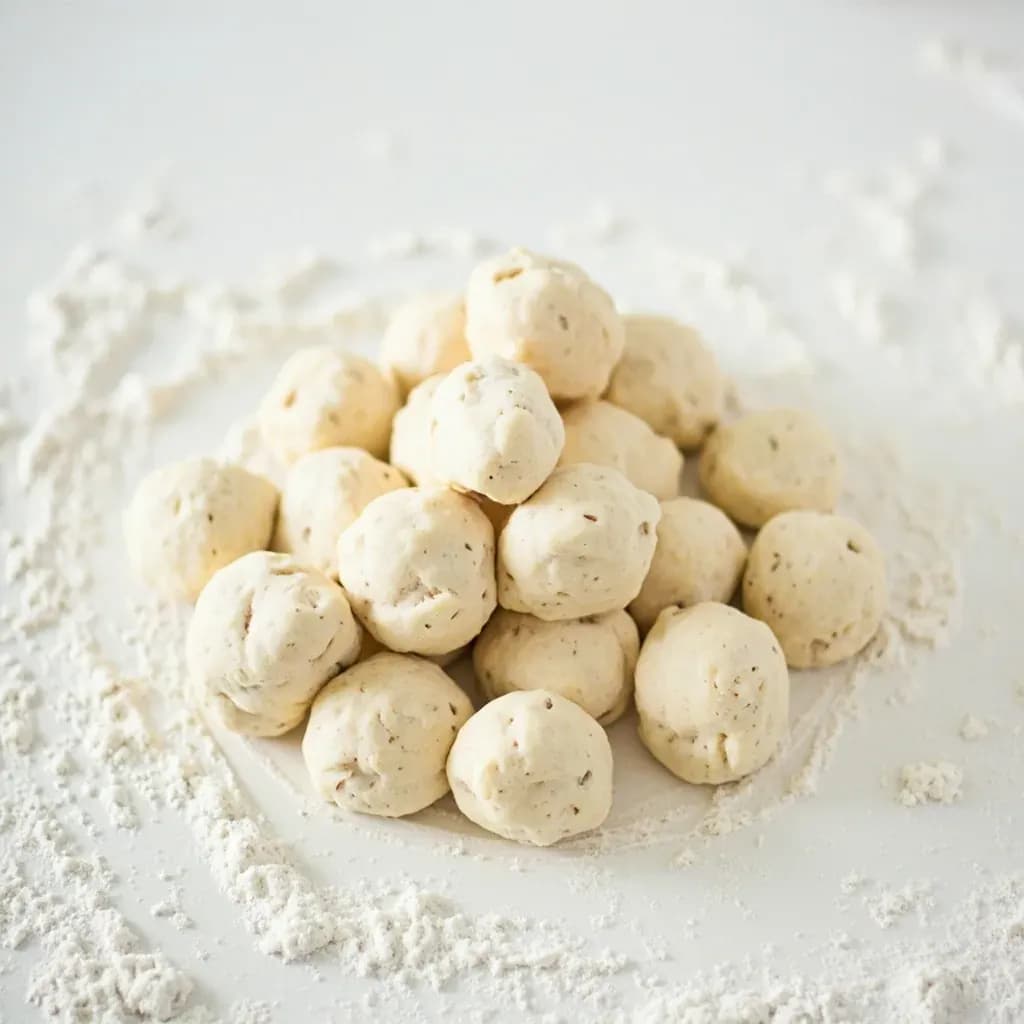
Gently rounding divided dough into loose balls to build tension before the final shape.
Pre-shaping, or boulage, lightly rounds each portion of divided dough into a taut ball to organize the gluten and create surface tension. A short bench rest follows, relaxing the dough so the final shaping goes smoothly and the loaf holds its form. The amount of tension applied at this stage strongly affects the finished crumb structure and rise.
Pre-shaping — boulage in French — is the intermediate rounding step that sits between dividing the bulk-fermented dough and giving it its final shape. After scaling, each piece is gently coaxed into a loose ball or short cylinder, then allowed to relax on the bench before the real shaping begins. It looks like a smaller, gentler version of shaping itself, and that is exactly what it is: a first pass that organizes the dough's outer skin without committing to the final form.
The job of pre-shaping is twofold. First, it builds a light, even tension across the surface of each piece, which gives the dough enough structure to hold itself together during the bench rest and through the final shape. Second, it sets up the gluten strands for relaxation: the brief handling wakes the dough up, and the 10–30 minute rest that follows lets the gluten ease back into a pliable state so the final shape can be sealed cleanly without the dough fighting back. Skipping this step is a common reason home bakers end up with torn skins, dense crumb, or shapes that relax and spread in the oven.
A good pre-shape leaves the interior gassy and undisturbed while the outside becomes smooth and taut. The cup-and-drag motion across a lightly floured bench does this through friction: the bench pulls the outer layer taut while your cupped hand guides the dough into a round. It is not a knead, it is not a degas, and it should never feel like wrestling. Done well, it takes about ten to thirty seconds per piece and sets the stage for an open, even crumb in the finished loaf.
- Difficulty
- Medium
Types & varieties
Dough gathered into a tight round by cupping both hands and pulling across the bench; used for round loaves and rolls
Dough gently elongated into a short cylinder with a seam-side-down log shape; used for oval loaves
Rolled lightly into a rough cylinder without sealing, left to rest seam-up before final rolling and shaping
Dough shaped into a fat log; common for bâtards and some sourdoughs
Dough flattened and folded like a letter to build light tension without sealing
How to do it
- 1
Prepare the bench and divide
Lightly flour the work surface with bread flour (or rice flour for high-hydration doughs). Divide the bulk-fermented dough into equal pieces using a bench knife or dough scraper; avoid tearing the dough — cut cleanly through the mass.
- 2
Cup and round
Cup one hand (or both) around each piece. Drag the dough gently in a half-circle across the lightly floured bench, letting the friction tighten the outer skin. The bottom should become smooth and slightly rounded; the top may look rough or gathered — that is fine and will become the seam.
- 3
Flip seam-side down
Turn the rounded piece so the smooth, tensioned underside is facing up. The seam where the dough folded onto itself now sits against the bench and will be tucked under during the final shape.
- 4
Bench rest
Transfer each pre-shaped piece to a lightly floured couche, a parchment-lined sheet, or a bowl. Cover with a damp towel, plastic, or the couche flap so the surface does not dry out. Rest 10–30 minutes depending on dough temperature and hydration.
- 5
Inspect and proceed to final shape
The rested piece should feel relaxed and slightly puffy. If it springs back hard when pressed, give it a few more minutes. It is now ready for the final shape — boule, bâtard, baguette, or roll.
Why the bench rest matters
After the pre-shape, the rested piece should feel noticeably softer and slightly puffy. This is gluten relaxing under tension — the strands you tightened with the cup-and-drag motion are slowly releasing back toward their resting state. The rest also redistributes moisture evenly through the piece, which is why a piece that springs back hard when poked needs more time, not more force. A piece that has rested too long will look slack and may already be over-proofed; a piece that has not rested enough will fight you during the final shape and tear when you try to seal it.
- A properly rested piece dimples slowly when pressed and holds the impression for a second or two.
- If the dough feels tight and rubbery after 15 minutes, give it another 10–15 — cold or under-developed doughs need longer.
- Cover every rested piece; a dry skin sets up in minutes and will crack during final shape.
When pre-shaping matters most
Pre-shaping is non-negotiable for high-hydration artisan breads and for any dough where an open, even crumb is the goal. Ciabatta at 80%+ hydration, slack sourdoughs, and enriched doughs like brioche all rely on the tension built in this step to keep their structure through shaping and the final proof. For very stiff, low-hydration doughs — bagels, pretzels, some lean sandwich loaves around 60% hydration — the final shape alone usually provides enough tension, and a pre-shape can over-handle the dough. The dough is firm enough that divided pieces will already hold their shape, and skipping the intermediate round saves time without sacrificing structure.
- Use pre-shaping for: ciabatta, slack sourdoughs, sourdough boules and bâtards, baguettes, enriched rolls, and the initial round of laminated doughs (croissant, danish) before lamination.
- Consider skipping for: bagels, pretzels, and stiff dinner-roll doughs at or below 60% hydration.
Common uses
Tips & pitfalls
- Use a light, even dusting of flour; too much flour at this stage prevents the final shape from sealing properly.
- Cup the dough, don't flatten it — let the bench drag do the work of creating tension on the outer skin.
- Flip seam-side down after rounding so the smooth, tensioned surface becomes the outside of the loaf.
- Keep the bench rest short (10–20 minutes for most lean doughs) to avoid over-proofing at this stage.
- Avoid pressing out the gases; you want to organize the crumb, not degas it — a common mistake is treating pre-shape like a mini-knead.
- If the dough sticks, use a bench scraper to free it instead of adding more flour, which will dry the surface.
- For very slack or high-hydration doughs (80%+), use rice flour or a well-floured couche to prevent spreading during the rest.
- If the skin tears during the final shape, the pre-shape was either too tight or the bench rest was too short — let the dough relax and try again.
Good to know
- Also called
- Boulage (French), pre-forming, preliminary rounding
- Stage in bread workflow
- After dividing/scaling, before final shaping
- Primary purpose
- Builds initial gluten tension and a smooth outer skin so the dough holds its shape during final shaping
- Typical bench rest after
- 10–30 minutes at room temperature; up to 45 minutes for very cold or stiff doughs
- Dough handling
- Gentle; preserves interior gas (no full degassing)
- Time per piece
- Roughly 10–30 seconds per divided piece
- Effect on crumb
- Better gas retention and a more open, even crumb in the final loaf
- Equipment
- Work surface (wood or marble), bench knife/scraper, optional couche, bowl, or banneton for resting
- Skill level
- Beginner to intermediate; technique improves with practice
Also called
Rounding / Pre-Shaping (Boulage) · Pre-Shaping · Boulage · Rounding
Related

Whisk
Beat ingredients smooth and aerated with a looping wire motion

Sift
Pass dry ingredients through mesh to aerate and remove lumps

Strain
Pour through mesh to separate solids from liquid for a smooth result

Filter
Pass liquid through fine material to clarify out the smallest particles

Rice
Press cooked potatoes through small holes for fluffy, lump-free texture

Mash
Crush soft cooked food into a rustic, creamy purée

Grind
Crush food into a coarse to fine texture, from spices to meat

Grate
Shred food into fine bits against a sharp-toothed surface