Water & Steam
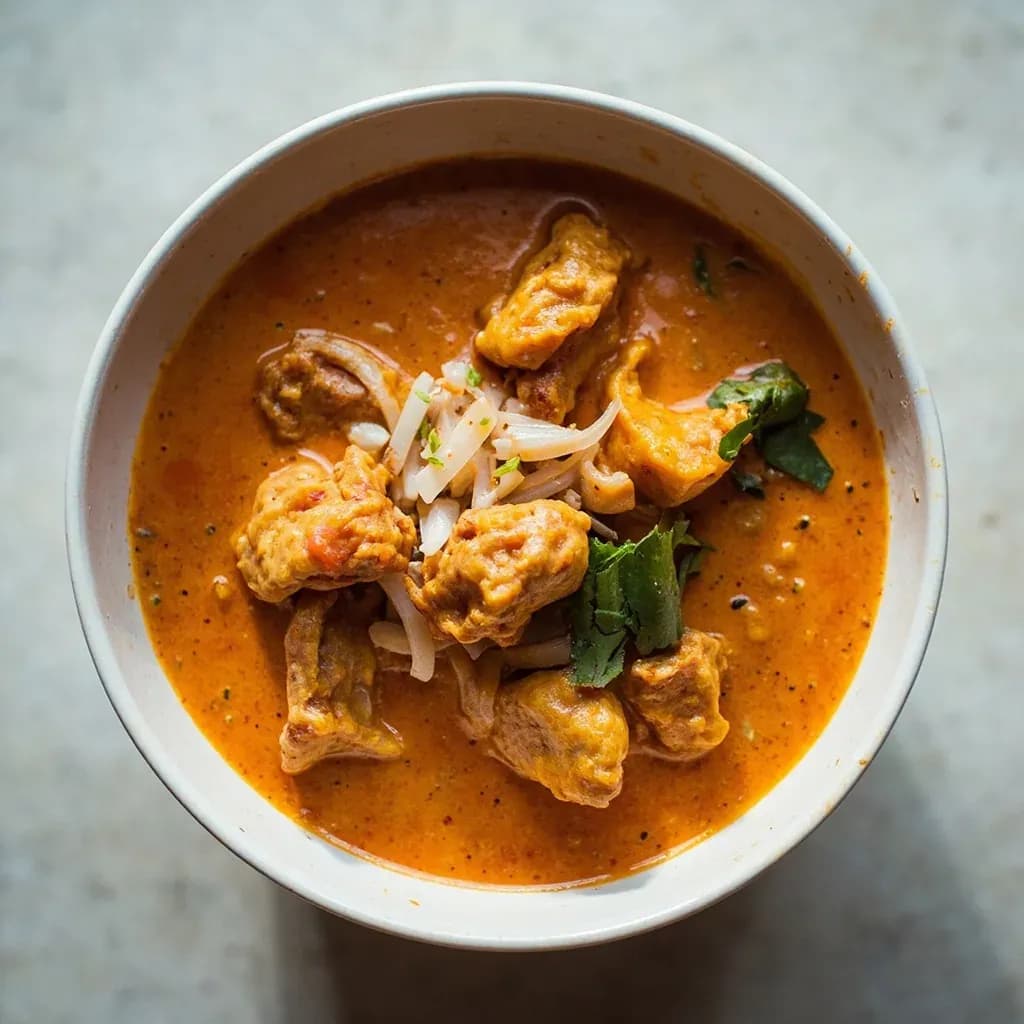
Red Curry (Roasted-Spice Simmer)
Frying a red chili paste in coconut cream, then simmering proteins and vegetables in coconut milk.
Red curry starts by cracking coconut cream and frying a red chili paste in it until fragrant and oil-split. Coconut milk, fish sauce, palm sugar, and proteins are then added and simmered until the sauce is silky and balanced between heat, salt, sweet, and richness. The technique is foundational to Thai curries, and properly frying the paste first is what builds the deep aromatic base.
Red curry, known in Thai as gaeng phed, is a Central Thai wet-heat technique built on a single defining move: frying a pounded aromatic paste in coconut cream until the fat splits and the paste turns a glossy brick-red, then finishing proteins and vegetables in the thinner coconut milk that follows. That cracking step is the heart of the method — the coconut fat dissolves the pigments of dried red chilies, releases the volatile oils of lemongrass, galangal, and kaffir lime zest, and produces the rounded, slightly sweet heat that distinguishes this curry from its green and yellow cousins. Once the paste is cooked through, the dish becomes a forgiving simmer where vegetables can be added in stages and seasoning balanced at the end.
Mastering the technique transfers directly to Panang and Massaman, which use the same paste family and the same cream-cracking method; the differences are mostly the paste's spice additions and how much coconut cream finishes the sauce. Practically, red curry is also a high-yield home technique: a single batch of paste keeps for two to three weeks refrigerated or several months frozen, and the same paste can be redeployed across chicken, duck, beef, seafood, or tofu with different vegetables each time, which is why most Thai cooks treat the paste, not the dish, as the unit of work.
- Difficulty
- Medium
Types & varieties
Red curry with chicken, often including Thai eggplant and bamboo shoots.
Beef version, frequently simmered with long beans and bell pepper.
Red curry with roasted duck; a celebratory Bangkok-Chinese dish that sometimes adds pineapple, lychee, or grape.
Seafood red curry, usually with prawns, calamari, and fish, cooked briefly so the seafood stays tender.
Vegetarian version using firm tofu and mixed vegetables, seasoned with soy sauce instead of fish sauce.
A thicker, drier offshoot of red curry where the paste is fried longer and the dish is finished with crushed peanuts and full-fat coconut cream rather than milk.
A milder, Indian-influenced relative of red curry, built on the same paste family but with warm spices (cardamom, cinnamon, cloves) and peanuts or potatoes.
How to do it
- 1
Prepare and toast the dry spices
If making paste from scratch, dry-toast coriander seed, cumin seed, and white peppercorns in a heavy pan over medium heat until fragrant and just starting to pop, about 1–2 minutes. Tip into a mortar to cool. This step is the 'roasted-spice' foundation of the dish.
- 2
Pound the curry paste
Soak a handful of deseeded dried red chilies in warm water for 15 minutes, then drain. Pound in a mortar with garlic, shallots, lemongrass, galangal, kaffir lime zest, coriander root, the toasted dry spices, and a thumbnail of shrimp paste. Work to a smooth, aromatic paste. (Skip steps 1–2 if using a commercial paste.)
- 3
Separate the coconut cream
Refrigerate a can of full-fat coconut milk for several hours or overnight. Skim the thick cream that has risen to the top; reserve the watery milk below for the simmer.
- 4
Crack the paste in the cream
Heat a wok or wide saucepan over medium heat. Add 3–4 tablespoons of the thick coconut cream and bring it to a gentle simmer, swirling, until the oil begins to separate. Add 3–4 tablespoons of curry paste and fry, stirring constantly, until the oil splits again and the paste turns a glossy brick-red, 2–4 minutes. This is the key 'roasted-spice simmer' step — the fat carries and dissolves the chili pigments and aromatics.
- 5
Cook the protein (if using meat or poultry)
Push the paste to the side. Add bite-sized pieces of chicken, beef, pork, or duck and turn to coat in the fat. Cook 3–5 minutes until the surface is opaque or lightly browned, so the meat absorbs the paste flavor before the liquid goes in.
- 6
Add the coconut milk and aromatics
Pour in the reserved thin coconut milk along with 2–3 torn kaffir lime leaves and a small piece of palm sugar. Bring to a gentle simmer — not a rolling boil — and skim any scum that rises.
- 7
Add vegetables in stages
Add harder vegetables first: Thai eggplant halves, bamboo shoots, pumpkin chunks, or carrots. Simmer 5–8 minutes. Add softer vegetables — long beans cut into 4 cm pieces, bell pepper, baby corn, straw mushrooms — and simmer another 3–5 minutes until just tender.
- 8
Season to balance
Season with fish sauce (salty) and more palm sugar (sweet), tasting as you go. A drop of tamarind paste or a squeeze of lime can correct a flat curry. The goal is harmony among salty, sweet, sour, and spicy.
- 9
Finish off the heat
Remove from heat. Stir in a handful of Thai basil leaves and any additional torn kaffir lime leaves. The residual heat releases their oils without cooking them off.
- 10
Serve
Ladle over steamed jasmine rice or alongside rice noodles. A small dish of pickled chilies (phrik dong) and a wedge of lime are traditional accompaniments.
The fat-split principle
Every Thai curry paste in this family depends on a single physical event: the oil separating from the coconut cream, and with it, the chili pigments and aromatic oils coming fully into the fat. Until that split happens, the paste is still raw, the chili color is dull, and the finished curry will taste chalky and harsh. Cooks learn to read the wok: the paste first looks pasty, then suddenly goes glossy and reddish-orange as clear oil beads and pools at the edges, and the aroma shifts from raw garlic to something rounder and toasted. That visible change is the cue to add the protein and, shortly after, the thin coconut milk.
- If the cream refuses to break, a teaspoon of the paste itself or a small splash of water can kick-start the split.
- Pastes that include shrimp paste or roasted spices split more readily than all-fresh pastes.
- The same split is the visual cue for green, yellow, Panang, and Massaman curries — once you can read it in red curry, you can read it in all of them.
Common uses
Tips & pitfalls
- Toast dried spices (coriander and cumin seeds, white peppercorns) in a dry pan until fragrant before pounding — this 'roasted-spice' step is what gives the curry its depth.
- Use only the thick cream scooped from the top of a chilled can of coconut milk for frying the paste; reserve the watery milk below for the simmer. If the cream refuses to break, add a teaspoon of the paste or a splash of water to encourage the split.
- Fry the paste until the oil fully separates and turns a glossy brick-red. Underdone paste is the most common flaw in home red curry and leaves the sauce tasting raw and chalky.
- Add proteins in stages: dense meats (beef, duck) go in after the paste is cooked; quick-cooking proteins (prawns, fish, tofu) go in only during the last 3–5 minutes so they do not toughen.
- Add harder vegetables (eggplant, pumpkin, bamboo) with the coconut milk, and softer vegetables (long beans, bell pepper) in the final 5 minutes so they keep their texture.
- Season only at the end with fish sauce and palm sugar, tasting after each addition. Start with about 1 tbsp fish sauce and 1 tsp palm sugar per 400 ml of coconut milk, then adjust; the salty-sweet-sour-spicy balance is a moving target.
- Do not let the curry boil hard after the coconut milk is added; a gentle simmer prevents the sauce from splitting into an oily mess.
- Stir in Thai basil and kaffir lime leaves off the heat — their volatile oils vanish if cooked.
- Common mistakes to avoid: substituting fresh red chilies for the dried ones (changes color, aroma, and the fat-splitting chemistry), pouring all the coconut milk in at once, and skipping the fish-sauce/palm-sugar balance.
Good to know
- Origin
- Central Thailand; technique documented in Thai culinary tradition under the name gaeng phed (แกงเผ็ด), where 'phed' means spicy.
- Heat method
- Wet-heat simmer preceded by a short fat-frying ('cracking') of the paste in coconut cream.
- Key flavor base
- Dried red chilies (soaked), lemongrass, galangal, kaffir lime zest, garlic, shallots, coriander root, white peppercorns, and shrimp paste.
- Fat phase vs. thin phase
- Thick coconut cream from the top of a chilled can fries the paste; the watery milk below builds the simmer.
- Difficulty
- Moderate; the timing of the paste-cracking step and final seasoning balance are the main learning points.
- Active / total time
- About 15–20 minutes active once the paste is made; 30–45 minutes total with store-bought paste, 1.5–2 hours from scratch.
- Yield
- Roughly 4 servings from one 400 ml can of coconut milk with about 1 kg of protein and vegetables.
- Finishing touch
- Off the heat: torn kaffir lime leaves and Thai basil (horapha) are stirred in to preserve their volatile aroma.
Also called
gaeng phet · Thai red curry
Related

Boil
Cook in vigorously bubbling liquid at full rolling heat

Simmer
Hold liquid at a gentle shimmer for tender, unhurried cooking

Poach
Cook gently in barely-trembling liquid for silky, tender results

Steam
Cook in rising vapor to keep color, nutrients, and shape intact

Blanch
Plunge briefly in boiling water, then shock cold to lock color

Braise
Sear, then cook slow in a little liquid until fall-apart tender

Stew
Simmer bite-sized pieces fully submerged into a rich, unified pot

Sous-Vide
Seal and cook in precise warm water for edge-to-edge doneness