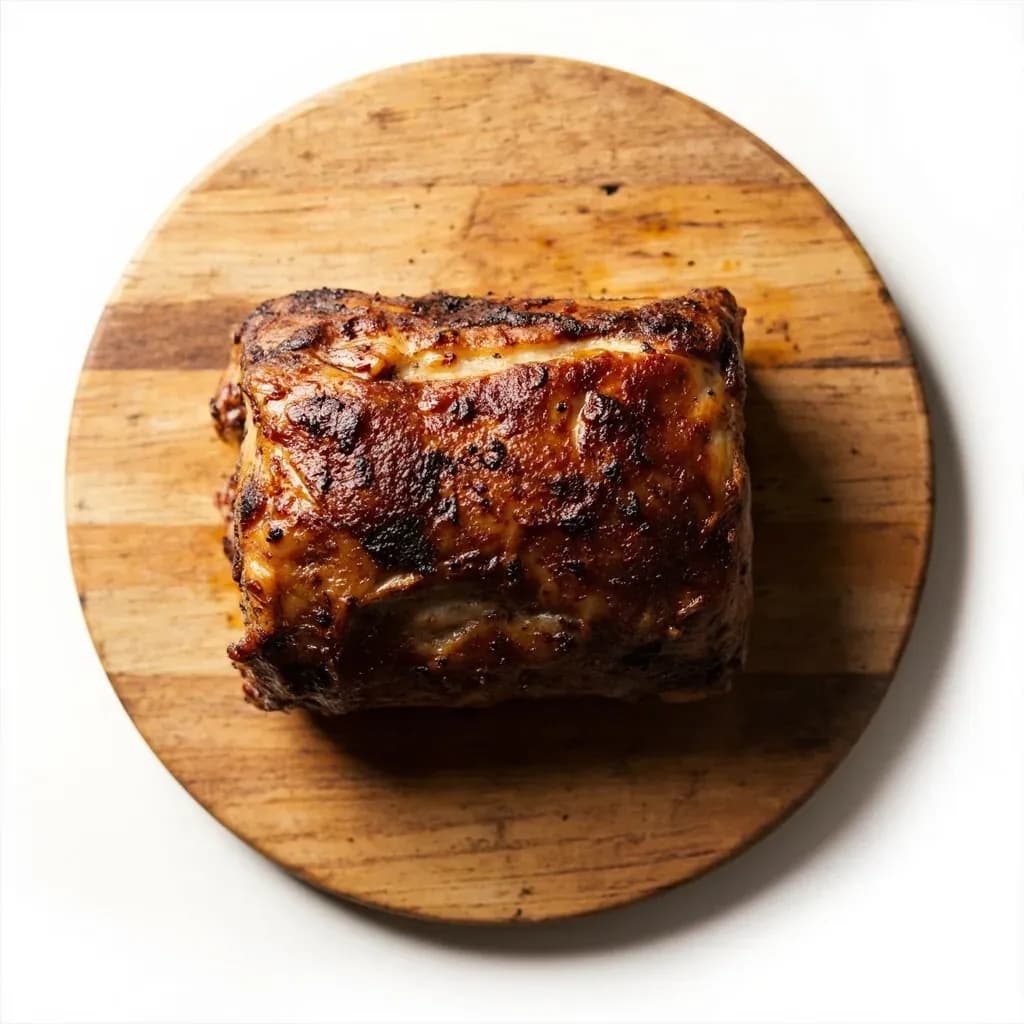
Heat & Fire
Resting Meat
Letting cooked meat sit before slicing so juices redistribute instead of running out.
Resting meat means setting it aside off the heat after cooking so the muscle fibers relax and reabsorb juices that were driven to the center. Cutting too soon spills those juices onto the board, leaving the meat dry. A rough guide is to rest roasts loosely tented for several minutes per pound, and steaks for five to ten minutes, while carryover heat finishes the interior.
Resting is the brief, deliberate pause between taking meat off the heat and putting a knife to it. It is the cheapest, most overlooked step in cooking, and the one that separates a steak that floods the board with pale liquid from one that stays moist and slices cleanly.
The traditional explanation — that juices migrate from the center outward and need time to redistribute — is partly folklore. The real mechanism, as Harold McGee and others have shown, is protein chemistry: as the meat cools below roughly 140°F (60°C), solubilized myosin and other sarcoplasmic proteins coagulate into a fine gel that holds free liquid in place when the meat is cut. At the same time, heat continues to flow inward from the hot exterior, finishing the cook by carryover. The visible result is less juice loss and a noticeably more even doneness from edge to center.
Resting also has a generous built-in margin of error: pull a steak 5–10°F below your target, rest it, and the carryover will bring it to where you wanted it. Skip the rest and you lose that window, ending up with a piece of meat that is overcooked at the surface and just right (or under) at the core. The one major exception is delicate fish — its fibers are short, its fat is low, and it overcooks in the time it takes to relax — so a 2–3 minute rest is the most it can stand.
- Difficulty
- Easy
Types & varieties
Best for seared steaks, chops, and short rests under ~10 min; no foil, so the crust stays dry and crisp
Standard for roasts and long rests; foil draped with airspace above the meat, never crimped tight, to slow heat loss without softening the crust
Meat on a wire rack over a sheet pan; air circulates underneath, the bottom is not stewed in its own juices, and drippings are saved for sauce or gravy
For very large roasts or for holding meat warm past a normal rest; transferred to a 150–200°F (65–95°C) oven, loosely tented, for up to 1–2 hours
How to do it
- 1
Pull at the right internal temperature
Remove the meat from the heat 5–10°F (3–6°C) below your final target doneness. Check with an instant-read thermometer in the thickest part, away from bone and fat. Pull earlier for thicker cuts, which carry over more.
- 2
Transfer to a warm resting surface
Move the meat to a warm wooden cutting board, warm plate, or — for roasts and whole birds — a wire rack set inside a sheet pan. A warm surface slows the temperature drop; a cold one accelerates it and can steal degrees you wanted to keep.
- 3
Cover or expose based on crust and rest length
For seared steaks and chops resting under 10 minutes, leave uncovered so the crust stays crisp. For roasts, whole birds, and anything resting longer, tent loosely with aluminum foil — drape it so air still circulates, do not crimp it tight. Trapped steam is the enemy of a good crust.
- 4
Time the rest correctly
Steaks and chops: 5–10 minutes. Thick pork chops: 5–10 minutes. Whole chicken or duck: 10–15 minutes. Whole turkey: 20–30 minutes. Beef or pork roasts over 3 lb (1.4 kg): 15–30 minutes. Thick fish fillets: 2–3 minutes only. Ground patties: 3–5 minutes.
- 5
Slice against the grain
Look for the direction of the long muscle fibers on the cut surface. Slice perpendicular (90°) to those fibers. Short fibers mean a tender bite; slicing with the grain produces chewy, stringy portions no matter how well the meat was cooked. On cuts where the grain changes direction (brisket flat vs. point, tri-tip, top sirloin), adjust your angle for each section.
The science, briefly
Two things happen during a rest, and they happen together. First, the temperature gradient between the hot exterior and the cooler center flattens out — the crust cools a little, the core climbs a little, and the result is more uniform doneness from edge to edge. Second, the proteins in the muscle fibers, which were loosened by heat, begin to re-form a gel network as the meat drops below about 140°F (60°C). That gel is what keeps the meat's free liquid from running out onto the board when you cut into it. The 'juices migrating to the center' story is a useful picture but not the actual mechanism; the gel-trapping model explains why a rested steak stays moister and a rested roast slices cleanly.
- Carryover cooking is bigger than most cooks expect — plan for it instead of being surprised by it
- Thicker and larger cuts carry over more than thin ones
- The same steak pulled from a screaming-hot grill climbs less than one pulled from a low-and-slow oven, where the gradient at pull is shallower
The fish exception
Fish is the one protein where the standard rest rules do not apply. Its muscle fibers are short, its connective tissue is minimal, and it carries very little internal fat, so it goes from perfectly cooked to overcooked in a narrow window. A 2–3 minute rest — long enough to let the carryover finish — is plenty; a 10-minute rest will cool the flesh and dry it out. Serve promptly.
Tenting, done right
Tenting is the most common failure point of resting. A tight wrap traps steam, which condenses against the crust and turns a carefully seared surface soft and damp in minutes. The foil should hover above the meat, not touch it, and the edges should remain open so vapor can escape. For short rests on steaks and chops, skip the foil entirely — the rest is short enough that heat loss is not a problem, and the crust stays better.
- Dome the foil so there is at least 1 inch of airspace above the meat
- Leave the ends of the foil open; do not crimp them around the pan
- For crusty cuts under 10 minutes, rest uncovered — the crust is worth more than the warmth
Common uses
Tips & pitfalls
- Pull meat 5–10°F below target doneness — carryover is real, and it is bigger on thicker cuts
- Never wrap meat tightly in foil for the rest; trapped steam will soften a carefully seared crust in minutes
- Use an instant-read thermometer instead of cutting the meat open to 'peek' — every cut is a juice loss
- For roasts, rest on a wire rack rather than flat on a board so pooled juices do not steam the underside
- Find the grain and slice across it; resting cannot rescue meat cut with the grain
- If a long rest has cooled the meat too much, briefly return it to a hot oven or sear the cut surfaces in a hot pan to warm and re-crisp
- For reverse-seared or sous-vide steaks, 5 minutes is plenty — the temperature is already very even throughout
- A 1-minute rest per 100 g (3.5 oz) is a reliable quick reference for small to medium cuts
- Do not skip the rest on prime rib or whole turkey — both the juice savings and the carryover finish are substantial
Good to know
- Category
- Post-cooking, knife-side technique
- Mechanism
- Below ~140°F (60°C), myosin and other sarcoplasmic proteins coagulate into a gel that traps free liquid; temperature equalizes edge to center
- Carryover cooking, small cuts
- 5–10°F (3–6°C) internal rise after leaving the heat
- Carryover cooking, large roasts & turkey
- 10–15°F (6–8°C) for roasts; whole turkey can climb 20–25°F
- Pull rule
- Remove from heat 5–10°F (3–6°C) below target doneness to account for carryover
- Rest time range
- Steaks and chops 5–10 min; whole poultry 10–30 min; roasts 15–30 min; thick fish 2–3 min; ground patties 3–5 min
- Quick reference
- Roughly 1 minute of rest per 100 g (3.5 oz) of meat
- Best for / not for
- Whole muscles with intact fibers benefit most; delicate fish, cuts under 1 inch, and long unattended holds in the danger zone do not
Also called
Rest Meat · Laisser Reposer
Related

Sear
Blast the surface hot for a deep-browned, savory crust

Sauté
Cook quickly in a little fat over lively heat, tossing as you go

Stir-Fry
Toss bite-sized pieces over roaring heat for fast, smoky cooking

Pan-Fry
Crisp food in a shallow layer of hot fat, turning once or twice

Deep-Fry
Submerge in hot oil for an all-over crackling crust

Roast
Cook uncovered in dry oven heat for browned edges and tender centers

Bake
Cook with steady, surrounding oven heat — the soul of bread and pastry

Broil
Hit food from directly above with fierce overhead heat