Water & Steam
Steam-Doming (Melt/Steam)
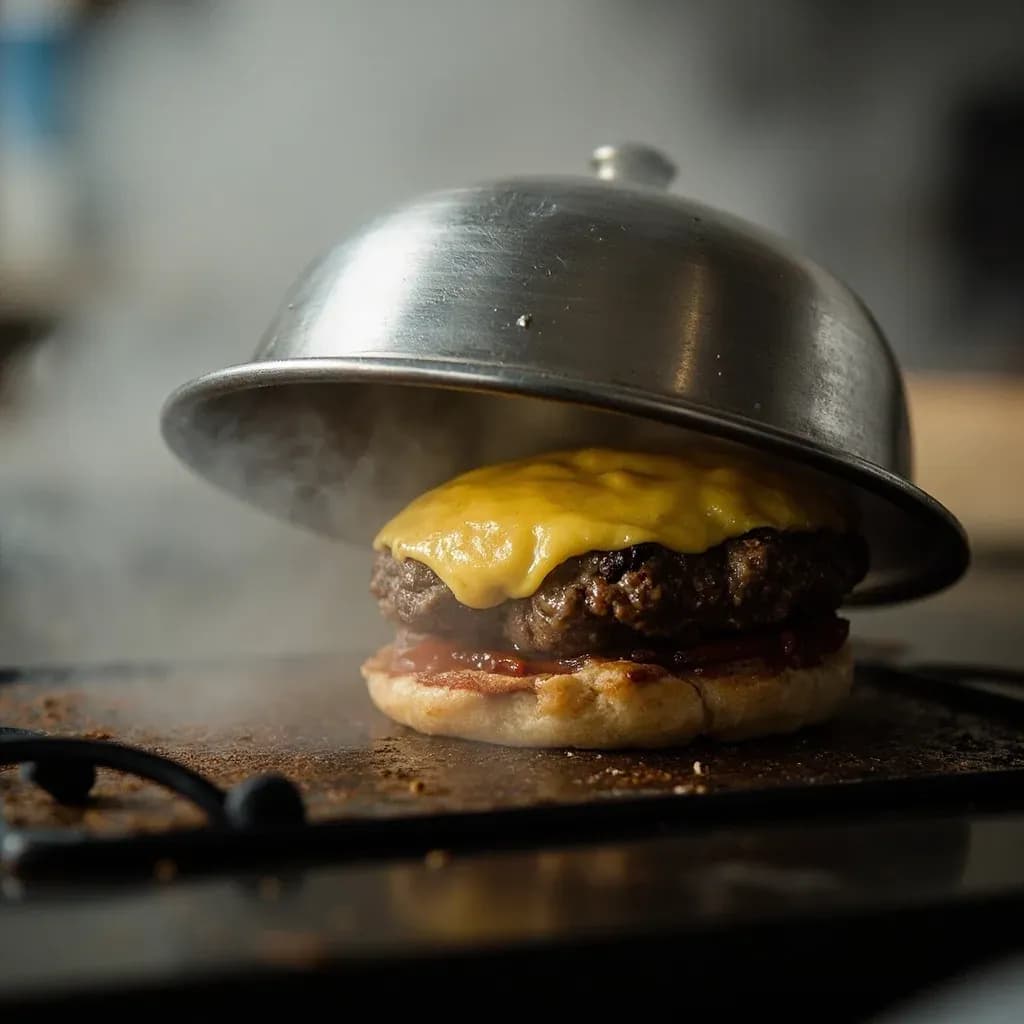
Covering food on a hot griddle with a dome and a splash of water to flash-steam and melt.
Steam-doming places a metal dome or cover over food cooking on a flat-top, often with a small splash of water, to trap a burst of steam. The steam quickly melts cheese, finishes the top of a smash burger, or warms a folded item without burning the griddle side. It is a fast finishing move on the griddle, prized for melting and gently steaming the upper surface in seconds.
Steam-doming turns a flat-top griddle into an instant steamer. A metal dome is set over food that has already been seared on the hot surface, a tablespoon or two of water is splashed onto the bare griddle at the dome's edge, and the contact heat flashes the water to steam in seconds. The dome traps that burst of vapor around the food long enough to melt a slice of cheese, wilt a pile of onions, or carry a steak the last few degrees to temperature — all without overcooking the crust that the dry griddle heat just built.
The technique matters because it solves a problem the flat-top creates: the surface is excellent at browning but poor at finishing. A salamander broiler or a covered sauté pan can finish a dish with top-down heat or trapped steam, but on the griddle line neither is always available. The dome — usually a 6- to 9-inch stainless or aluminum cup — costs almost nothing, takes up no extra space, and replicates that finishing step using heat the griddle already has. It is the workhorse move of the American short-order kitchen and the secret behind the glossy, edge-to-edge melted cheese on a diner smash burger.
The behavior is worth understanding. Water dropped on a 400°F griddle converts to steam almost instantly and expands roughly 1,700 times in volume; even a single tablespoon of water produces a large pocket of vapor inside the dome. That humidity transfers heat far faster than dry air would, which is why cheese slumps in 15–30 seconds under a dome but takes a full minute or more under a plain cloche. Lift the dome too early and the steam escapes before the job is done; leave it too long and the crust the dry griddle worked to build turns soft and pale. Treat the dome as a brief, intense finishing tool, not a slow cooker.
- Difficulty
- Easy
Types & varieties
Dome over a burger or patty melt with a slice of cheese and a splash of water to flash-melt the cheese in seconds.
A pat of butter plus water under the dome; the butter melts and bastes while the steam finishes the food.
A splash of beer, wine, or stock in place of water for an aromatic finish; common in steakhouse plating.
Tossed vegetables on the griddle are domed with water to soften and finish through carryover heat.
Split buns, tortillas, or flatbreads domed briefly to soften and warm without drying out.
How to do it
- 1
Heat the griddle
Bring the flat-top or cast-iron pan to 350–450°F (175–230°C). The surface must be hot enough to flash the water to steam instantly on contact.
- 2
Cook the food to near-done
Sear and cook the main item — burger, steak, vegetables — to just under the target doneness, since the dome will finish the last bit with steam.
- 3
Position the cheese or finishing ingredient
If melting cheese, lay the slice on top now. For vegetables, toss with a pinch of salt and any fat (butter or oil) so they don't dry out under the dome.
- 4
Set the dome over the food
Place the basting dome directly over the food. A slight air gap at the base is fine; full sealing isn't necessary and can trap too much pressure.
- 5
Add water (or butter + water)
Splash 1–2 tablespoons of warm water onto the griddle right at the edge of the dome, never directly on the food. For richer results, drop in a small pat of butter first.
- 6
Steam for 15–60 seconds
Watch through the dome: cheese should slump and glisten in 15–30 seconds; vegetables soften in 30–60 seconds. Don't walk away — the steam action stops the moment the dome is lifted.
- 7
Lift the dome away from you
Raise the dome tilted away from your face and the diner's. Plate immediately while the surface is still glossy from the steam.
The physics, briefly
Steam carries far more heat per unit than dry air at the same temperature, and it condenses on cooler food surfaces, releasing that latent heat directly into the item. That is why a domed burger melts cheese in seconds while an uncovered burger sitting in 400°F air barely softens it. Three details follow from this: the water should be warm so the griddle does not shed temperature to flash it; the dome should sit close to the food so the vapor has little air to heat first; and the action is short because the steam runs out — once the tablespoon of water has flashed, the dome is just trapping warm air, not steam.
Choosing and caring for a dome
A good griddle dome is heavy-gauge stainless with a rolled or welded handle, sized so it covers a single burger patty with about an inch of clearance to spare. Aluminum domes heat and warp faster but cost less and are fine on a home griddle. A few habits keep them working well:
- Dry the inside between uses — pooled water drips back and spatters oil across the line.
- Avoid soap on seasoned cast-iron or carbon-steel domes; wipe with a hot, damp towel and re-oil lightly.
- Replace any dome with a loose handle or visible warping; a rocking dome vents steam unevenly and steams one side of the food more than the other.
- On high-volume lines, dedicate one dome to cheese duty and another to vegetables to keep flavors from drifting.
Common uses
Tips & pitfalls
- Pour the water onto the bare griddle next to the food, not on top of it — pouring on the food rinses off seasoning and washes browned bits away.
- Use warm or hot water; cold water drops the griddle temperature too far and produces a weak, sputtering steam.
- Add a small pat of butter with the water for richer flavor and to keep the surface from cooling excessively.
- Lift the dome tilted away from you and the diner — the burst of trapped steam at the table is hot enough to burn skin.
- Don't oversteam: 15–30 seconds is enough for a slice of cheese; vegetables usually need 30–60 seconds. Past that, the crust softens and the food goes gray.
- Wipe the inside of the dome dry between uses; pooled water inside will drip back onto the food and spatter oil.
- Use a heavier-gauge stainless dome on high-heat griddles; thin aluminum can discolor and warp over time.
Good to know
- Category
- Moist-heat griddle finishing technique
- Primary equipment
- Basting/melting dome, stainless steel or aluminum, 6–9 in. diameter
- Surface
- Flat-top griddle or cast-iron pan
- Water per cycle
- 1–2 tablespoons (15–30 mL)
- Typical time
- 15–60 seconds
- Griddle temperature
- 350–450°F (175–230°C)
- Origin
- Mid-20th-century American short-order and diner cooking
- Also called
- Melt-and-steam, dome steam, griddle steam, the melt
Also called
steam dome · melt dome · basting cover
Related

Boil
Cook in vigorously bubbling liquid at full rolling heat

Simmer
Hold liquid at a gentle shimmer for tender, unhurried cooking

Poach
Cook gently in barely-trembling liquid for silky, tender results

Steam
Cook in rising vapor to keep color, nutrients, and shape intact

Blanch
Plunge briefly in boiling water, then shock cold to lock color

Braise
Sear, then cook slow in a little liquid until fall-apart tender

Stew
Simmer bite-sized pieces fully submerged into a rich, unified pot

Sous-Vide
Seal and cook in precise warm water for edge-to-edge doneness