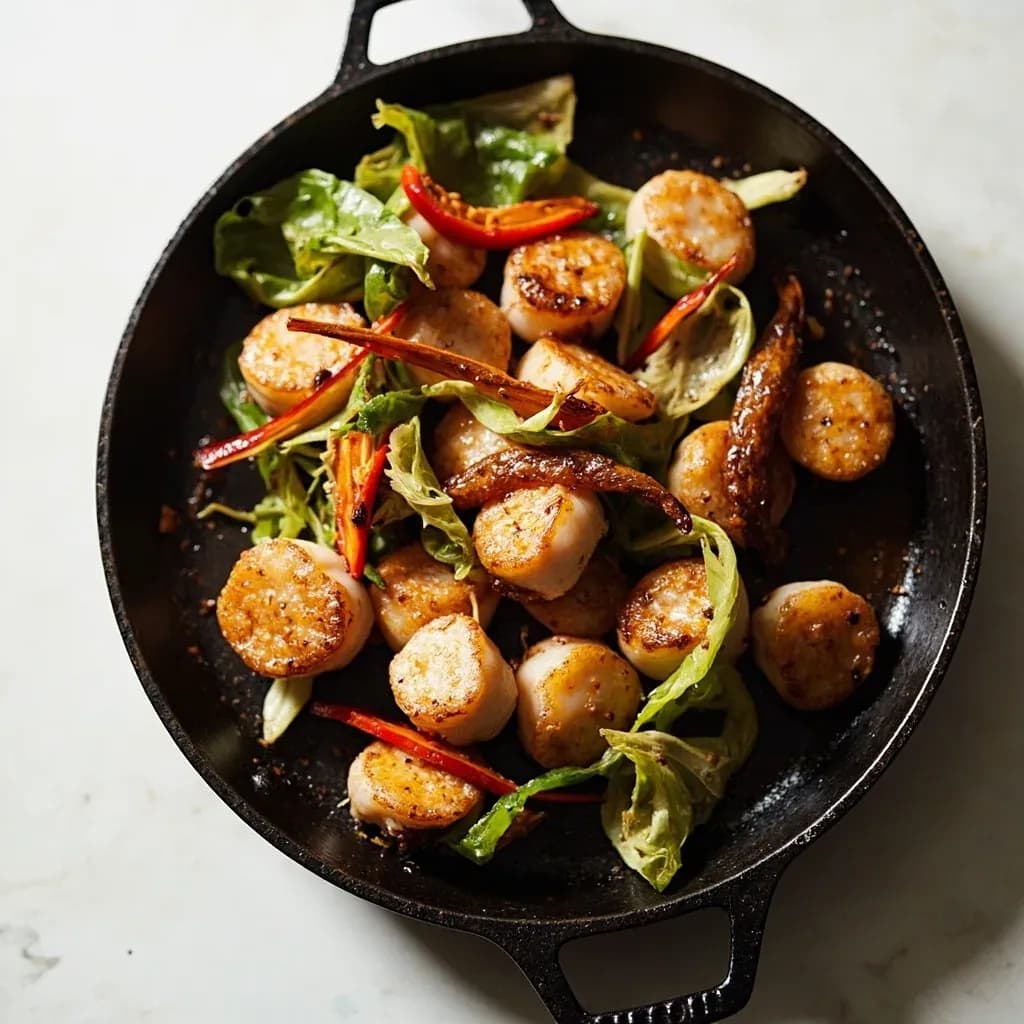
Heat & Fire
Teppanyaki Grilling
Cooking on a flat iron griddle plate, searing meats, seafood, and vegetables tableside.
Teppanyaki is a Japanese technique of cooking on a large flat iron griddle (teppan) heated to high temperatures. The broad, even hot surface sears meats, seafood, and vegetables quickly while letting the cook chop, season, and arrange everything in one place, often as a tableside performance. The flat plate gives more contact and control than open-flame grilling.
Teppanyaki is Japanese grilling on a thick, flat iron plate (the teppan, 鉄板) heated by gas or electric elements, where proteins, seafood, vegetables, rice, and noodles are cooked in rapid succession on the same surface, often within arm's reach of the diner. The technique was named in 1945 by the Misono restaurant in Kobe, which began plating Western-style cuts of beef on a solid griddle in the post-war period — a new approach that ran parallel to, rather than against, the older yakitori tradition. The defining characteristic of a good teppan service is precise heat management: a service temperature of 200–260°C (400–500°F) drives a fast, even Maillard crust on meats and seafood without overcooking the interior, and the chef manages a moving landscape of hot and cooler zones, scraping the plate clean between items so each new ingredient lands on a properly seasoned surface.
In Japan, the form evolved in two directions: the restrained Kobe/Hyogo style that treats high-grade wagyu, garlic rice, and seasonal vegetables with almost reverent minimalism, and the more boisterous Osaka style that tosses offal, tongue, and horumon with aggressive sauces. In the United States, the technique was carried over by Rocky Aoki's 1964 opening of Benihana of Tokyo and reshaped into the now-familiar tableside show — onion volcanoes, shrimp flipped into chef's hats, rice chopped into sizzling mounds. Whether minimalist or theatrical, the discipline underneath is the same: immaculate mise en place, two-spatula knife work, and the confidence to cook each component to order on a surface that never stops giving up heat.
Teppanyaki is frequently confused with hibachi, but they are different pieces of equipment and different cooking traditions. Hibachi (火鉢, 'fire bowl') is a small, portable charcoal or gas grill with an open grate; teppanyaki is a solid plate. Confusing the two is a common English-language shorthand, but in Japan the distinction is absolute, and it changes everything about how the food behaves on the surface.
- Difficulty
- Medium
Types & varieties
The originator; emphasizes high-grade wagyu (Kobe, Matsusaka), garlic rice, and a restrained, ingredient-focused presentation.
Larger teppans, often multiple guests cooking around the same plate, broader ingredient range, slightly more theatrical.
U.S. adaptation built on tableside showmanship — onion volcanoes, shrimp flipped into hats, and a standardized menu.
Features cheaper cuts like offal, tongue, and horumon, plus vegetables tossed aggressively with miso-based sauce.
Steamed wheat noodles cooked on the teppan with a Worcestershire-shoyu sauce, vegetables, and pork.
In wider Japanese usage, 'teppanyaki' refers to anything cooked on a flat iron plate, including monjayaki and okonomiyaki.
How to do it
- 1
Prepare the station
Heat the teppan to 200–260°C (400–500°F). Gather two metal spatulas, tongs, a flat scraper, a small bowl of high-smoke-point oil, salt, pepper, garlic, and any sauces. Trim and portion every protein and vegetable, and stage them within reach — the cooking itself is fast and there is no time to fetch mid-service.
- 2
Oil the plate
Spoon or brush a thin film of oil across the surface and wipe it evenly with a folded paper towel held in tongs. The plate should glisten but not pool; pooled oil smokes and burns the seasoning on the first item that lands in it.
- 3
Cook aromatics and vegetables first
Cut vegetables to a uniform size. Start with the densest (asparagus, zucchini, mushrooms) — they need the longest contact. Add minced garlic and salt only in the last 30 seconds, or it will scorch on a fully heated plate.
- 4
Move to proteins
Pat seafood and meat thoroughly dry, season with salt and pepper, and lay them away from you on the plate. Do not move them for 60–90 seconds; let the crust form undisturbed. Flip once. Push finished items to the cooler outer edge to rest.
- 5
Build rice or noodles
Scrape the plate clean, add a touch of oil, then day-old rice or pre-steamed noodles. Press and chop with the two spatulas to break up clumps, then add sauce and aromatics. For garlic rice, finish with raw minced garlic off the heat so it stays pungent rather than bitter.
- 6
Sauce and finish
Add a final drizzle of soy-tare, ponzu, or a squeeze of lemon over the proteins. Plate directly from the teppan or transfer to warmed dishes so the food doesn't lose its crust on a cold plate.
- 7
Clean the teppan
While the plate is still hot, scrape residue into a waste tray with the flat scraper, then wipe with a barely damp cloth. The surface should be nearly black and dry before the next course or service begins.
Teppanyaki vs. Hibachi
The two terms are routinely conflated in English-language menus, but they describe very different equipment and very different cuisines. Hibachi (火鉢) is a small, portable 'fire bowl' — historically a box of burning charcoal with a wire grate set above it, used for grilling skewered foods like yakitori or whole fish. Teppanyaki uses a solid iron plate, no flame touching the food, with a thick steel surface that retains and radiates heat. A hibachi sears via radiant heat from below and smoke from dripping fat; a teppan conducts heat directly into the food through metal-to-surface contact, producing an even crust and a different Maillard profile. A practical test: if you can spill liquid on it and have it pool and steam, it's a teppan. If it falls through into a fire, it's a hibachi.
Zone Management on the Teppan
A restaurant teppan is rarely one uniform temperature. The center, directly over the burner, is the searing zone — used for the hard crust on wagyu and the initial sear on scallops. The outer edges, especially the corners, run noticeably cooler and act as the holding zone, where finished proteins rest without overcooking. Between courses, the chef scrapes the surface clean with a flat scraper and wipes it with a barely damp cloth, which both removes burnt residue and briefly drops the surface temperature, giving the next ingredient a more controllable starting point. Mastering these moving zones is what separates a teppanyaki cook from someone simply frying on a hot plate.
The Two-Spatula Grip
The signature tool pairing is two metal spatulas, often held in a chopstick-like grip — one in each hand, used together to slice, flip, dice, and plate directly on the surface. The leading edge of the spatula is the chef's knife: garlic is minced, vegetables are chopped, and rice is broken into individual grains, all on the teppan itself. This eliminates a cutting board from the workflow and is the single most distinctive mechanical skill in teppanyaki. At home, a long, offset fish spatula paired with a metal bench scraper is a workable substitute.
Common uses
Tips & pitfalls
- Preheat the teppan for at least 8–10 minutes before oiling; a Maillard crust requires a thoroughly saturated, evenly hot surface, not a tepid one.
- Use a high smoke-point oil (rice bran, grapeseed, or refined canola). Never put butter on the bare plate at service temperature — it burns almost instantly and turns every subsequent ingredient acrid.
- Pat proteins bone-dry and season just before they hit the plate. Surface moisture is the difference between a hard sear and a steamed grey surface.
- Cook in a deliberate order — vegetables, then aromatics, then rice or noodles, then seafood, then red meat — so each item finishes on a clean, appropriately hot zone and the plate never runs out of working space.
- Reserve a 'cool zone' by pushing food toward the outer edge. The center is for crust, the perimeter is for holding, and the two should never be confused.
- For wagyu, lay the meat fat-side down first and let the rendered fat baste the vegetables. Discarding the fat is wasted flavor and a missed opportunity.
- Do not overcook shrimp or scallops: 60–90 seconds per side on a properly hot plate is usually enough. They should be just opaque and still bouncy.
- Home electric teppans run significantly cooler than restaurant gas teppans. Sear in small batches and never crowd the surface, or the temperature will collapse and the food will steam.
Good to know
- Origin
- Japan; the term 'teppanyaki' (鉄板焼き, 'iron plate grilled') was coined in 1945 by the Misono restaurant in Kobe.
- Equipment
- A flat iron or steel griddle called a teppan, typically 3–5 cm thick for thermal mass, heated by gas or electric.
- Service temperature
- 200–260°C (400–500°F); some steakhouses push to 280°C for a hard sear on wagyu.
- Core ingredients
- Beef (often wagyu, sirloin), shrimp, scallops, lobster, chicken, garlic rice, yakisoba noodles, and seasonal vegetables.
- Seasoning tradition
- Minimalist: flaky sea salt, cracked black pepper, grated garlic, soy-based tare, ponzu, and lemon.
- Western popularization
- Brought to the U.S. by Rocky Aoki, who opened Benihana of Tokyo in New York in 1964.
- Utensils
- Two metal spatulas (one doubles as a chopping blade) and tongs; the two-spatula grip is the working posture.
- Not the same as hibachi
- Hibachi is a small charcoal or gas grill with an open grate; teppanyaki is a solid flat plate.
Also called
Teppanyaki · Teppanyaki Grilling · Iron-Griddle Cooking
Related

Sear
Blast the surface hot for a deep-browned, savory crust

Sauté
Cook quickly in a little fat over lively heat, tossing as you go

Stir-Fry
Toss bite-sized pieces over roaring heat for fast, smoky cooking

Pan-Fry
Crisp food in a shallow layer of hot fat, turning once or twice

Deep-Fry
Submerge in hot oil for an all-over crackling crust

Roast
Cook uncovered in dry oven heat for browned edges and tender centers

Bake
Cook with steady, surrounding oven heat — the soul of bread and pastry

Broil
Hit food from directly above with fierce overhead heat