Heat & Fire
Toast-and-Grind Method
Dry-toasting whole spices to bloom their oils, then grinding them fresh for maximum aroma.
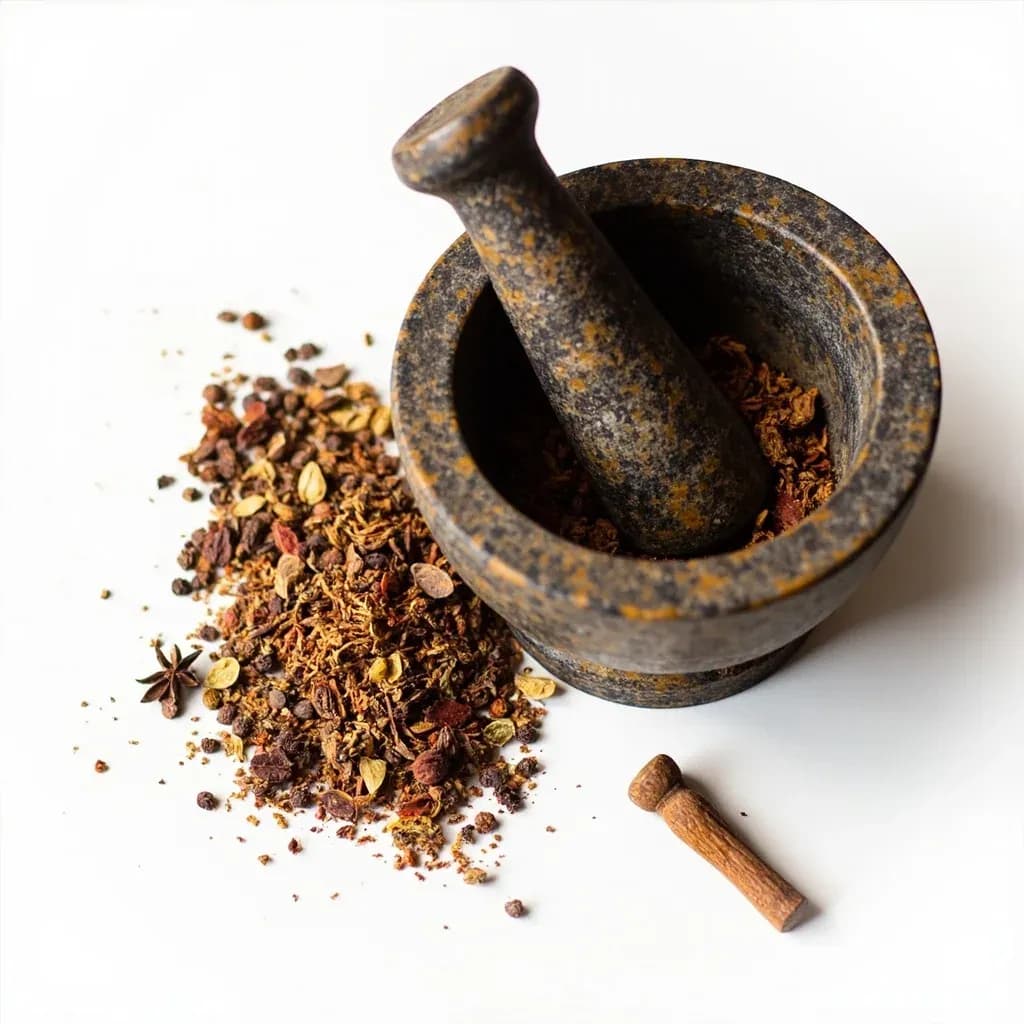
The toast-and-grind method dry-roasts whole spices in a hot pan until fragrant, then cools and grinds them into fresh powder. Toasting drives off raw moisture and activates volatile aromatic oils, giving far deeper flavor than pre-ground spice. It is the foundational step for fresh curry powders, garam masala, and spice rubs.
The toast-and-grind method is a two-stage dry-heat technique that turns sleepy jars of whole spices into the most aromatic powder you can make at home. First, whole seeds, pods, or bark are toasted in a dry pan until their volatile essential oils bloom and the surface takes on a shade or two of deeper color. Then, while the spices are still warm, they're crushed or ground. The warmth keeps those newly released oils moving and volatile, so they end up in your dish rather than reabsorbing back into the seed.
This is fundamentally different from blooming spices in oil or from making a tadka (also called tempering or chhonk), where whole or ground spices are briefly sizzled in hot fat to flavor the fat itself. Here there is no fat, and the goal is the spice, not the medium. The heat is gentle — medium to medium-low — and the cook is short, often under three minutes. Run the pan too hot and you'll torch the most aromatic compounds in the seed before they ever reach your food; run it too cool and you're left with the flat, dusty taste of a spice that should have been replaced last year.
The payoff is striking: a teaspoon of freshly toasted-and-ground cumin will perfume a pot of dal in a way that pre-ground supermarket cumin cannot. The method is forgiving in equipment (any heavy pan, a comal, a tava, even a sheet pan in the oven) but unforgiving in timing. That's why smell, not the clock, is the cook's best instrument.
- Difficulty
- Easy
Types & varieties
Standard home method using a single heavy skillet over medium heat with constant motion
Traditional Mexican flat griddle; good for larger batches and works especially well for whole dried chiles alongside seeds
Indian flat or slightly concave griddle; classic surface for assembling curry-spice blends
Spreads spices on a sheet pan at 150–165°C / 300–325°F for even, lower-risk batches
Charcoal or gas flame directly under a mesh or dry pan; lends a smoky edge, used for whole chiles and cumin in some regional cuisines
Spices stirred in a pan with coarse salt, which buffers heat and prevents scorching of delicate seeds
How to do it
- 1
Select whole spices
Choose whole, fresh spices. Test each by crushing one seed between your fingers and smelling it; if the aroma is flat or dusty, the spice is past its prime and toasting won't rescue it.
- 2
Measure and stage
Measure by volume or weight and group spices by density and size. They'll be toasted in separate batches, because a small mustard seed and a fat coriander seed don't share a clock.
- 3
Heat the pan dry
Place a heavy skillet, comal, or tava over medium to medium-low heat. No oil. Let it warm for about a minute; flick a drop of water onto the surface — if it skitters and evaporates, you're in range.
- 4
Add a single layer of spices
Pour in enough seeds or pods to cover the pan in one uncrowded layer. Crowding steams them instead of toasting, and uneven toasting is the most common cause of bitter blends.
- 5
Stir or shake constantly
Keep the spices moving with a wooden spatula or by tossing the pan. Watch for color change, swelling (mustard seeds fatten before they pop), and the first audible cues.
- 6
Pull at the aroma peak
Remove the pan from heat the moment the smell shifts from raw and dusty to warm, nutty, and pronounced. This is typically 1–3 minutes for most seeds; cloves, sesame, and other tiny or oily seeds can be done in under a minute.
- 7
Cool briefly on a flat surface
Tip the spices onto a cool plate, a metal sheet, or a stone countertop. They should still feel warm — not hot — when you move to grinding. Leaving them in the hot pan carries the residual heat forward and can scorch them after the fact.
- 8
Grind to target texture
Use a mortar and pestle for fullest flavor (and the most oil release), a blade grinder for speed, or a burr mill for a uniform powder. Grind while still warm, pausing to stir and let heat dissipate, especially in a blade grinder where friction can re-toast the spice.
- 9
Sift or crush as needed
For rubs and finishing spices, a coarse crack is ideal. For curry powders and spice blends, sift out any large bits through a fine mesh and regrind them so the blend integrates evenly.
- 10
Use soon or store airtight
Fold the ground spice into your dish within minutes for peak aroma, or seal it in a small jar away from light and heat. Toasted-and-ground spices are at their best for a couple of weeks; plan to toast only what you'll use in that window.
The Chemistry of the Bloom
Whole spices store their flavor in two places: in volatile aromatic compounds locked inside oil-bearing cells, and in slower-moving background notes that need a little coaxing. Gentle dry heat ruptures those cells and lets the volatile oils escape into the air, which is why a pan of toasting cumin can perfume a kitchen in under a minute. At the same time, surface sugars and amino acids undergo a light Maillard reaction, producing the deeper, nuttier, almost-caramelly edge that raw spices lack.
The danger zone is narrow. Once the pan passes roughly 180°C / 350°F at the seed surface, the same volatile oils that smelled glorious begin to pyrolyze, breaking down into the sharp, acrid, singed notes most people associate with 'burnt curry powder.' The art of the method is to thread that needle — to drive off just enough moisture and break open just enough cells to release the aroma, and to pull the pan before the aromatics turn on themselves.
- Volatile oils are the headline act: aldehydes, terpenes, and pyrazines that vaporize at relatively low temperatures
- Maillard browning adds depth but also signals the approach of the burn point — color is a lagging indicator, smell is leading
- Cumin's signature warm, spicy note comes largely from cuminaldehyde, which is highly volatile and fades within minutes of grinding if the spice is left to cool too long
How It Differs From Related Techniques
The toast-and-grind method is one of three or four ways cooks coax flavor from whole spices, and the differences matter. Tadka (also called tempering, chhonk, or baghar) drops spices into hot fat, usually at the start of cooking, so the fat becomes the carrier of flavor. Blooming in oil is a Western cousin — ground or whole spices are cooked briefly in fat to infuse it, used either at the start of a dish or as a finishing drizzle. Wet roasting simmers spices with moisture until they soften into a paste, the foundation of curry pastes in Thailand, Vietnam, and parts of India. Dry toasting-and-grinding is the only one of these that uses no fat, no moisture, and aims to deliver the spice itself — ground and ready to be measured into a recipe or dusted over a finished plate.
- Tadka / tempering: spices sizzle in hot ghee or oil; the oil is the flavor vehicle
- Blooming in oil: ground or whole spices cooked briefly in fat to infuse it, used at the start of a recipe or as a finishing step
- Wet roasting: spices simmered with liquid into a paste, used as a curry base
- Toast-and-grind: dry heat only, spice is the goal, ground while still warm
Common uses
Tips & pitfalls
- Smell is more reliable than color: pull the pan the moment the aroma turns rich and rounded; burned spices smell acrid or singed, and you'll smell the mistake before you see it.
- Toast spices separately by density and size. Cumin and coriander take longer than fennel or mustard; cloves and sesame can scorch in under 30 seconds.
- Warm your mortar and pestle with hot water, then dry it thoroughly, before grinding. A warm vessel keeps volatile oils moving instead of condensing back into the seed.
- Grind while still warm, ideally within a minute of toasting. As the spice cools, some aromatics reabsorb into the cell structure and the open-pan smell becomes a closed-jar whisper.
- Use a heavy pan. Thin pans create hot spots that scorch seeds before their neighbors have toasted; cast iron, carbon steel, and clad stainless all do the job well.
- Keep the spices moving — toss, shake, or stir constantly. Never walk away, especially with small seeds, which can go from golden to black in seconds.
- Remove from the hot pan immediately and spread on a cool plate or sheet. Residual heat in a crowded pan can carry the cook forward and scorch a perfectly toasted batch.
- For very oily seeds like coriander or fennel, lower the heat and toast a touch longer to drive off moisture without burning; their high oil content makes them prone to flash-toasting.
Good to know
- Method type
- Two-stage dry-heat technique: pan-toasting whole spices, then grinding them while still warm
- Heat medium
- Dry pan, no oil or fat
- Typical pan temperature
- Medium to medium-low; spices should sizzle gently, not smoke
- Toasting time
- 30 seconds to 4 minutes, depending on spice size and density
- Key indicator of doneness
- Color deepens by one or two shades and aroma becomes markedly fuller and nuttier
- Best equipment
- Heavy skillet (cast iron, carbon steel, or clad stainless), comal, or dry tava
- Grinding tools
- Mortar and pestle, blade grinder, or burr mill
- Yield effect
- Releases volatile essential oils and creates light Maillard compounds that deepen flavor
- Difficulty
- Low to moderate; the technique is forgiving in equipment, critical in timing
- Cuisine traditions
- Central to Indian, Mexican, Ethiopian, North African, Middle Eastern, and Levantine cooking
Also called
Dry-Toasting Spices · Roasting and Grinding Spices
Dishes that rely on it
Related

Sear
Blast the surface hot for a deep-browned, savory crust

Sauté
Cook quickly in a little fat over lively heat, tossing as you go

Stir-Fry
Toss bite-sized pieces over roaring heat for fast, smoky cooking

Pan-Fry
Crisp food in a shallow layer of hot fat, turning once or twice

Deep-Fry
Submerge in hot oil for an all-over crackling crust

Roast
Cook uncovered in dry oven heat for browned edges and tender centers

Bake
Cook with steady, surrounding oven heat — the soul of bread and pastry

Broil
Hit food from directly above with fierce overhead heat