Heat & Fire
Dry-Toasting Spices
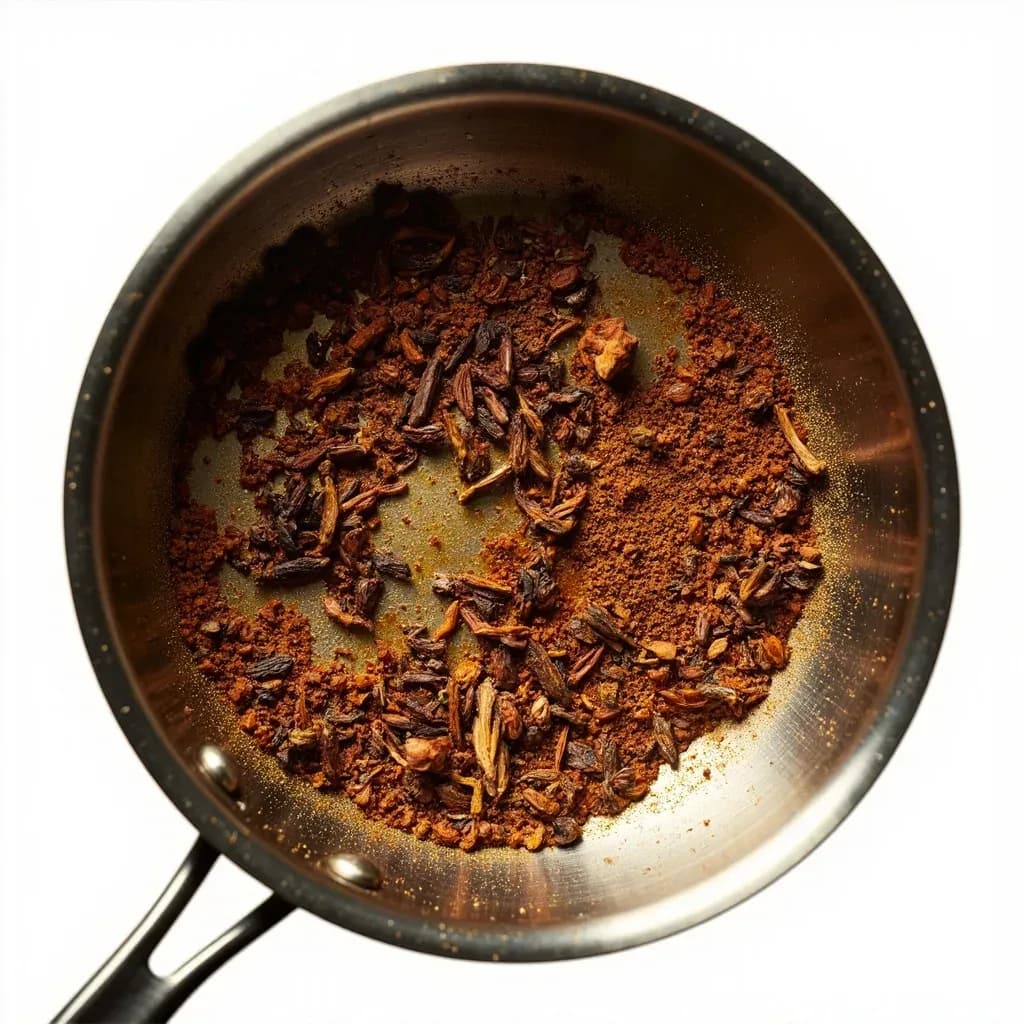
Toasting whole spices in a dry pan to release deeper, fuller aromas.
Dry-toasting heats whole spices in a dry pan or over an open flame until they darken slightly and become fragrant, driving off raw notes and unlocking volatile oils. Toasted spices are then ground or used whole for noticeably deeper flavor in curries, spice blends, and rubs. Constant movement and a watchful eye prevent the small seeds from scorching and turning bitter.
Dry-toasting is the brief application of dry heat to whole spices in an ungreased pan, and it is one of the most powerful flavor transformations a cook can perform in under three minutes. Heat drives off residual moisture, ruptures the seed's outer coat, and triggers Maillard-style browning reactions that generate dozens of new aromatic compounds — pyrazines, aldehydes, and furans that exist only in trace amounts in the raw seed. The same cumin, the same coriander, the same fennel tastes richer, sweeter, and noticeably more complex after a short toast; you are not merely waking the spice, you are cooking it into a different ingredient.
Because volatile oils are released and partially lost during the process, dry-toasting trades a little of a spice's raw pungency for depth, nuttiness, and a darker, rounder aromatic profile. This is the trade-off Indian tadka, Ethiopian berbere, Mexican comal-toasting, and the dry-roasting of components for Chinese five-spice all exploit: a brief, controlled application of heat that turns an everyday spice into the soul of a dish. The technique is universal, but it rewards understanding its narrow margin — most seeds go from perfectly toasted to acrid and burnt in well under a minute once they begin to color.
The cardinal rules are simple and unforgiving: even heat, constant motion, small batches, and immediate removal from the pan. Once you have internalized those, dry-toasting becomes less a special technique and more a reflex — the first thing you reach for when a dish tastes flat and the last thing you skip when it doesn't.
- Difficulty
- Easy
Types & varieties
Standard Western approach: heavy skillet over a burner, small batches, constant motion.
Traditional in Mexican, Indian, and Middle Eastern kitchens; good for larger seed quantities and even contact.
High-walled pan that lets tossing seeds be returned easily; common in Chinese dry-roasting.
Spread on a sheet pan at 150–160°C / 300–325°F for 5–10 minutes; better for large quantities, lower risk of scorching.
Spices are dry-toasted first, then bloomed in hot fat (ghee, oil, butter) as a finishing technique.
Toasting just before stone-grinding or mortar-and-pestling for garam masala, dukkah, baharat, berbere, and curry powders.
How to do it
- 1
Choose the right pan and heat
Select a heavy-bottomed skillet (cast iron or stainless steel), a comal, or a dry wok. Set over medium to medium-low heat and let the pan preheat for about 30–60 seconds. It should be hot enough that a drop of water skitters across the surface, not so hot that it smokes.
- 2
Add whole spices in a single layer
Add your whole spices — cumin, coriander, fennel, mustard, cardamom, cloves, peppercorns, chilies, and so on — in a thin, even layer. Avoid overcrowding; work in small batches of 1–3 tablespoons at a time so every seed contacts the pan.
- 3
Stir or shake constantly
Keep the spices moving. Swirl the pan or stir with a wooden spoon so nothing sits in one spot long enough to scorch. Watch and listen: mustard, cumin, and fennel will begin to pop or jump, and a deep, toasty aroma will rise.
- 4
Toast until fragrant and lightly colored
Most seeds and small spices need 1–3 minutes; larger items like cinnamon sticks or dried chilies may take a little longer. You are looking for a shade or two deeper in color and a noticeably fuller, nuttier aroma — not dark brown or smoky.
- 5
Remove from heat immediately
Pull the pan off the burner the instant the spices smell fully toasted. Carryover heat from the metal keeps cooking them, so do not wait for one more minute.
- 6
Transfer to a cool surface
Tip the spices onto a cool plate, a sheet pan, or into a bowl — never leave them in the hot pan. Spreading them out also helps them cool quickly and evenly.
- 7
Use or store
Use right away in a tempering, grind while warm for maximum aroma, or let cool completely before sealing in an airtight container. Toasted whole spices keep their punch for several months; ground blends are best within 2–3 months.
What actually changes when you toast a spice
A raw seed is roughly 8–12% water by weight, and that water dulls its flavor. Dry heat evaporates it, concentrating the fixed oils and sugars already present. At higher surface temperatures — typically above 130°C / 265°F — amino acids and reducing sugars begin to react in the Maillard pathway, producing the toasted, bread-like, sometimes cocoa-like notes that define a properly toasted spice. Smaller molecules called pyrazines, formed through Strecker degradation and related Maillard pathways, are particularly responsible for the earthy, roasted aroma of toasted cumin and coriander. Volatile terpenes and aldehydes, which give raw spices their bright top notes, are partly driven off; what remains is deeper, less pungent, and more integrated into a finished dish. The practical implication: a toasted spice behaves differently in a recipe, and you generally need slightly less of it to achieve the same aromatic impact.
Choosing which spices to toast
Not every spice benefits equally. Small, oily seeds — cumin, coriander, fennel, mustard, nigella, caraway, dill — respond dramatically and are the safest place to start. Harder items like peppercorns, cardamom pods, cloves, and whole dried chilies benefit as well but can scorch at the edges before the centers warm. Bark spices (cinnamon, cassia) and large pods (cardamom) tolerate longer toasting and a slightly higher heat. Ground spices toast unevenly because their high surface area hits the hot metal almost instantly; many cooks prefer to toast whole and grind after, which gives a fresher, more complex powder than pre-ground blends.
- Most responsive: cumin, coriander, fennel, mustard, nigella, caraway
- Reliable with attention: peppercorns, cardamom pods, cloves, allspice, star anise
- Larger and slower: cinnamon sticks, cassia bark, dried chilies, bay leaves
- Handle with care: ground spices, fenugreek (very bitter if overdone), sesame seeds (burn in seconds)
Common uses
Tips & pitfalls
- Use a heavy, dry pan — thin pans create hot spots that scorch seeds before others color.
- Preheat the pan before adding spices so toasting starts immediately and evenly.
- Add spices to a DRY pan — any moisture will cause spattering and uneven browning.
- Stir, swirl, or shake the pan almost constantly; most seeds go from toasted to burnt in 20–30 seconds.
- Pull the pan off the heat the moment spices smell fully fragrant — carryover heat will finish them.
- Transfer toasted spices to a cool plate or bowl right away; leaving them in the hot pan continues cooking.
- Toast in small batches; a single layer toasts, a piled mass steams.
- Toasting ground spices is risky: use very low heat, watch constantly, and consider toasting whole and grinding after.
- Always let toasted spices cool completely before grinding or storing; residual heat drives off volatile oils and can fog storage containers.
- Bloom toasted spices in fat (ghee, oil, butter) within a few minutes of toasting for maximum flavor release.
Good to know
- Category
- Dry-heat cooking technique
- Primary equipment
- Heavy-bottomed skillet, cast-iron pan, comal, or dry wok
- Heat level
- Medium to medium-low
- Typical time
- 1–3 minutes per batch
- Best for
- Whole spices; ground spices require very low heat and constant attention
- Visual cue
- Spices deepen in color, may darken slightly, and release strong aroma
- Auditory cue
- Mustard, cumin, and fennel seeds pop or jump in the pan
- Yield
- Noticeably more aromatic than untoasted; minimal change in weight
- Origin / tradition
- Practiced across Indian, Middle Eastern, North African, Ethiopian, Chinese, and Latin American cuisines for centuries
- Related technique
- Forms the dry stage of Indian tadka (tempering), after which fat is added
- Storage of toasted spices
- Cool fully before grinding; store airtight, away from light, up to 6 months for ground blends
Also called
Dry-Roasting Whole Spices · Open-Flame Toasting · Toasting on the Flame · spice toasting
Related

Sear
Blast the surface hot for a deep-browned, savory crust

Sauté
Cook quickly in a little fat over lively heat, tossing as you go

Stir-Fry
Toss bite-sized pieces over roaring heat for fast, smoky cooking

Pan-Fry
Crisp food in a shallow layer of hot fat, turning once or twice

Deep-Fry
Submerge in hot oil for an all-over crackling crust

Roast
Cook uncovered in dry oven heat for browned edges and tender centers

Bake
Cook with steady, surrounding oven heat — the soul of bread and pastry

Broil
Hit food from directly above with fierce overhead heat