Heat & Fire
Toasting Whole Spices
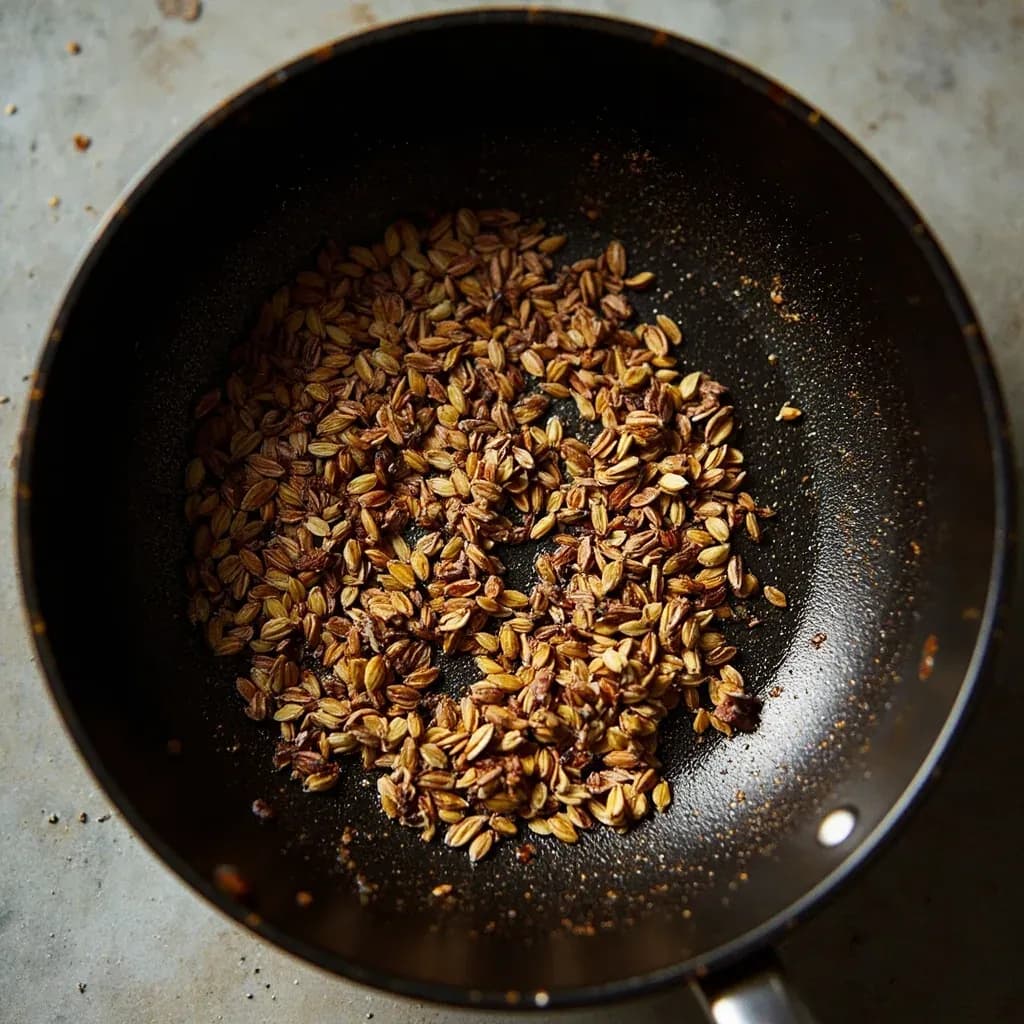
Dry-heating whole spices in a hot pan to release their aromatic oils before grinding.
Toasting whole spices in a dry skillet over medium heat awakens the volatile oils locked in seeds and pods, deepening their fragrance and adding a warm, nutty complexity. It is a foundational step in cuisines from India to Mexico, done just until the spices smell fragrant and turn a shade darker, usually under two minutes. The toasted spices are then ground fresh, which gives a far brighter result than pre-ground packaged powders.
Toasting whole spices is the act of dry-heating seeds, pods, and bark in a hot pan to coax out the volatile oils locked inside them. Heat ruptures the seed's outer coat and vaporizes the lighter aromatic compounds — the terpenes, aldehydes, and pyrazines that give a spice its characteristic smell. The same chemistry that makes a cumin seed smell earthy in your hand makes it taste muted in a dish; toasting is what bridges that gap.
The payoff is dramatic. Spices that have been toasted and freshly ground typically read as two to three times more flavorful than the same spice used raw, and the difference between a flat curry powder and a fragrant one almost always lives in this step. The risk is equally real: the window between perfectly toasted and bitter can be as narrow as fifteen seconds, especially with small, oil-rich seeds like mustard or fenugreek. Treat toasting like searing a steak — controlled, attentive, and pulled early.
Foundational across Indian, North African, Middle Eastern, Mexican, Ethiopian, and Chinese cuisines, the technique travels under many names — bhuna, chaunk, blooming, dry-roasting — but the principle is identical: dry heat, single layer, constant motion, and a quick exit. Once you build the habit, it becomes the single highest-leverage step in your spice work, costing almost nothing in time while multiplying what the rest of the dish can do.
- Difficulty
- Easy
Types & varieties
Spices heated alone in a dry skillet; the standard method and the most universal. In Indian cooking this is also called 'bhuna'.
Spreads spices on a sheet pan at 150-160°C / 300-325°F for 5-10 minutes; hands-off and good for large batches or delicate blends.
Traditional Mexican flat-griddle method used for cumin, peppercorns, and dried chilies.
Skewer or directly toast individual pods (cardamom, star anise) over a gas flame for a smoky edge.
Spread between paper towels at full power in 30-second bursts; convenient but uneven and easy to scorch.
Closely related Indian variant where spices are bloomed in hot ghee or oil; the fat itself becomes flavored and is used as a finishing condiment.
How to do it
- 1
Choose spices and prep the pan
Select whole, dry spices. Place a heavy skillet (cast iron, carbon steel, or stainless steel) over medium or medium-low heat and let it warm for about a minute. No oil is needed; the pan must be completely dry.
- 2
Add spices in a single layer
Pour in just enough spice to cover the bottom of the pan without crowding. Work in batches if needed — a thick layer steams instead of toasting and toasts unevenly.
- 3
Shake or stir constantly
Keep the spices moving, either by shaking the pan with a wrist flick or stirring with a wooden spoon. The goal is contact with heat without any single seed sitting still long enough to burn.
- 4
Watch and smell
After 30-60 seconds you'll notice the first wave of aroma; this is the sign to pay close attention. Color change (golden, nut-brown, or a touch of smoke on seeds like cumin) confirms the toast. Most spices are done in 1-4 minutes; tiny seeds and powder-prone spices (mustard, fenugreek) are fastest.
- 5
Pull the pan off the heat at the right moment
Err on the side of slightly underdone — spices continue cooking from residual heat. The moment the fragrance is bold and the color has just shifted, remove the pan from the burner entirely.
- 6
Transfer immediately to a cool surface
Spoon or pour the spices onto a cold plate, metal bowl, or parchment. Leaving them in the hot pan is the most common cause of a bitter, burnt finish.
- 7
Cool fully before grinding or storing
Let the spices cool 5-10 minutes until they are no longer warm to the touch. Hot spices clump in grinders, can clog sieves, and will keep cooking if sealed in a container.
- 8
Grind or use as needed
Crack with a mortar and pestle, run through a spice grinder, or drop whole into a dish. Use soon — toasted spices lose their edge faster than raw whole ones.
Spice timing hierarchy
Not all spices tolerate heat equally. Hardy, dense seeds can take several minutes of medium heat; tiny, oil-rich seeds and delicate buds scorch in under a minute. When building a blend, either toast in stages or split the work into a first wave (the sturdy seeds) and a second wave (everything that needs gentler treatment).
- Hardy seeds (cumin, coriander, fennel, caraway, peppercorns): medium heat, 2-4 minutes, almost always added first.
- Bark and pods (cinnamon sticks, star anise): medium heat, 2-3 minutes, often toasted with the first wave.
- Small oil-rich seeds (mustard, nigella, sesame, fenugreek): medium-low heat, 30-90 seconds, usually added last — fenugreek in particular turns bitter fast.
- Delicate buds and seeds (cardamom, cloves, nutmeg): lowest heat or off the burner, 30-60 seconds.
- Dried chilies: medium heat, 30-60 seconds per side; press flat against the pan for an even char and to bring out sweetness.
Common uses
Tips & pitfalls
- Always start with a fully dry pan — any moisture makes spices steam rather than toast and can cause spattering.
- Toast in small batches in a single layer; overcrowding steams the spices and toasts unevenly.
- Shake or stir constantly; stationary spices scorch in the spot touching the pan.
- Watch the smell more than the color — fragrance peaks just before burning starts, and color change can lag behind the actual flavor peak.
- Delicate spices (cloves, cardamom, fenugreek, nutmeg) go in last or use lower heat; hardy seeds (cumin, coriander, fennel) can take more.
- Transfer to a cool plate, metal bowl, or parchment the moment they're done. The residual heat of the skillet keeps cooking them — leaving them in the pan is the most common cause of a burnt, bitter finish.
- Never grind hot. Let spices cool 5-10 minutes until no longer warm to the touch, or you'll get a clumpy, gummy paste and clog your grinder.
- Store toasted spices whole and grind as needed; pre-grinding exposes far more surface area to oxidation and aroma fades within weeks.
Good to know
- Also called
- Dry-roasting, blooming, or dry-frying; 'bhuna' in Indian cooking, and 'tadka' or 'chaunk' when spices are bloomed in hot fat rather than dry
- Heat level
- Medium or medium-low; too high scorches the oils and turns spices bitter within seconds
- Typical time
- 30 seconds to 5 minutes depending on the spice; delicate spices (cloves, cardamom) finish far faster than hardy seeds (cumin, coriander)
- Visual cue
- Slight darkening, a wisp of smoke, and a sudden burst of fragrance
- Yield benefit
- Perceived flavor intensity typically increases 2-3× over untoasted equivalents when freshly ground after toasting
- Cooling requirement
- Must cool 5-10 minutes before grinding; hot spices clump, keep cooking, and can ruin grinders
- Storage
- Airtight jar, away from light, once fully cooled; toasted spices lose aroma within 2-4 weeks versus 6+ months for raw whole spices
Also called
Spice Toasting · Dry-Roasting Spices · Dry-Frying Spices · Dry-Roasting Whole Spices
Dishes that rely on it
Related

Sear
Blast the surface hot for a deep-browned, savory crust

Sauté
Cook quickly in a little fat over lively heat, tossing as you go

Stir-Fry
Toss bite-sized pieces over roaring heat for fast, smoky cooking

Pan-Fry
Crisp food in a shallow layer of hot fat, turning once or twice

Deep-Fry
Submerge in hot oil for an all-over crackling crust

Roast
Cook uncovered in dry oven heat for browned edges and tender centers

Bake
Cook with steady, surrounding oven heat — the soul of bread and pastry

Broil
Hit food from directly above with fierce overhead heat