Transform & Preserve
Water Activity Control
Lowering available water in food, via salt, sugar, or drying, to halt microbial growth.
Water activity control manages the amount of free water in food, measured as aw, since microbes need available water to grow rather than total moisture. Cooks reduce it by drying, salting, adding sugar, or curing to make cured meats, jams, and dried goods shelf-stable. Hitting the right aw threshold is what makes a product safe at room temperature.
Water activity — written aw — is the single most important number a food microbiologist cares about, and the invisible reason a great many traditional recipes work. It is the ratio of the partial vapor pressure of water in a food to the vapor pressure of pure water at the same temperature, on a scale from 0.0 (bone-dry) to 1.0 (pure water). Microbes do not grow on water itself; they grow on water that is available to them, and aw measures exactly that. Lowering aw by adding salt or sugar, or by driving off moisture, is the oldest preservation strategy in the kitchen, and it is the mechanism behind everything from prosciutto to peach preserves.
The critical distinction for cooks is that aw is not the same as moisture content. A pot of jam is roughly 33% water by weight but its aw sits around 0.82, low enough to keep mold at bay. Fresh bread is about 35–40% water with aw near 0.95, which is why it molds in days and crackers do not. The difference is what is dissolved in that water: dissolved solutes bind water molecules and make them unavailable to spoilage organisms. Pathogenic bacteria generally need aw above about 0.91, most yeasts above 0.88, and only a few xerophilic molds can creep down to 0.60 or so. In practice, the home cook controls aw through three levers: the ratio of solute to water, the final moisture, and the storage temperature.
- Difficulty
- Hard
Types & varieties
NaCl lowers aw by binding water; dry cures, brines, and marinades all exploit this. Most pathogens are inhibited at 8–10% NaCl in the water phase.
Sucrose, glucose, fructose, and high-fructose corn syrup tie up water; jams, glazes, and confits rely on it. ~65% soluble solids (°Brix) brings aw to roughly 0.85.
Mechanical, solar, or air drying removes water directly. Freeze-drying gives the lowest aw for a given moisture because ice-bound water sublimes away.
Evaporating water from juices, stocks, milk, or syrups raises solute concentration and lowers aw; the basis of condensed milk, demi-glace, and caramel.
Glycerol, sorbitol, propylene glycol, and honey bind water strongly; used in intermediate-moisture pet foods and some modern confections to keep texture stable.
Salt + smoke + drying (prosciutto, biltong, country ham) and sugar + acid + pectin (jams) layer aw reduction with pH and antimicrobials for robust safety.
How to do it
- 1
Set a target aw for the food
Decide how long the product must keep and on what shelf. Working rules: aw ≤ 0.60 for honey and very dry foods; ambient-stable dried fruit typically lands at 0.60–0.70; 0.80–0.85 for jams and sweet preserves; 0.85–0.90 for cured meats, which combine aw reduction with salt, smoke, or curing salts; 0.86–0.91 only with combined hurdles (salt plus pH, or refrigeration).
- 2
Choose the primary method
Sugar and concentration for sweet preserves; salt and drying for meats and fish; mechanical drying for fruits, herbs, and crackers; salt plus smoke plus dry aging for traditional charcuterie.
- 3
Calculate the dose by mass
Weigh solutes against the water in the food, not the total mass. For a 1 kg food at 70% water (700 g water), 70 g salt equals 10% in the water phase. Use a refractometer (°Brix) for sugar systems and straightforward mass math or a salinometer for salt systems.
- 4
Apply and equilibrate
Brine, dry-cure, simmer, dehydrate, or concentrate until solutes are evenly distributed. Cured meats need days to weeks of equilibration; jams need a clear set near 105 °C (220 °F) or 65 °Brix; dried foods need a steady-state weight that does not change day to day.
- 5
Measure the final aw
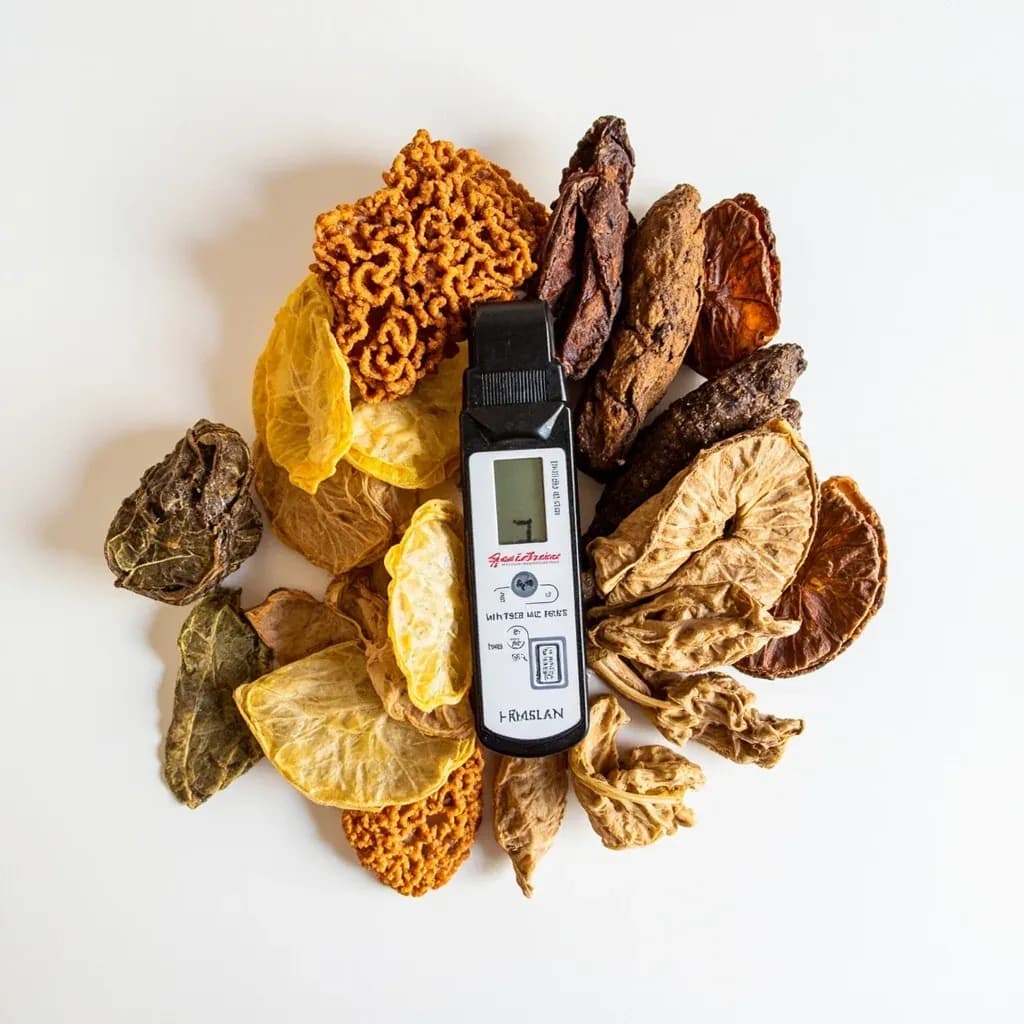
Use a calibrated water activity meter at the planned storage temperature. Confirm the reading is in the safe range for the product class before packaging. If you do not have a meter, follow validated time, temperature, and concentration targets and treat the margin of error as small.
- 6
Package and store appropriately
Seal against moisture pickup — vacuum seal, jar with a tight lid, or foil overwrap. Store cool. Refrigeration extends the safe life of any borderline-aw product and is cheap insurance for home cooks. Aw creeps up in warm, humid kitchens faster than the recipe assumes.
Why traditional recipes work
Water activity control is rarely named in cookbooks, but it is the silent reason a recipe specifies a finish temperature, a salt percentage, or a drying time. Italian salami, Spanish jamón, Moroccan preserved lemons, Chinese century eggs, Japanese nukazuke, and every pot of jam on a stovetop are all aw-control projects. The recipe is the math made edible. When a jam recipe says 'cook to 220 °F / 105 °C,' it is really saying 'reach ~65 °Brix so the aw falls below 0.85.' When a charcuterie formula says '2.5% salt by weight of meat,' it is really saying 'hold the water-phase salt high enough to suppress pathogens while the meat dries toward aw 0.90.' Recognizing aw as the underlying variable makes it much easier to adapt old recipes to new ingredients or climates.
- Botulism risk in home ferments and garlic-in-oil comes from aw above ~0.94 combined with low acid and warm, anaerobic storage — the classic triple failure.
- The 1953 paper by W. J. Scott at CSIRO is the canonical citation for the aw concept in food science.
- Validated acid-preserved recipes (jams, pickles, fruit butters) always pair low aw with low pH for safety, since neither hurdle alone is considered sufficient.
Calculating solute dose by mass
Salt and sugar are most reliably added as a percentage of the water in the food, not the total mass. A 1 kg food with 70% water (700 g water) needs 70 g of salt for 10% in the water phase. For sugar systems, a refractometer reading of °Brix is the easiest proxy; for salt systems, weigh the water phase and the salt separately, or measure the brine with a salinometer. Invert sugar depresses aw slightly more than sucrose at the same Brix, which is partly why some commercial jam formulas use glucose syrup.
Common uses
Tips & pitfalls
- Test at the storage temperature you will actually use — aw rises roughly 0.01–0.02 per 10 °C of warming in many high-salt systems, which can pull a borderline-safe product out of the safe zone.
- Do not substitute aw targets for moisture targets. A '60% moisture' specification is meaningless without knowing what solutes are dissolved in that water.
- Salt works by mass, not by volume. Always calculate brine percentage against the mass of water in the food, not the total mass.
- In jams, target 65 °Brix or higher (refractometer) to reliably reach aw below ~0.85. Invert sugar depresses aw more than sucrose at the same Brix.
- Cured meats are considered safe from botulism when aw and salt reach validated limits together, for example 5% NaCl in the water phase combined with aw below 0.97, or stricter combinations per USDA FSIS Appendix A.
- Wood, cloth, and the moldy surfaces of 'good' sausages carry xerophilic molds that tolerate aw down to ~0.70. Keep aging rooms clean and humidity-controlled.
- Dried foods are hygroscopic. Package with desiccant or vacuum-seal once conditioned, otherwise aw creeps back up and mold follows within days.
- Err on the side of lower aw for long storage; the gap between 'safe in theory' and 'safe on a warm kitchen shelf' is the margin you cannot afford to lose.
Good to know
- Definition
- Water activity (aw) is the ratio of the partial vapor pressure of water in a food to the vapor pressure of pure water at the same temperature; ranges from 0.0 (bone-dry) to 1.0 (pure water).
- Not the same as
- Moisture content. A high-moisture food like jam can have low aw (~0.82), and a drier food can have higher aw if the water is loosely bound.
- Bacterial growth limits
- Most pathogens are inhibited below aw ~0.91. Salmonella needs aw above ~0.94, C. botulinum above ~0.94, and Staphylococcus aureus toxin formation is halted near 0.86.
- Yeast and mold limits
- Most yeasts stop near aw 0.88; xerophilic molds (Eurotium and relatives) can grow down to aw ~0.61, which is why even dried fruit must be packaged carefully.
- Typical jam
- aw ~0.82–0.85 at 65–68% soluble solids, the classical set point for fruit preserves.
- Cured meats
- Salami and dry-cured hams finish around aw 0.85–0.90; safety comes from combining lower aw with salt, pH, and sometimes smoke or curing salts.
- Equivalence
- Water activity × 100 equals the Equilibrium Relative Humidity (ERH) of the product, in percent — the humidity the food will reach in a sealed jar.
- Measurement
- Dedicated aw meters use chilled-mirror dew point or capacitance sensors; readings depend on temperature, so measure at the planned storage temperature.
Also called
Aw Control · Water Activity Management
Related

Confit
Cook slowly submerged in fat for silky tenderness and keeping

Cure
Draw out moisture with salt and time to preserve and concentrate

Pickle
Steep in acidic brine for bright, tangy, crunchy preservation

Ferment
Let friendly microbes transform food into tangy, complex flavor

Marinate
Soak in a seasoned mix to flavor and tenderize before cooking

Brine
Soak in salt water so meat stays juicy and seasoned throughout

Dehydrate
Slowly dry out moisture to concentrate flavor and extend shelf life

Cold-Smoke
Perfume cured food with smoke without cooking it through