Prep & Assembly
Yuba Skimming
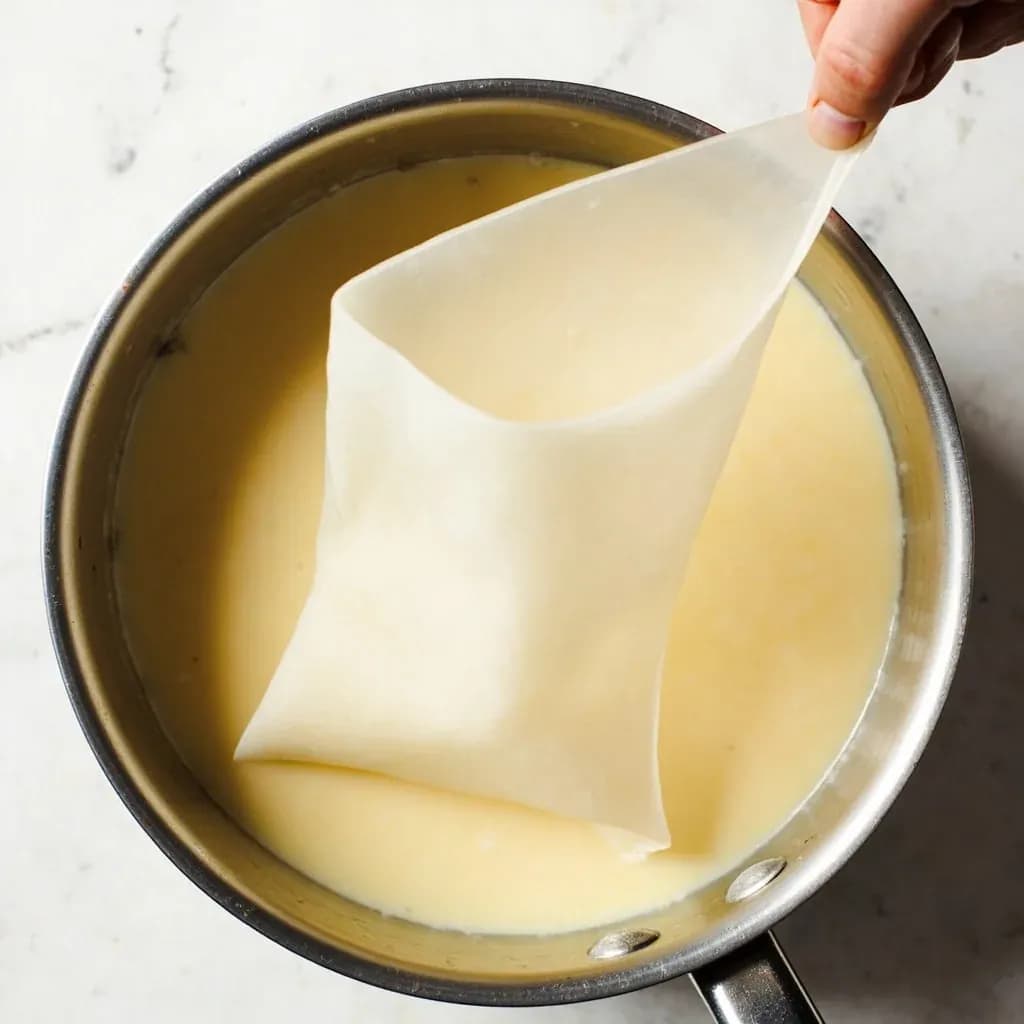
Lifting the protein-rich skin off gently heated soy milk to harvest yuba (tofu skin).
Yuba skimming gently heats soy milk so a thin film of coagulated soy protein and fat forms on the surface, then carefully lifts that delicate sheet off with a skewer or fingers. Each skimmed layer is fresh yuba (tofu skin), prized for its silky texture and used fresh, folded, or dried. The milk is kept just below a simmer so a new skin forms repeatedly without scorching.
Yuba skimming is the quiet, attentive craft of coaxing successive protein films off the surface of gently heated soy milk. As the milk warms toward 80–90 °C, soy proteins and lipids denature and migrate upward, forming a delicate membrane that thickens into a flexible sheet over 7–15 minutes. The skimmer slides long chopsticks or a thin skewer under one edge and draws it across the pan in a slow, level motion, then drapes the wet film over a rack or stick to cool or dry. Each pan yields four to six lifts before the milk thins out, and the very first sheets are the richest in fat and the most prized.
The technique matters because yuba is not so much a manufactured product as a controlled accident of soy-milk heating — every variable (fat content, temperature, stillness, pan geometry) decides whether you get a glossy, whole sheet or a torn, rubbery mess. It is central to Kyoto-style workshops and to Buddhist shōjin ryōri, where yuba stands in for meat, and it underpins familiar pantry items from dried sticks to deep-fried puffs. Home cooks can approximate the craft with a wide stainless skillet, a thermometer, and patience; the depleted milk at the end is traditionally served hot as the closing course of a yuba meal.
The craft is essentially the management of stillness: drafts, vibration, and boiling all punish a forming film, and the deeper you go, the more clearly the lift-by-lift decline in thickness reveals how the milk is being spent.
- Difficulty
- Medium
Types & varieties
Soft, slippery, ivory sheets lifted wet from the pan; eaten the same day, often sashimi-style.
Fresh sheets air- or oven-dried flat; reconstituted by soaking in warm water.
Fresh skin draped over sticks or bamboo rods and dried into pale yellow curls; the most familiar shelf-stable form.
Fresh sheets hand-tied into loose knots before drying; a Kyoto specialty prized for its chewy, layered texture.
Skin wrapped around a thin rod as it dries, forming a tube used in simmered dishes.
Larger, thinner sheets used to wrap dim sum fillings and fried into crisp tofu-paper snacks.
Twisted, fully dried sticks, brittle until soaked; the basis of many braises and hot-pot ingredients.
Fresh yuba deep-fried until puffed and golden; sweet, nutty, and airy.
How to do it
- 1
Choose and prepare the soy milk
Use freshly made, full-fat soy milk with no additives, or strain commercial plain soy milk through cheesecloth. Aim for roughly 5–7% solids — thinner milk gives a film that is too delicate to lift cleanly.
- 2
Set up a wide, shallow pan
Pour the milk into a clean, wide, shallow pan (traditionally unlined copper or stainless steel) to a depth of about 2–3 cm. A larger surface area means larger, easier-to-lift sheets and a more uniform film.
- 3
Heat gently to skin-forming temperature
Warm slowly over medium-low heat until the surface reaches 80–85 °C. Hold it there; do not let the milk simmer or boil. The first signs of a film usually appear within a few minutes.
- 4
Let the film develop undisturbed
Leave the pan completely still for 7–15 minutes, until the surface looks matte, slightly wrinkled at the edges, and feels like a thin membrane when touched lightly with a chopstick.
- 5
Lift the skin
Slide a long chopstick or thin wooden skewer under one edge of the film, then draw it slowly across the pan to free the sheet. Lift in one smooth, level motion and drape the wet film over a rack, bamboo mat, or thin stick to cool.
- 6
Repeat for successive layers
Allow a new skin to form on the still-warm milk and lift it the same way. Each film is thinner than the last; most makers stop after 4–6 lifts, when the milk is too thin to set properly.
- 7
Use, dry, or store
Use fresh yuba the same day. To dry, hang sheets over sticks or lay them on a mesh rack at room temperature until brittle. Refrigerate fresh yuba submerged in cold water, changed daily, and use within 1–2 days.
Why the film forms — and why it fails
Yuba is the visible face of interfacial denaturation. As soy milk warms, the proteins that were previously dispersed and stabilized by their native structure begin to unfold. At the air–milk boundary, those unfolded proteins — along with entrained soy lipids — pack into a denser, more organized layer than the bulk liquid, which is why the skin is essentially a concentrated soy solid. Once nucleated, the film thickens as more protein migrates upward over several quiet minutes.
That is also why the technique punishes agitation. A draft, a bump of the stove, or a stir disrupts the forming lattice, and the film either never coalesces or tears when you try to lift it. Boiling is worse still: vapor bubbles rupture the surface and you end up with foam and curd rather than a continuous sheet. Temperature stability is therefore the single most important variable; the rest is keeping your hands off the pan.
- Hold the surface just under a simmer — visible quivering, not rolling bubbles.
- Use full-fat, additive-free milk; gums and emulsifiers in commercial products weaken the film and can give it a rubbery texture.
- The first skin is the easiest to lift because the milk is richest; later lifts need a steadier hand as the film thins.
- Wide, shallow pans give a larger, slower-setting surface and easier lifting than deep pots.
In the Kyoto yuba-ya
Traditional Kyoto workshops (yuba-ya) begin the morning by heating a broad copper pan of unseasoned soy milk, then work a slow rhythm of lift, drape, lift, drape. Sheets are hung on bamboo rods strung across the room to dry into bō-yuba, and the depleted milk — thin, slightly sweet, still warm — is ladled out as yuba-jiru at the end of a kaiseki or shōjin meal. A yuba meal there is essentially a tour through the pan: fresh sashimi-style sheets, simmered knotted pieces, fried ama-age, and finally the drinking milk that produced them all.
Common uses
Tips & pitfalls
- Use full-fat, additive-free soy milk; gums, emulsifiers, and low-fat formulations give a weak, patchy, or rubbery film.
- Hold the surface at 80–90 °C — a rolling boil pops the film and yields bubbles and curd instead of a continuous sheet.
- Keep the pan absolutely still; drafts, stove vibration, or stirring will tear the forming membrane.
- Skim one layer at a time and let each new film re-form naturally — the first one or two lifts are the thickest and most forgiving.
- Lift slowly from one edge across the pan with long chopsticks or a thin skewer; yanking straight up almost always tears the sheet.
- If a skin tears, slide it aside and let it sink rather than fishing out fragments — broken pieces cloud the next lift and weaken the film.
- Work in a wide, shallow pan (no deeper than 3–4 cm of milk) so the film has room to spread and set evenly.
- Don't throw out the depleted milk; it is sweet, warm, and is traditionally served as the final course of a yuba meal.
Good to know
- Names
- Japanese yuba (湯葉); also tofu skin, beancurd skin, soy milk film. Chinese: 腐皮 (fǔ pí) for sheets, 腐竹 (fǔ zhú) for dried sticks.
- Origins
- China, documented by the Tang dynasty as a tofu-making byproduct; strongly associated with Kyoto (Kyō-yuba) and Minoh, Osaka, in Japan.
- Composition
- A concentrated layer of soy proteins and lipids that coagulate at the air–milk interface; dried yuba is roughly 50% protein by weight.
- Target temperature
- Hold the milk surface at 80–90 °C (175–195 °F); boiling ruptures the forming film.
- Time per skin
- 7–15 minutes of undisturbed heating for a liftable film.
- Yield per pan
- Typically 4–6 successive skins from one batch; the first lifts are thickest.
- Pan
- Wide and shallow (about 2–3 cm of milk); unlined copper or stainless steel preferred for even heat and a clean film.
- Fresh storage
- Use same day, or refrigerate up to 1–2 days submerged in cold water changed daily. Dried yuba keeps several months sealed and dry.
Also called
Yuba Skimming · Tofu Skin Skimming
Related

Whisk
Beat ingredients smooth and aerated with a looping wire motion

Sift
Pass dry ingredients through mesh to aerate and remove lumps

Strain
Pour through mesh to separate solids from liquid for a smooth result

Filter
Pass liquid through fine material to clarify out the smallest particles

Rice
Press cooked potatoes through small holes for fluffy, lump-free texture

Mash
Crush soft cooked food into a rustic, creamy purée

Grind
Crush food into a coarse to fine texture, from spices to meat

Grate
Shred food into fine bits against a sharp-toothed surface