Dairy & Eggs
Danish Blue (Danablu)
A creamy, sharp, salty blue with a soft crumble; melts into rich sauces and dressings or crumbles over salads and steaks for a bold tang.
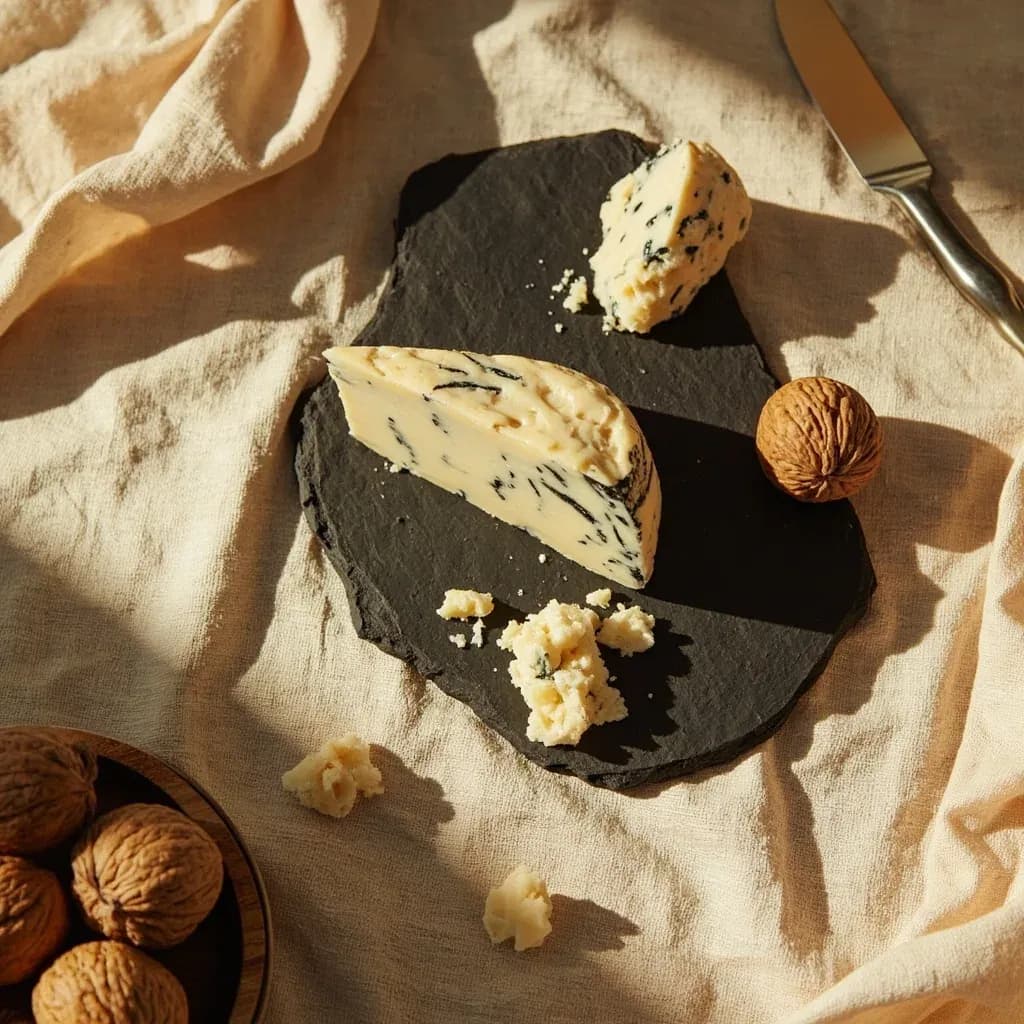
Danablu — sold outside Denmark as Danish Blue — is the country's signature blue cheese, born in 1925 when Jutland cheesemaker Marius Boel adapted the French Roquefort method to local cow's milk. The result is a semi-soft, moist blue with a creamy white paste laced through with blue-green veins of Penicillium roqueforti. It sits in a useful middle ground: sharper and saltier than Gorgonzola Dolce or a young Stilton, but rounder and less aggressive than Roquefort or Cabrales, which makes it an everyday workhorse rather than a special-occasion cheese.
In the kitchen it behaves much like other cow's-milk blues — it crumbles cleanly when cold, softens to a spreadable texture at room temperature, and melts into a velvety sauce when introduced gently to warm cream. Its flavor leans salty and pungent with a buttery undertone that holds up against bold partners like steak, bitter greens, and sweet fruit. Genuine Danablu carries EU Protected Designation of Origin status, meaning wheels labeled 'Danablu' must be made in Denmark under traditional methods; cheeses made elsewhere are usually labeled simply 'Danish Blue' or sold under proprietary names such as Castello or Saga.
The cheese's character changes noticeably with age and temperature. A young wheel (8–10 weeks) is creamy and relatively mild; an aged or 'reserve' wheel tightens in texture and intensifies in pungency. Always serve it warmer than you think — straight from the fridge it tastes flat and almost chalky, while 30–60 minutes at room temperature unlocks its full aromatic, salty depth.
- Measured in
- g
- Storage
- Wrapped & Refrigerated
Allergens
Find it in
Suits
Types & varieties
The PDO original; balanced sharp, salty, creamy profile and the benchmark for the style.
Popular Danish blue made by Arla; slightly creamier and milder, widely exported.
Danish blue in distinctive packaging; often milder and creamier than classic Danablu.
Longer-aged wheels with a denser texture and more concentrated, pungent flavor.
Softer, higher-moisture style intended for spreading or melting into sauces.
Working with Danablu in the kitchen
Danablu behaves like most cow's-milk blues — forgiving in sauces when handled correctly, fragile under direct high heat. Understanding how it responds to temperature and liquid is the difference between a silky steak sauce and a broken, grainy one.
- Cold cheese crumbles cleanly with fingertips or a fork; let it warm 10–15 minutes for cleaner cuts on a board.
- For melted applications, always bring the cheese to room temperature first — cold cheese seizes and clumps when it hits hot liquid.
- Add crumbled cheese to warm (not boiling) cream, or off the heat into a finished béchamel, to keep the emulsion smooth.
- Salt goes in last when cooking with Danablu; its pronounced saltiness means most recipes won't need added seasoning until you taste.
- Crumbled on top of a finished dish, Danablu softens just enough to coat each piece in creaminess without fully melting — the ideal finishing move for steak, salads, and soups.
Buying and storing
Look for wheels or wedges with a moist, slightly sticky rind and clearly defined blue-green veining running through the paste. Avoid wheels that smell sharply of ammonia or feel dried out at the edges.
- Buy from a cut wheel when possible; pre-crumbled packs lose aroma quickly and often contain anti-caking agents that affect melting.
- Wrap in foil or wax paper, then place loosely in a container with a slightly cracked lid so the cheese can breathe.
- Never seal Danablu in airtight plastic — trapped ammonia accelerates spoilage and turns the flavor soapy.
- Change the wrapping every few days; the paper will absorb moisture and odors that would otherwise transfer back into the cheese.
- A small bloom of white surface mold beyond the intended blue is usually harmless — trim it. Strong ammonia or deep discoloration means the cheese has turned.
Common uses
Tips & pitfalls
- Always bring Danablu to room temperature before serving; cold mutes the aroma and flavor that define it.
- Don't melt Danablu over high direct heat — it breaks and turns grainy. Add it off the heat or fold it into warm cream so it melts gently and stays smooth.
- For a blue cheese sauce, base it on a small amount of béchamel before adding the cheese; the starch stabilizes the emulsion and prevents splitting.
- Use less than you think: because the cheese is salty and pungent, 30–40 g per portion is usually plenty in cooked dishes.
- Pair salty Danablu with sweet or acidic counterpoints — honey, port, pears, balsamic — to keep dishes balanced rather than overwhelming.
- When making dressings, mash the cheese with a fork before whisking it into buttermilk or sour cream to prevent lumps.
- If using Danablu in baking, layer or stuff it late in the bake so it stays creamy rather than drying out into chalky pockets.
- Crumble with fingertips or a fork rather than slicing — it keeps the texture irregular, looks better on a board, and reduces smearing.
Nutrition
Energy
1477 kJ · per 100 g
Where the calories come from
Protein
21.4g
43% DV
Carbs
2.3g
1% DV
Fat
28.7g
37% DV
Fiber
0g
0% DV
Sugars
0.5g
of which
Sodium
1146mg
50% DV
Source · USDA FoodData Central · approx. Cheese, blue
View on FDC →In the shops
Matched grocery products
No matched grocery products for Danish Blue (Danablu) yet.
Good to know
- Origin
- Denmark; invented 1925 by Marius Boel in Jutland
- Milk
- Cow's milk, usually pasteurized
- Protected status
- EU Protected Designation of Origin (PDO) for 'Danablu'
- Mold cultures
- Penicillium roqueforti (sometimes P. glaucum); blue-green veining
- Texture
- Semi-soft, creamy, slightly crumbly with a moist interior
- Rind
- Thin, often sticky or slightly wrinkled; frequently wrapped in foil or waxed paper
- Color
- Creamy white paste with distinctive blue-green marbling
- Aging
- Typically 8–12 weeks; longer for sharper, denser wheels
- Fat content
- Approximately 25–30% total fat (~50% fat in dry matter)
- Storage
- Refrigerate wrapped in foil or wax paper inside a loose container; keeps 3–4 weeks
- Serving temperature
- Best at room temperature, 30–60 minutes out of the fridge
Substitutes
- Gorgonzola Dolce — Milder, sweeter, and creamier — the closest match for sauces and dressings where you want less bite.
- Stilton — Similar creaminess and salt level; a strong British-blue alternative for boards and salads.
- Roquefort — Sheep's-milk blue, sharper and more pungent — use slightly less when swapping.
- Cabrales — Spanish blue with strong, earthy character; works in cooked sauces but tastes noticeably more aggressive.
- Maytag Blue — American cow's-milk blue, close in sharpness and saltiness — good for steaks and salads.
- Cashel Blue — Irish cow's-milk blue; milder and slightly grassy, fine for boards and melting.
- Bleu d'Auvergne — French cow's-milk blue with a creamier texture and rounded flavor — works in sauces and dressings.
Pairs with
Also called
danablu · danish blue cheese