Spices
Fine Sea Salt
Clean-tasting, quick-dissolving fine crystals from evaporated seawater; the everyday workhorse for seasoning doughs, batters, and salting pasta water by weight.
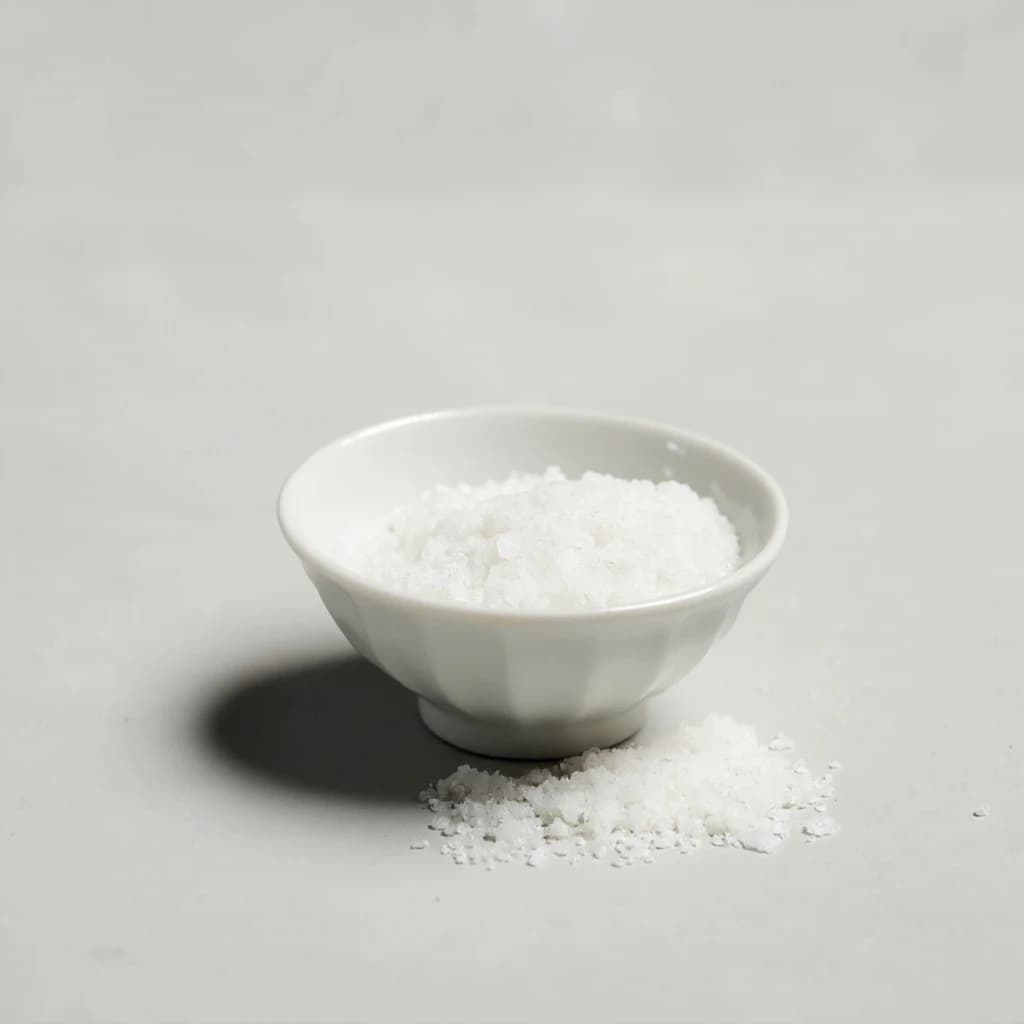
Fine sea salt is evaporated seawater that has been harvested and milled to a small, uniform crystal — usually between 0.1 and 0.5 mm across. Unlike flaky finishing salts such as Maldon or fleur de sel, which are prized for their irregular, delicate crystals and crunchy texture, fine sea salt is judged by how invisibly and quickly it disappears into food. There are no anti-caking agents, no added iodine, and typically no bleaching; what you taste is close to pure sodium chloride with a whisper of trace minerals from the source water.
That combination — additive-free purity plus fast dissolution — is what makes it the everyday workhorse of a serious kitchen. Fine crystals disperse evenly through flour and liquid in a way that coarser salts cannot, which is why professional bakers, pasta makers, and charcutiers reach for it instead of kosher or flake salts. It seasons from within a dish rather than sitting on the surface, delivering clean salinity without the metallic edge that iodized table salt can carry, and without the volume-to-weight confusion of larger-grained salts.
The single most important thing to know about fine sea salt is its density: by volume it is roughly twice as heavy as flaky salts like Maldon and noticeably heavier than Diamond Crystal kosher salt, though it weighs almost exactly the same as ordinary table salt. Volume conversions from older or American recipes are unreliable for that reason, and the home cook who wants predictable results learns to weigh salt in grams — the way every bread, pastry, and curing recipe is actually written.
- Measured in
- g
- Storage
- Pantry
Find it in
Suits
Types & varieties
Solar-evaporated in coastal salinas of Sicily, Sardinia, Spain, and southern France; the classic all-purpose fine sea salt.
Ground from the gray French Atlantic salt of Brittany; carries a touch of mineral character from the clay-lined marsh beds.
Hand-harvested in Brittany using traditional wooden tools; retains some moisture and a grayish cast from the ponds.
Slow-harvested Sicilian and Adriatic salts sold in a fine grind for everyday Italian cooking.
Common American supermarket brand; uniform, pure white crystals with no additives.
Mined from an ancient seabed in Redmond, Utah, and sold in a fine grind with subtle mineral flavor.
Milled from Khewra-mined rock salt; pale pink from trace iron oxides; often used interchangeably with fine sea salt despite being a rock salt.
Why fine grain matters in baking and curing
In bread dough, batter, and brine, salt has to do two things at once: season the food and regulate what is happening chemically. In bread it tightens gluten and slows yeast; in pastry it strengthens structure and sharpens flavor; in a cure it draws moisture out and preserves the protein. None of that works evenly if the salt is sitting in undissolved pockets. A 0.5 mm crystal of fine sea salt vanishes into a wet dough in seconds, while the same weight of flaky salt can take minutes to break down, leaving visible specks and unevenly seasoned loaves. This is why virtually every professional baking formula and every serious curing recipe is written in grams of fine salt — it is the form in which salt behaves most predictably.
Weighing salt: the single most useful habit
The volume of a teaspoon of salt depends entirely on the size and shape of its crystals. One teaspoon of fine sea salt weighs about 5 to 6 grams; one teaspoon of Maldon weighs about 2.5 grams; one teaspoon of Diamond Crystal kosher weighs about 3 grams; one teaspoon of Morton kosher weighs about 4.5 grams. That is more than a 2-to-1 spread across common pantry salts, which is why recipes translated from one salt to another by the teaspoon often come out over- or under-seasoned. A $15 digital scale and a habit of reading recipes in grams removes the problem entirely. As a rule of thumb, 1 g of fine sea salt seasons roughly 100 g of food or liquid as a background seasoning, and 10–15 g per liter (about 1 tablespoon per quart) makes properly salted pasta water.
Common uses
Tips & pitfalls
- Measure by weight, not volume. Fine sea salt is about twice as dense as flaky salts and heavier than Diamond Crystal kosher by volume, so cup-for-cup substitution is unreliable — a $15 scale solves this permanently.
- Taste pasta water as you go; it should taste like mild seawater. Salt only penetrates the outer starch layer of pasta, so an under-salted pot leaves the inside of the noodle bland no matter how good the sauce.
- When swapping in fine sea salt for iodized table salt, go 1:1 by weight — perceived saltiness is nearly identical, but you lose the iodine, which matters if you eat very little seafood or dairy.
- Avoid flake salts in brines and salt cures. They dissolve slowly, sink to the bottom, and concentrate unevenly, which can leave the cure patchy or, in extreme cases, over-salted in spots.
- Layer salt during cooking: a small amount early on seasons from within, and a final pinch at the end adjusts the top notes. Skipping the early seasoning means the dish tastes salted only on the surface.
- Drop a few grains of uncooked rice or a food-safe silica packet into a salt cellar in humid climates to keep fine crystals from caking — clumping is harmless but inconvenient.
- Toast fine sea salt in a dry skillet over low heat for 1 to 2 minutes to deepen its flavor for spice rubs, salted caramel, or finishing salts where you want a hint of warmth.
- Don't use fine sea salt as a finishing garnish where crunch and a burst of salinity are the point — reserve flaky salts like Maldon or fleur de sel for that last, visible touch.
Nutrition
Energy
0 kJ · per 100 g
Protein
0g
0% DV
Carbs
0g
0% DV
Fat
0g
0% DV
Fiber
0g
0% DV
Sugars
0g
of which
Sodium
38758mg
1685% DV
Source · USDA FoodData Central · approx. Salt, table
View on FDC →In the shops
Matched grocery products
 €0.75
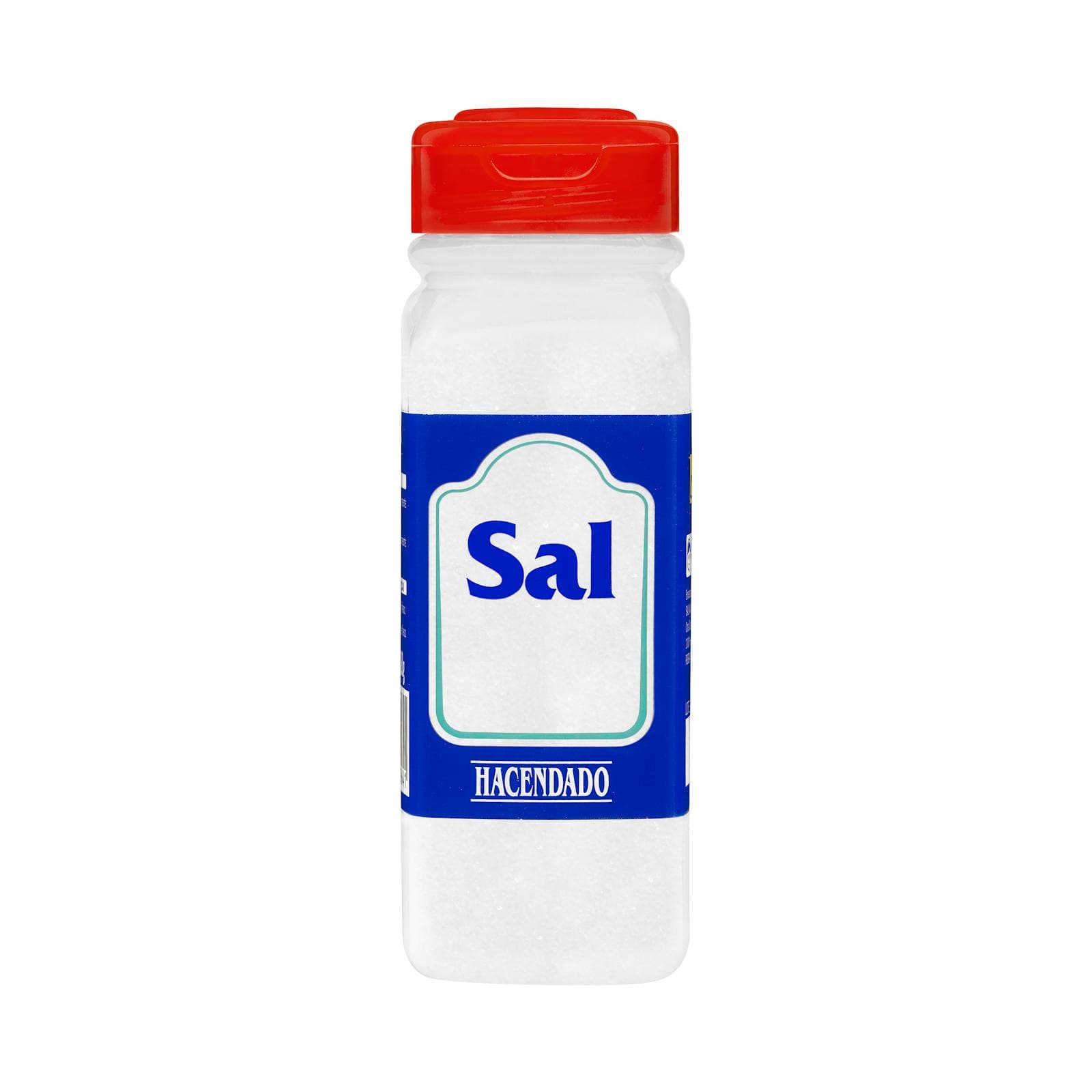
€0.75Fine Table Salt
Hacendado · 300 g · Mercadona
 €0.40
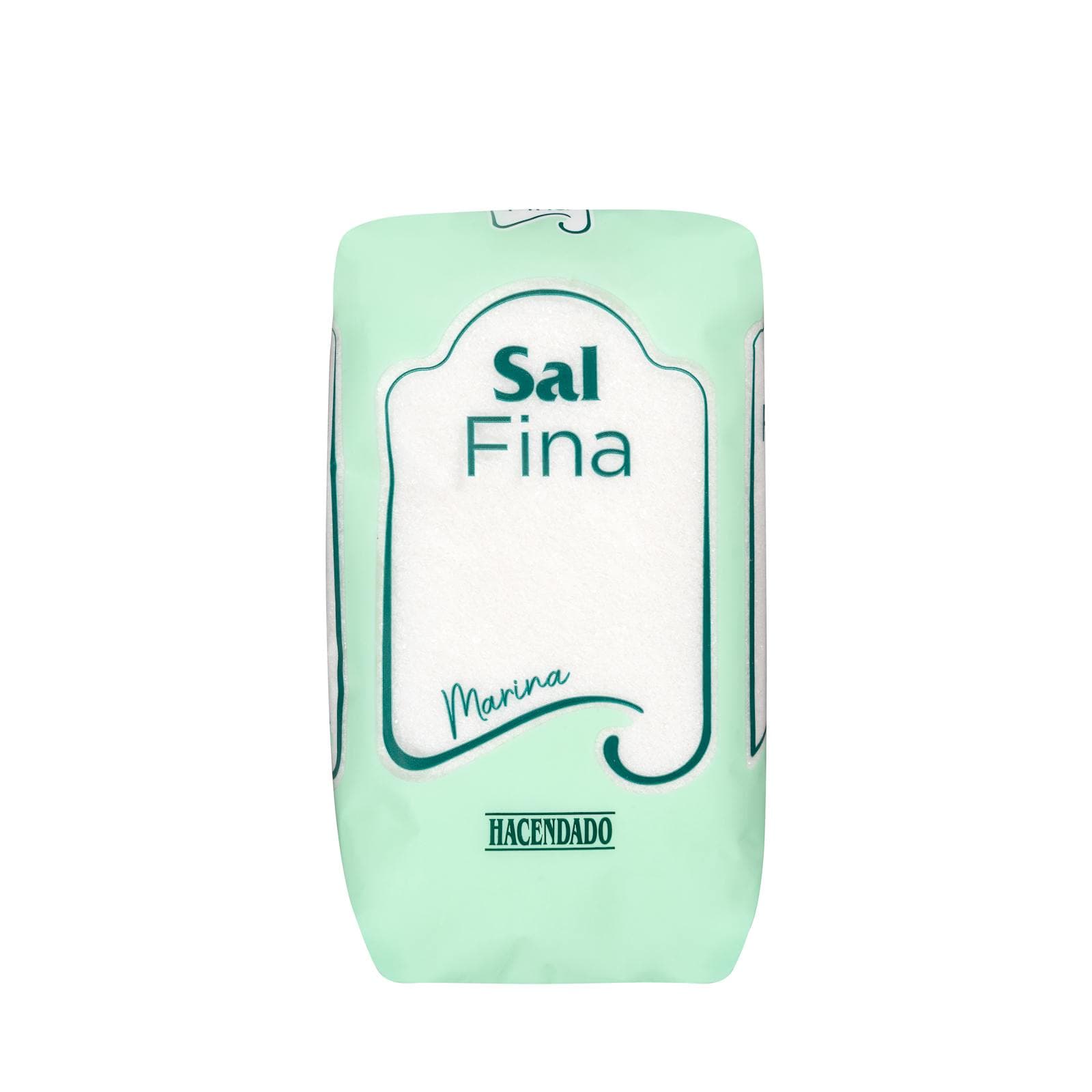
€0.40Fine Salt
Hacendado · 1 kg · Mercadona
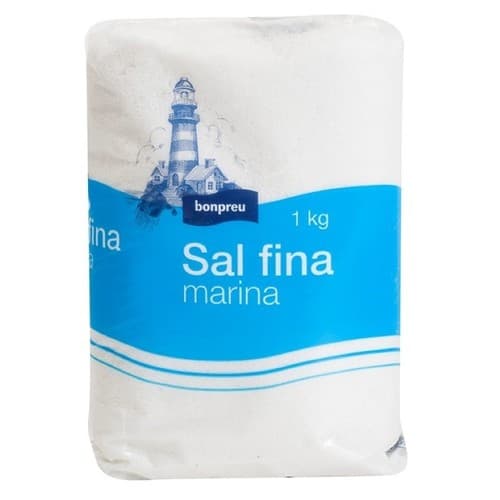 €0.40
€0.40Fine Sea Salt
BONPREU · kg · Bonpreu
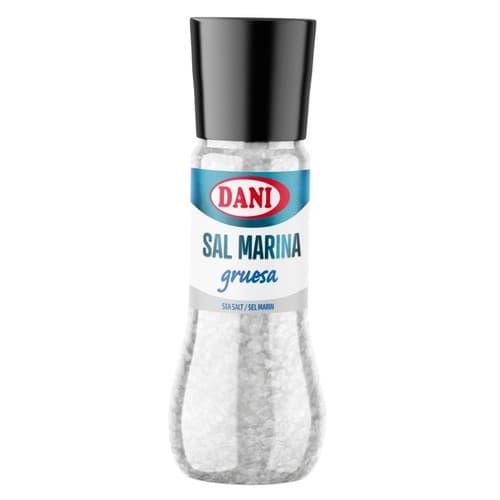 €2.99
€2.99Coarse Sea Salt
DANI · kg · Bonpreu
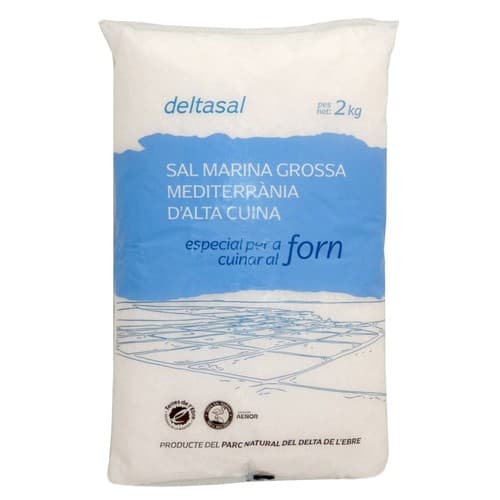 €1.40
€1.40Deltasal Coarse Sea Salt
DELTASAL · kg · Bonpreu
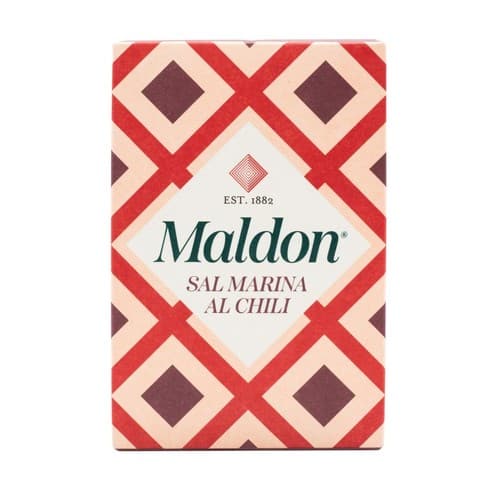 €5.89
€5.89Maldon Chili Sea Salt
MALDON · kg · Bonpreu
Good to know
- Source
- Evaporated seawater, harvested by solar evaporation in coastal salt pans or by vacuum evaporation
- Crystal size
- Typically 0.1–0.5 mm — smaller and more uniform than coarse or flaky sea salts
- Additives
- Generally none; no iodine, no anti-caking agents
- Sodium chloride
- Roughly 95–98% NaCl by weight; trace magnesium, calcium, and potassium from source water
- Density vs. flake salts
- About twice as heavy per cup as Maldon or fleur de sel; equal by weight
- Density vs. table salt
- Slightly heavier by volume than iodized table salt (which is fluffed by anti-caking agents); essentially identical by weight
- Major producing regions
- Atlantic and Mediterranean coasts — Brittany (Guérande, Île de Ré), Portugal, Sicily (Trapani), Sardinia, Balearic Islands, and mainland Spain; also Pacific and Caribbean sources
- Storage
- Airtight container in a cool, dry place; clumping in humidity is cosmetic, not spoilage; indefinite shelf life
- Best for
- Baking, brining, pasta water, batters, doughs, and any application where salt should dissolve quickly and evenly
- Cost tier
- Mid-range — pricier than basic table salt, cheaper than premium flake salts
Substitutes
- Fine kosher salt — 1:1 by weight. Diamond Crystal is much lighter per cup than Morton, so weigh for precision. No iodine, similar dissolution rate.
- Table salt — 1:1 by weight, but expect a slightly sharper taste from iodine and a faint metallic note; anti-caking agents can cloud brines and affect dry-cure texture.
- Pickling salt — Pure fine-grained salt with no additives or iodine; essentially interchangeable in brines, pickles, and lacto-ferments.
- Fine Celtic sea salt — Direct 1:1 substitute by weight; carries a bit more mineral complexity and residual moisture, so reduce other liquids by a teaspoon or two when subbing in.
- Fine Himalayan pink salt — 1:1 by weight; adds pale pink color and a subtle mineral edge — fine for general cooking, less ideal where neutral flavor matters, such as in pastry.
- Flaky sea salt (in a pinch) — Use about 1.5 to 2 times by weight and crush between fingers before adding; not recommended for fine-textured batters, doughs, or brines.
Pairs with
Also called
sea salt · fine sel de mer · fine-grain sea salt