Beverages
Marsala Wine
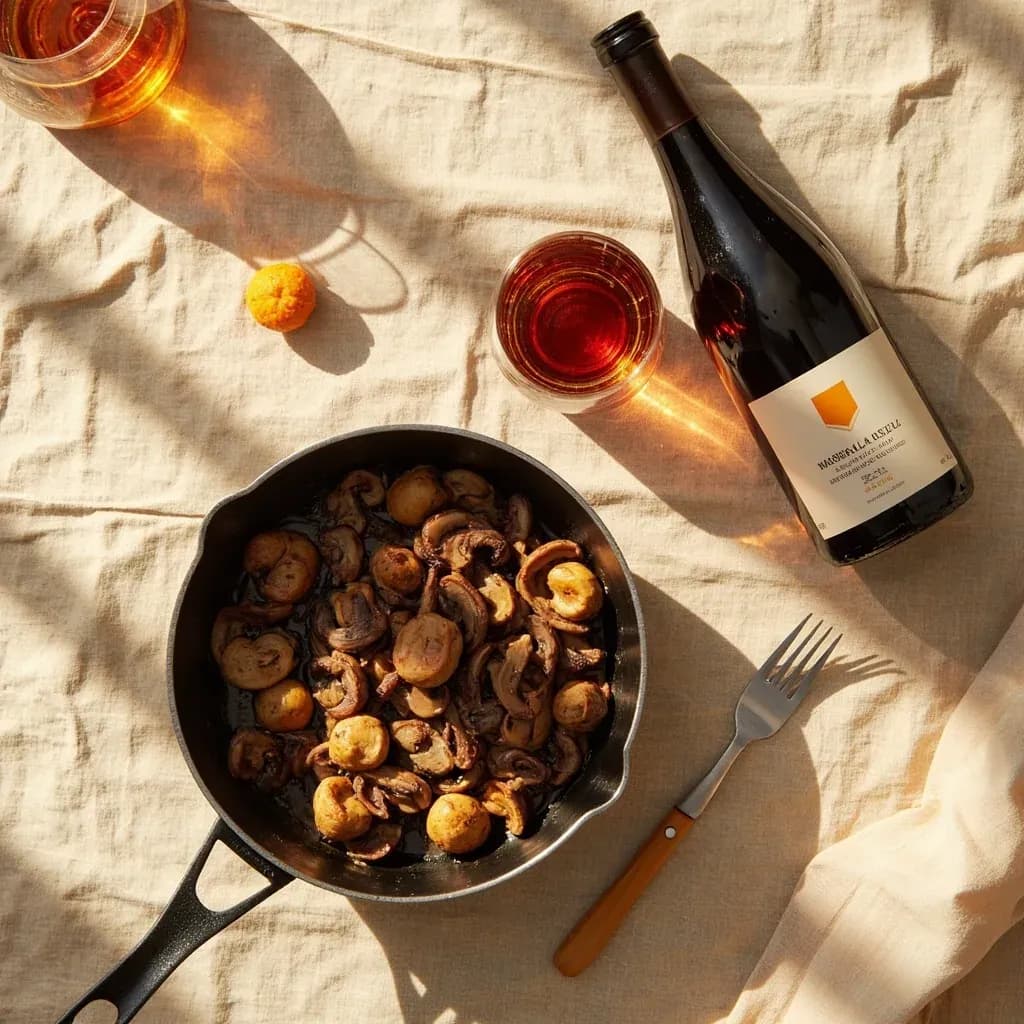
Sicilian fortified wine with caramel-raisin depth — the soul of chicken and veal marsala pan sauces and the boozy backbone of zabaglione and tiramisu.
Marsala is a fortified wine produced under DOC rules in the province of Trapani, on Sicily's western coast, made primarily from Grillo and Inzolia (for white Marsalas) or Perricone and Nero d'Avola (for Rubino). What separates it from other fortified wines is its oxidative upbringing: the wine is aged in oak casks — traditionally large Slavonian oak — and frequently blended fractionally using the 'in perpetuum' Soleras-like system, which layers new wine into barrels that always retain a fraction of the oldest. The result is a wine with the toasted-nut, brown-butter, faintly burnt-honey character that defines dishes like Chicken Marsala and zabaglione.
For a cook, Marsala is best understood along three axes: color (Oro/gold from white grapes, Ambra/amber from white grapes plus mosto cotto cooked must, and Rubino/ruby from red grapes), sweetness (Secco under 40 g/L residual sugar, Semisecco 40–100 g/L, Dolce over 100 g/L), and aging tier (Fine, Superiore, Superiore Riserva, Vergine, Vergine Stravecchio). In American kitchens, an unqualified 'Marsala' in a savory recipe almost always means dry Oro — the workhorse bottle for pan sauces — while desserts specify sweet. Reading the label carefully is half the job.
In the pan, Marsala behaves like an amplifier. Its alcohol lifts fond off hot stainless steel in seconds, its residual sugar (or its absence) caramelizes quickly, and its oxidative nuttiness marries with butter, cream, and mushrooms more readily than almost any other wine. A splash added at the wrong moment can evaporate and leave only bitterness; a splash added to a properly hot pan and reduced by half is what gives Marsala sauces their glossy, mahogany depth.
- Measured in
- ml
- Storage
- Pantry
Find it in
Suits
Types & varieties
Minimum 1 year of aging; the entry-level quality tier, suitable for everyday pan sauces.
At least 2 years in cask; rounder and more developed; the standard kitchen workhorse.
Aged 4+ years; deeper oxidative notes and enough complexity to drink as well as cook with.
Dry only, aged 5+ years using the 'in perpetuum' fractional method; nutty, austere, prized for reductions.
10+ years of aging; the most prestigious tier, intensely nutty, reserved for special applications.
Made from white grapes; the most common color in U.S. cooking; available across all sweetness levels.
White grapes plus mosto cotto (cooked grape must); deeper amber color; usually sweet.
Made from Perricone and other red grapes; rarer; can be amabile or dolce; suited to richer red-meat sauces.
Choosing the Right Bottle
Three rules eliminate most mistakes. First, for any savory pan sauce — chicken, veal, mushrooms, pork — buy dry Marsala (Secco) at the Superiore level from a reputable producer such as Florio, Cantine Pellegrino, Lombardo, or De Bartoli. Second, for desserts (tiramisu, zabaglione, cassata), buy sweet Dolce. Third, never buy 'cooking Marsala' sold in large salted jugs in the supermarket aisle; it is preserved with salt, tastes briny, and will ruin a sauce.
- For Chicken or Veal Marsala: dry Oro Superiore — the standard kitchen bottle.
- For tiramisu and zabaglione: sweet Dolce, traditionally Oro or Ambra.
- For sipping or showpiece reductions: Vergine or Vergine Stravecchio, served cool in a small glass.
- For richer red-meat glazes: Rubino, dolce or amabile, used sparingly.
How Marsala Works in a Pan
Marsala's usefulness comes from a small set of predictable behaviors. The alcohol flash-evaporates in a hot pan and pulls fond up with it; the residual sugar (when present) browns fast; and the wine's oxidative aromatics — nut, caramel, dried fruit — concentrate dramatically under reduction. Knowing this sequence lets you control when caramelization happens relative to when butter, cream, or stock goes in.
- Pour into a hot, deglazed pan and let it simmer steadily for 20–40 seconds to burn off harsh alcohol before adding stock.
- For a glossy body in a pan sauce, reduce the Marsala by roughly half before mounting with cold butter.
- Add sweet Marsala later in the cooking process than dry, since its sugar burns quickly.
- If a finished sauce tastes sharp or has broken, finish with a cold knob of butter whisked in off the heat (monter au beurre).
Common uses
Tips & pitfalls
- Match style to dish: dry (Secco) for savory sauces, sweet (Dolce) for desserts and zabaglione — substituting one for the other unbalances the recipe.
- Never buy 'cooking Marsala' from the grocery aisle; the salt added for shelf life ruins sauces. Use a real drinking Marsala instead.
- Add Marsala to a hot pan and let the alcohol burn off for 20–40 seconds before adding stock or cream; a hard rolling boil makes the sauce harsh.
- Reduce dry Marsala by about half before mounting with butter or cream — this concentration is what gives Chicken Marsala its glossy, mahogany body.
- Flambé only if you are comfortable doing so: tilt the pan away from the flame, let the alcohol burn off fully, then continue with stock or cream.
- Sweet Marsala in tiramisu softens the coffee's bitterness; increase the espresso slightly to keep the dessert balanced.
- Store upright, sealed, in a cool dark place. Dry Marsala fades within a few months of opening; sweet styles hold considerably longer thanks to residual sugar.
- If a Marsala sauce breaks or tastes sharp, finish with a cold knob of butter whisked in off the heat to round out the flavors.
Nutrition
Nutrition
No USDA FoodData Central match for Marsala Wine yet. We surface a per-100 g profile once a generic whole-food entry is matched and verified.
In the shops
Matched grocery products
No matched grocery products for Marsala Wine yet.
Good to know
- Origin
- Marsala, province of Trapani, western Sicily, Italy
- Classification
- DOC (Denominazione di Origine Controllata) since 1969
- Type
- Fortified wine (with added grape spirit)
- ABV
- Typically 15–20%, depending on style
- Color Categories
- Oro (Gold), Ambra (Amber), Rubino (Ruby)
- Sweetness Levels
- Secco (≤40 g/L), Semisecco (40–100 g/L), Dolce (>100 g/L residual sugar)
- Aging Tiers
- Fine (1 yr), Superiore (2 yrs), Superiore Riserva (4 yrs), Vergine/Soleras (5+ yrs), Vergine Stravecchio (10+ yrs)
- Flavor — Dry
- Toasted nuts, brown butter, dried herbs, saline minerality, oxidized complexity
- Flavor — Sweet
- Caramel, raisin, brown sugar, fig, burnt honey, walnut
- Opened Shelf Life
- Several months for dry styles in a cool dark place; sweet styles keep longer thanks to residual sugar
- Commercial Origin
- 1796, by English merchant John Woodhouse
Substitutes
- Dry Madeira (Sercial or Verdelho) — Closest savory substitute for dry Marsala — fortified, nutty, slightly more austere.
- Amontillado or Oloroso Sherry — Good stand-in for dry Marsala in pan sauces; oxidative and nutty, with less raisin character.
- Dry White Port — Fortified and lightly oxidative; works well in chicken and veal preparations.
- Malmsey (sweet Madeira) — Best substitute for sweet Marsala in desserts; rich, caramelized, and raisin-like.
- Sweet Vermouth (Rosso) — Reasonable substitute for sweet Marsala in zabaglione or tiramisu; herbal rather than oxidative.
- Tawny or Ruby Port — Works for sweet applications; fruitier and sweeter — reduce slightly to match Dolce Marsala.
- Vin Santo — Italian alternative for dessert use; nutty and dried-fruit, though not fortified.
- Brandy + dry white wine + a touch of browned butter — Approximation when no fortified wine is on hand; lacks true Marsala's oxidative depth.
Pairs with
Also called
marsala · vino marsala
Appears in these dishes
Related

White Rum
Light, clean rum for mojitos, daiquiris, and piña coladas

Dark Rum
Rich, molasses-deep rum for tiki drinks and sipping
Tequila
Bright agave spirit for margaritas, palomas, and shots
Mezcal
Smoky agave spirit for sipping and smoldering cocktails
Vodka
Clean, neutral spirit for mixing into almost any cocktail
Gin
Botanical, juniper-forward spirit for G&Ts and martinis
Whisky
Warm, oak-aged spirit for sipping and classic cocktails

Brandy
Rich, fruity grape spirit for sipping, sauces, and flambé