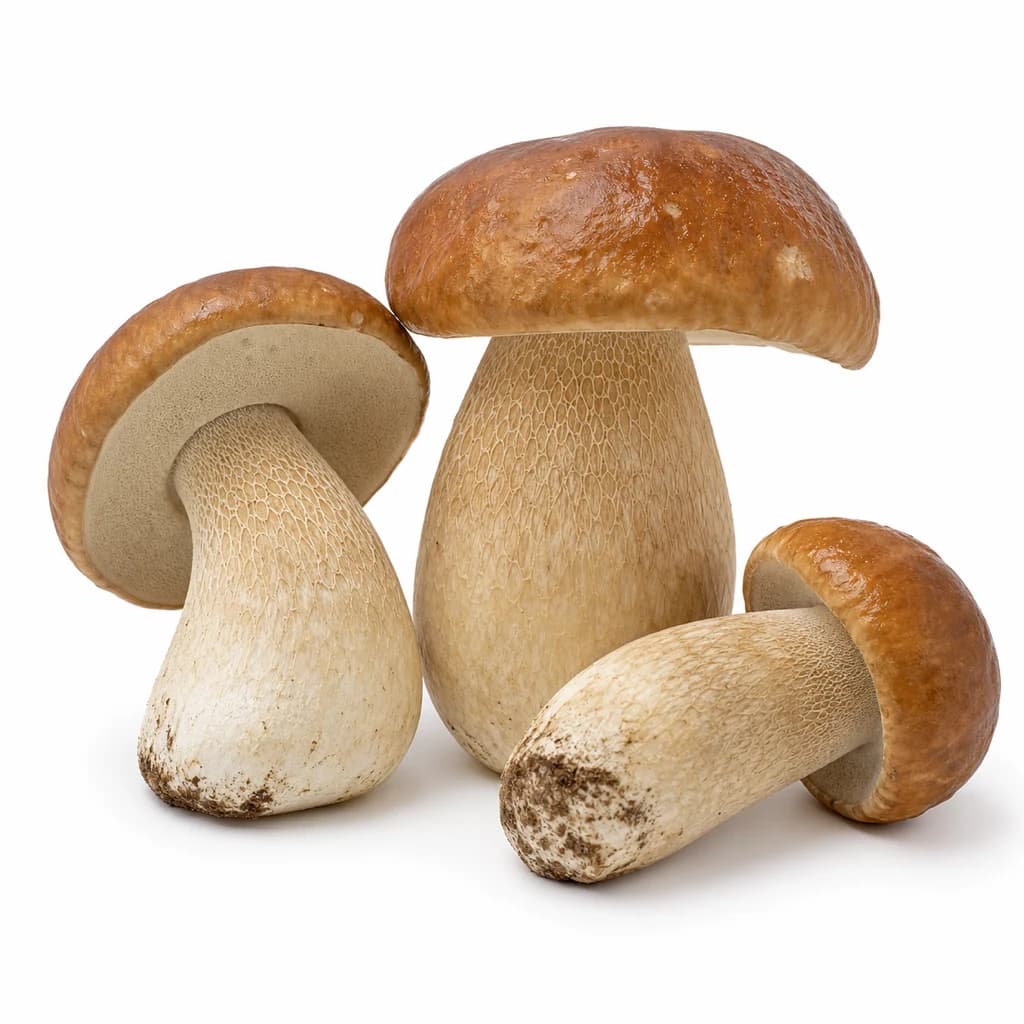
Natural form
Fresh porcini mushrooms whole, showing the broad convex cap and thick pale stem.
Shows the reader the defining physical form of porcini — bulbous beige-brown cap, swollen cream stem, and overall bolete silhouette — so they can identify it in markets or forests.
Produce
Porcini Mushroom
Meaty, nutty wild mushroom used fresh or dried to deepen risottos, pastas, and stocks.
Porcini are large, fleshy boletes with a rich, earthy, nutty flavor that intensifies when dried. They are central to Italian cooking, sliced into risottos and pastas or rehydrated to make a deeply savory broth. The soaking liquid from dried porcini is itself a prized umami-rich seasoning.
Porcini (Boletus edulis) are the most celebrated wild mushroom in the Western culinary tradition. Their dense, meaty flesh delivers an intense, nutty-umami flavor that no cultivated mushroom approaches—this is why cooks reach for them when they want a dish to taste of the forest floor. The mushroom forms mycorrhizal relationships with specific trees—oak, beech, chestnut, pine—which makes commercial cultivation essentially impossible. Every porcino has been hand-foraged, typically by specialists in the forests of Piedmont, Burgundy, or the Pacific Northwest. Fresh porcini appear briefly in autumn for two to four weeks; dried porcini—sliced caps sold loose or in packages—are the form most cooks use year-round. The dried version is not a compromise: the flavor concentrates dramatically during drying, and a small amount transforms risottos, stocks, and sauces with a depth that fresh mushrooms alone cannot achieve. When buying fresh, look for firm caps with white to pale yellow pores beneath and a stalk showing fine reticulation; avoid any specimen that smells sour, musty, or of ammonia, as these are signs of over-the-hill fruitings that can cause digestive upset.
The mushroom's Italian name, porcino (little pig), describes its squat, chunky silhouette. In Italy and France, fresh porcini are sold whole or sliced in autumn markets; internationally, dried sliced porcini are the reliable retail standard. Reconstituting dried porcini is straightforward—warm water, twenty to thirty minutes, lift out and rinse—but the soaking liquid deserves equal respect: strain it through a coffee filter or cheesecloth to remove grit, and use it in place of water or stock wherever you want deep mushroom backbone. Cooked porcini should retain a firm, yielding chew; they turn rubbery if the pan is crowded or the heat too low, and slimy if cooked in excessive fat. Properly handled, they are a profoundly satisfying ingredient—earthy, meaty, and unmistakably forest.
Fresh porcini are delicate in storage. Keep them refrigerated in a paper bag, never sealed in plastic, and use within a day or two of purchase. Dried porcini live comfortably in an airtight container in a cool dark pantry for six to twelve months. Their premium price reflects real scarcity: a skilled forager might harvest only a few pounds in a good season, and the supply chain from forest to market is short and fragile. Worth it, most cooks would say—porcini are among the handful of ingredients that genuinely elevate a dish beyond ordinary.
- Measured in
- g
- Storage
- Pantry
Types & varieties
The classic European porcini; creamy white pores, netted stalk, broad distribution across temperate forests.
Darker chocolate-brown cap, slightly more robust flavor; found in Mediterranean oak forests.
Earlier season (late spring–summer), paler cap, more permeable cap skin; welcome early appearance in markets.
Associated with conifers, burgundy-brown cap, found late season; many consider it the most intensely flavored of the group.
The Soaking Liquid: A Cook's Gold
The strained liquid from rehydrating dried porcini is one of the most concentrated flavor boosters in the pantry. It carries the water-soluble aromatic compounds that were drawn out of the mushrooms during drying, and it adds a depth of forest floor character that no stock or broth can match. Do not discard it. Strain through a coffee filter or doubled cheesecloth to remove grit—even crystal-clear-looking liquid often carries fine sand. Use it in place of water or stock wherever you want a mushroom backbone: in risotto, pan sauces, soups, braises, or even risotto rice cooking liquid. Freeze it in ice cube trays (1 oz cubes) for effortless weeknight use—one or two cubes transforms a simple weeknight risotto into something that tastes of autumn forests. The liquid will keep refrigerated for 3–4 days, or frozen for months.
- Strain through a coffee filter or fine-mesh cheesecloth—grit settles in the bottom but fine sand stays suspended
- Replace stock or water in risotto and braises for a concentrated mushroom base
- Freeze in 1-oz ice cube trays; each cube is a ready flavor boost for sauces and soups
- Never pour off the soaking liquid—taste it first; you will understand immediately why it matters
Combining Dried and Fresh in One Dish
Using both dried and fresh porcini in a single preparation is a technique that exploits the strengths of each form. Dried porcini provide concentrated, dissolved flavor that permeates the entire dish. Fresh porcini contribute textural contrast—their firm, yielding chew that dried porcini lose during rehydration. The combination produces a more complex result than either form alone can achieve. Apply this principle deliberately: dried porcini and their strained soaking liquid as the flavor foundation, fresh sautéed porcini folded in near the end for texture. This works across risotto, pasta sauces, soups, and braises.
- Add dried porcini (and their soaking liquid) early in the cooking process so their flavor develops and integrates
- Add fresh porcini near the end of cooking—sauté separately in a hot pan, then fold in
- Use fresh minced porcini in a garnish role for soups: a few pieces per bowl add visual and textural appeal
- In risotto: dried porcini in the stock, fresh porcini folded in during the last 2 minutes of mantecatura
Common uses
Tips & pitfalls
- Fresh porcini: brush clean with a barely damp cloth or soft brush—never submerge in water. Trim any bruised spots; the stem and cap are both edible.
- When sautéing fresh porcini: dry thoroughly, heat pan aggressively (cast iron or stainless, medium-high), use high-smoke-point fat (clarified butter, grapeseed, or vegetable oil). Season mid-way to avoid drawing out moisture too early. Do not crowd the pan—work in batches or mushrooms will steam and turn rubbery.
- Dried porcini: soak in warm (not boiling) water 20–30 minutes until pliable. Lift out and rinse briefly to remove grit; reserve the soaking liquid, strain through fine mesh or a coffee filter. Add liquid to stocks, risottos, or sauces for concentrated flavor.
- A single ounce of dried porcini hydrated and finely minced adds significant depth to a dish serving 4–6; more is not always better—excess can dominate and add bitter notes.
- Always cook porcini thoroughly before eating; raw porcini (especially in quantity) can cause gastrointestinal upset in sensitive individuals.
- If fresh porcini smell sour, musty, or of ammonia, discard—they are past prime and can cause digestive issues.
- Crowding the pan is the most common error when sautéing fresh porcini. Work in batches over high heat; the mushrooms should hiss and brown, not steam in their own moisture.
- Season mid-sauté, not at the start. Adding salt too early draws moisture out before browning can occur, producing a gray, rubbery texture.
Nutrition
Energy
134 kJ · per 100 g
Where the calories come from
Protein
1.5g
3% DV
Carbs
6.9g
2% DV
Fat
0.5g
1% DV
Fiber
3.8g
14% DV
Sugars
1.2g
of which
Sodium
9mg
0% DV
Source · USDA FoodData Central · approx. Mushrooms, Chanterelle, raw
View on FDC →In the shops
Matched grocery products
No matched grocery products for Porcini Mushroom yet.
Good to know
- Scientific name
- Boletus edulis
- Family
- Boletaceae (pore mushroom)
- Also known as
- King bolete, cep, penny bun, Steinpilz (German), porcino (Italian)
- Origin
- Temperate forests of Europe, North America, and Asia; mycorrhizal with oak, beech, chestnut, and pine
- Peak season
- Late summer through autumn; very short fresh availability (2–4 weeks)
- Fresh appearance
- Buff to dark brown convex cap (3–30 cm), white to yellowish pores beneath, thick white stalk with fine reticulation
- Dried form
- Most common commercial form; sliced or whole caps, intensely concentrated flavor
- Flavor
- Meaty, nutty, earthy, deeply umami; more assertive than most cultivated mushrooms
- Price
- Premium pricing; fresh can exceed $50/lb; dried runs $30–60/lb depending on origin
- Fresh storage
- Refrigerate in paper bag, use within 1–2 days; never sealed in plastic
- Dried storage
- Airtight container, cool dark pantry; retains quality 6–12 months
- Yield (dried)
- ~1 oz dried = 8–10 oz fresh (8–10× rehydration ratio)
- Cooked texture
- Firm, dense, meaty; should retain some chew, not become rubbery or slimy
- Cultivation
- Not commercially cultivated; all porcini are wild-foraged
Substitutes
- Dried shiitake — More savory and deeply umami, less nutty; acceptable 1:1 substitute but the flavor profile differs noticeably. Best when paired with a splash of soy sauce or a pinch of tomato paste to approximate porcini's earthiness.
- Morel mushrooms (dried) — Different texture (honeycombed) and flavor (faintly anise, smokier notes); considerably more expensive but acceptable in risotto, pasta, and sauces where the nuttiness of porcini is not the central concern.
- Dried porcini pieces and crumbs — Same flavor as whole dried slices; cheaper because presentation is not a factor. Ideal for stocks, sauces, and risotto where you mince them anyway.
- Fresh chanterelles — Delicate and fruity, less meaty; not a direct substitute but acceptable in quantity when paired with umami boosters (soy, miso, Parmesan) to compensate for the missing depth.
Pairs with
Also called
Cep · Herkkutatti · Porcini · King Bolete
Appears in these dishes
Related
Tomato
Juicy, sun-sweet fruit for sauces, salads, and slow-cooked depth
Yellow Onion
The aromatic backbone of soups, sofritos, and braises
Garlic
Pungent cloves that perfume nearly every savory dish
Lemon
Bright, acidic citrus that wakes up almost any dish
Potato
Humble, hearty staple — roast, mash, fry, or boil
Carrot
Sweet, crunchy root — raw, roasted, or the base of a sofrito
Cucumber
Cool, crisp, and watery — for salads, pickles, and tzatziki

Lettuce
Crisp leaves for salads, wraps, and a fresh crunch