 Georgian
Medium · Chilled
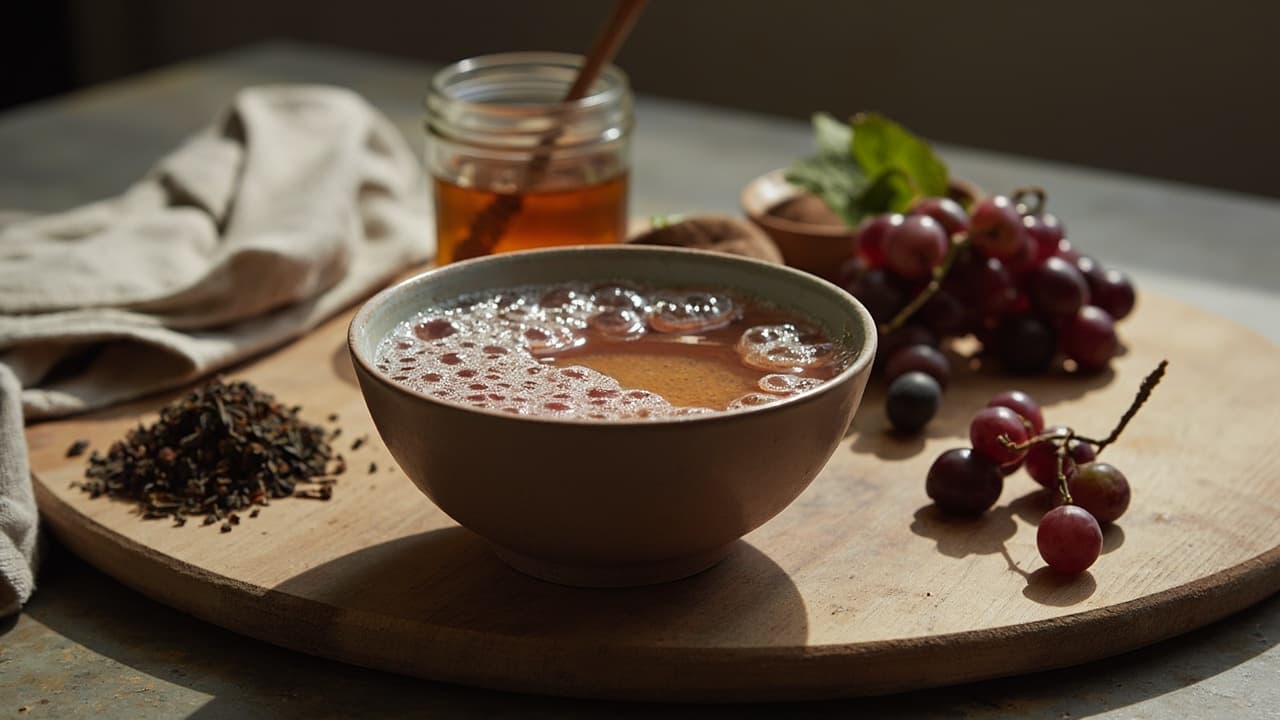
Jun SCOBY Tea with Wild Grape and Honey
A honey-sweetened fermented tea cultured on a living Jun SCOBY, finished with wild grape for delicate fruit depth and natural carbonation. The Result is a bright, tangy elixir with layers of wild-fermented complexity passed down through Georgian mountain traditions.

Prep
20 min
Cook
15 min
Total
35 min
Method
1
Bring 8 cups of spring water to a rolling boil in a large stainless steel pot over high heat.
2
Remove from heat, add 4 bags of black tea, and steep for 12-15 minutes until the tea is deeply amber and aromatic.
3
Remove tea bags without squeezing. Stir in 1/2 cup raw honey until fully dissolved into the warm tea.
4
Cool the sweetened tea to room temperature, 20-22C, uncovered. This takes about 1 hour. Do not rush with ice — rapid cooling shocks the tea.
5
Pour the cooled tea base into a clean glass fermentation jar or ceramic crock.
6
Gently submerge 1 Jun SCOBY into the tea along with 1 cup of previous fermentation liquid (jun starter) to inoculate the batch.
7
Cover the vessel with a clean natural cloth secured with a rubber band. The cloth allows the culture to breathe while blocking debris.
8
Ferment at room temperature, 21-24C, for 7-10 days. The liquid will become pleasantly sour and slightly effervescent. Begin tasting after day 6 — stop when the tanginess balances the honey sweetness to your preference.
9
Transfer the fermented tea to glass bottles, leaving 1 inch of headspace at the top of each bottle.
10
Add 1 cup of wild grape to the bottled tea. Seal the bottles loosely with a cap or swing-top.
11
Allow secondary fermentation at room temperature for 2-3 days to build natural carbonation. Burp bottles once daily to release excess pressure.
12
Refrigerate to halt fermentation. Serve chilled. The tea will keep for 2-3 weeks refrigerated. Reserve 1 cup of finished liquid and the SCOBY to start your next batch.
Grade pending
Nutri-Score
Estimated nutrition
Grade pending · 100% ingredient coverage
Calories
99
per serving
Protein
1g
Carbs
25g
Fat
0g
Sat. fat
1g
Fiber
0g
Sugar
23g
Sodium
26mg
Anti InflammatoryGut Health SupportHeart HealthyImmune SupportAntioxidant RichGut HealthHoney SweetenedLow Calorie
Nutri-Score is a general nutritional-balance guide, not medical or dietary advice.
Grade pending
Environmental impact
Estimated footprint
Grade pending · 100% ingredient coverage
kg CO2e
0.2
per serving
Jun Starter Liquid drives 44% of this recipe’s estimated footprint.
Carbon from Poore & Nemecek 2018; water, land & runoff from Agribalyse — modelled averages for comparing recipes, not a measurement of your groceries.
Flavor Profile
5
Umami
6
Sweet
1
Salty
7
Sour
3
Bitter
0
Spicy
Textures
EffervescentSmoothThin Bodied
Aromas
EarthyFermentedFloralFruityHerbal
Kitchen Equipment
Primary Tool
Stainless Steel PotCeramic CrockGlass Fermentation JarStainless Steel PotGlass BottlesMeasuring CupsMeasuring SpoonsThermometerWooden PaddleNatural ClothRubber Bands
Techniques
Safety & Storage
High Risk Population
Raw honey is not recommended for infants under 12 months due to risk of infant botulism. Use pasteurized honey if serving to young children or immunocompromised individuals.
Handling
Cool sweetened tea to room temperature (20-22C) before adding SCOBY. Adding to hot liquid will kill the fermentation culture.
Temperature
Primary fermentation should occur at 21-24C. Temperatures outside this range can promote harmful bacterial growth or stall fermentation.
Equipment Safety
Burp bottles daily during secondary fermentation to release excess CO2 pressure. Failure to do so can cause glass bottles to explode.
Storage
After secondary fermentation, refrigerate immediately at 2-4C to halt fermentation. Store upright in glass bottles with sealed caps.
Shelf Life
Refrigerated finished Jun tea maintains quality for 2-3 weeks. Discard if off-odor, mold, or unusual sliminess develops.
Cross Contamination
Use only sanitized glass or ceramic vessels for fermentation. Avoid metal utensils as acidity can react with metals. Natural cloth covers prevent contamination while allowing culture to breathe.
Allergen Warning
Though not a top-14 allergen, individuals with bee pollen or apiculture-related allergies may react to raw honey. SCOBY starter liquid contains live cultures and can cause reactions in those with severely compromised immune systems.
Pro Tips
Technique
When you test the fermentation with a clean wooden paddle rather than metal, you honor the living cultures — they speak more freely to wood than to steel, and your SCOBY will reward your patience with deeper, more complex tanginess.
Substitution
If wild grape is beyond your reach, seek out unsulphured grape juice pressed from organicConcord or Niagara grapes — what matters is the wild yeast living on the grape skin, not the variety itself.
Equipment
Never ferment in plastic, no matter how convenient it seems. The cultures absorb micro-plastics and lose their ancestral character. Glass or clay vessels only — if you can find a small qvevri, even better.
Storage
The finished Jun keeps its vitality for 2-3 weeks refrigerated, but I have never seen it last that long in anyone's kitchen — it is too alive, too delicious, and too good for you to leave sitting idle.
From the chef
My great-grandmother would read the morning clouds before she ever touched the SCOBY, and I learned from her that fermentation is a conversation, not a formula. This Jun — lighter than kombucha, sweetened with honey from our mountain apiaries and finished with wild grapes pressed by hand in the first September frost — carries the memory of every dawn she spent watching bubbles rise like small prayers. When I make this, I am not creating something new; I am returning to a conversation that has been happening in my family for generations, one living vessel at a time.
TagsFermentedKombuchaJunHoney SweetenedCarbonatedProbioticNon AlcoholicWild GrapeGeorgian TraditionalCold ServedAged
Source: generated · June 13, 2026