Transform & Preserve
Agar Clarification
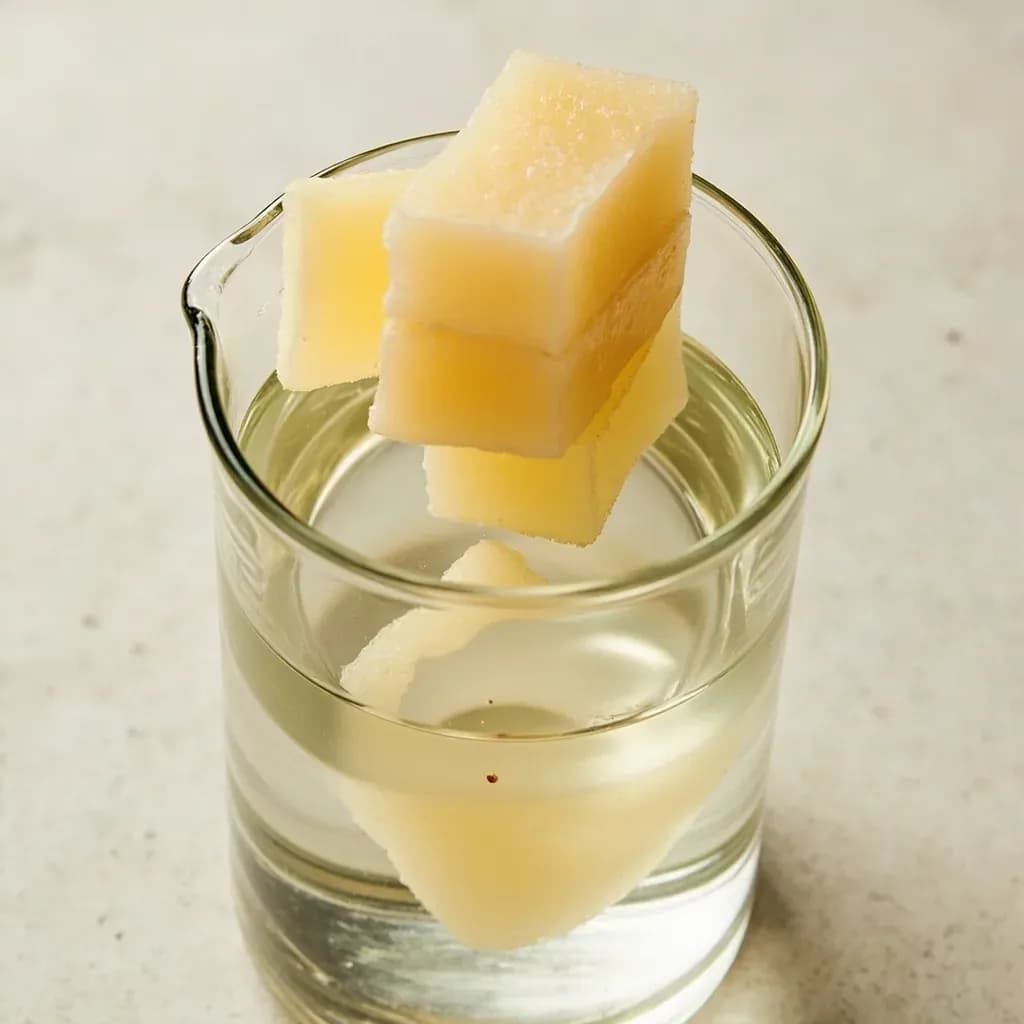
Setting a liquid with agar then thawing it to drip out a perfectly clear consommé or juice.
Agar clarification gels a flavored liquid with a small amount of agar, freezes or simply sets it, then lets it slowly drain so a crystal-clear liquid passes through while solids and haze are trapped in the gel. It produces clean broths, fruit waters, and consommés without long egg-raft work. The gel network acts as a filter, holding back particulates by size.
Agar clarification is a modern fining technique that uses the gelling power of agar to pull suspended particles, haze proteins and tannins out of a liquid. The agar is dissolved with gentle heat, then chilled until it sets into a firm block. That block is broken up and suspended in cloth; as it slowly weeps in the refrigerator, the clarified liquid drips free and the impurities stay locked inside the polymer matrix. The result is a consommé, juice or vinegar of startling brightness, often clearer than a traditionally rafted stock, and possible on liquids that would never survive a French clarification.
The technique sidesteps the two main constraints of egg-white rafting: sustained heat (the raft needs a bare simmer to coagulate) and flavour carry-through (eggs, ground meat and mirepoix always leave something behind). Agar is essentially neutral, sets at roughly 32–40 °C, and will clarify anything from a meat stock to a cold-pressed apple juice or an aged sherry. The trade-off is that, unlike a raft, agar adds no richness — it only filters — so for deep-flavoured consommés it is often combined with a classic clarification or run on a pre-reduced stock. Yield is typically 70–85% of the original volume, and a second pass through fresh agar produces visibly brighter results than a single drip.
- Difficulty
- Hard
Types & varieties
The baseline technique: bloom agar in the cold liquid, dissolve, set, then drain through cloth.
Used for heat-sensitive juices (citrus, herbs, melon) — the liquid is never boiled, only gently warmed to dissolve the agar.
Two successive set-and-drain cycles for crystal-clear results, the usual choice for consommé or fine wines.
Same principle using low-acyl gellan gum instead of agar; useful when agar's melting point is too high or when a more neutral flavour carry-through is wanted.
Sets softer and melts lower than agar, sometimes preferred for very delicate or slightly acid liquids; behaves similarly.
How to do it
- 1
Weigh and calculate
Measure your liquid by weight. Aim for 0.2–0.4% agar (1–2 g per 500 g). For very cloudy or protein-rich liquids, err toward 0.4%; for delicate juices or wines, stay near 0.2%. Anything above 0.5% produces a rubbery gel that will not drip cleanly.
- 2
Bloom the agar
Sprinkle the agar over the cold liquid and whisk briefly. Let stand 5–10 minutes so the granules hydrate without clumping at the surface.
- 3
Dissolve
Heat gently, whisking, to about 90–95 °C and hold for 1–2 minutes until the agar is fully dissolved — the liquid should be perfectly clear with no visible grains. For a heat-sensitive juice, keep the temperature below 70 °C and hold a little longer.
- 4
Pour and set
Pour into a shallow tray, mould or individual containers to a depth of about 2–3 cm (thinner blocks set faster and drain better). Refrigerate uncovered until fully firm, 2–4 hours.
- 5
Cut the gel
Unmould the block. Cut it into roughly 1–2 cm cubes with a knife, or pass it through a coarse grater for maximum surface area. Do not blend or whip — you want the matrix intact.
- 6
Suspend for draining
Line a chinois or large fine-mesh sieve with a double layer of cheesecloth (or a clean nut-milk bag) and set it over a non-reactive bowl. Pile the cut gel loosely into the cloth; do not pack it down.
- 7
Drip, do not squeeze
Refrigerate and let gravity do the work for 4–12 hours. The clarified liquid drips through, leaving impurities trapped in the gel. Resist the urge to press, twist or squeeze the cloth — that forces particulates back through.
- 8
Filter and (optionally) repeat
Pass the collected liquid through a fresh paper coffee filter or a single layer of cheesecloth to catch any stray gel fragments. For the brightest result, repeat the entire set-and-drain cycle once more on the first drip.
- 9
Store and use
Keep the clarified liquid refrigerated and use within 2–3 days, or freeze for later. Reserve the spent gel for stocks, pan sauces or compost — it still holds the captured impurities and flavour, so it is not waste.
How it works
Agar clarification exploits a simple property of gelling hydrocolloids: when a polymer network forms in a liquid, it forms around every suspended particle, protein floc and tannin aggregate in the pot. Those particles are physically trapped in the matrix. When the set block is later broken up and allowed to drip slowly, the polymer re-liquefies, but most of the trapped matter cannot escape the loose gel — it stays behind as the clear liquid weeps out. The action is mechanical, not chemical: nothing is being precipitated or reacted, only strained at a microscopic scale through the polymer mesh.
- The matrix must be firm enough to hold the particles but soft enough to drip — 0.2–0.4% agar is the working window.
- A finer cut on the gel means more surface area and faster, more complete drainage.
- A second pass through fresh agar polishes out haze the first drip leaves behind.
Agar versus egg-white rafting
Egg-white rafting remains the right tool when you want to enrich and clarify at the same time: the proteins and aromatics in the raft add body as they coagulate, which is why a classical consommé tastes more substantial than an agar-clarified one of the same stock. Agar is the right tool when clarity, freshness and the ability to work cold are the priorities. Many kitchens use both in sequence — a classic raft to concentrate flavour, then an agar pass on the reduced stock to polish the appearance.
- Choose egg-white rafting for traditional meat and game consommés where mouthfeel matters.
- Choose agar clarification for delicate stocks, juices, wines, vinegars and any liquid you cannot or do not want to simmer with raw protein.
- Combine the two: raft first for flavour, agar second for clarity.
Choosing agar vs. other hydrocolloids
Agar is the default because it sets cleanly, is widely available and dissolves in a short simmer. Low-acyl gellan gum gels at similar concentrations but produces a more brittle set and tolerates acid and calcium better, which is why it is sometimes preferred for citrus juices and fortified wines. Iota carrageenan gives the softest set of the three and is occasionally chosen for very low-solids liquids. None of these alternatives behaves identically to agar, so the percentage and setting times need to be re-tested when switching.
- Agar: standard, neutral, sets at 32–40 °C; loses strength below pH 3.5.
- Low-acyl gellan gum: brittle set, acid-tolerant; needs calcium or sodium ions to set firmly.
- Iota carrageenan: soft set, best for the most delicate applications.
Common uses
Tips & pitfalls
- Weigh the agar rather than measuring by spoon; powder density varies widely, and over-dosing is the single most common failure.
- Bring the bloomed agar to a full simmer — undissolved grains leave a gritty drip and a hazy final liquid.
- Never squeeze the cloth during draining. Gravity alone produces a bright result; pressure forces haze back through the mesh.
- Run a second agar pass on the first drip for visibly brighter results — particularly worth doing for consommés, jellies and any liquid served in a glass.
- With citrus or other acid liquids (below pH 3.5), agar loses strength and the gel may weep rather than hold; reduce the acid first or switch to low-acyl gellan gum.
- If the target liquid is almost clear to begin with — distilled water, a very dilute infusion — add a small amount of protein (whisked egg white or bloomed gelatin, around 1–2 g per litre) before setting; without enough suspended matter, agar has little to trap and the drip will be transparent but not actually clean.
- Save the spent gel: it still carries the captured flavour and can be folded into stocks, pan sauces or a vegetable broth.
Good to know
- Method type
- Hydrocolloid (agar) gel clarification
- Active agent
- Agar agar, a polysaccharide extracted from red algae (Gelidium and Gracilaria species)
- Typical concentration
- 0.2–0.4% of liquid weight (1–2 g per 500 g); never above 0.5%
- Setting temperature
- Sets at roughly 32–40 °C — well below gelatin
- Melting temperature
- Fully melts at about 85–95 °C
- Drain time
- Usually 4–12 hours at refrigerator temperature; can be left overnight
- Yield
- About 70–85% of original volume; the gel retains some liquid
- Origin in modern kitchens
- Adopted into restaurant technique in the early 2000s via the modernist and Spanish avant-garde movements; documented by Heston Blumenthal, Ferran Adrià and the elBulli team
Also called
Agar Filtration · Gel Clarification
Related

Confit
Cook slowly submerged in fat for silky tenderness and keeping

Cure
Draw out moisture with salt and time to preserve and concentrate

Pickle
Steep in acidic brine for bright, tangy, crunchy preservation

Ferment
Let friendly microbes transform food into tangy, complex flavor

Marinate
Soak in a seasoned mix to flavor and tenderize before cooking

Brine
Soak in salt water so meat stays juicy and seasoned throughout

Dehydrate
Slowly dry out moisture to concentrate flavor and extend shelf life

Cold-Smoke
Perfume cured food with smoke without cooking it through