Transform & Preserve
Aioli Emulsifying
Slowly whisking oil into garlic and egg to form a thick, stable garlic emulsion or cold sauce.
Aioli emulsifying disperses oil into garlic, and often egg, in tiny droplets stabilized into a thick, creamy sauce. The oil must be added gradually while whisking or blending so the emulsion forms rather than breaks. The same emulsifying skill thickens cold Spanish soups like salmorejo and gazpacho into silky, spoon-coating textures.
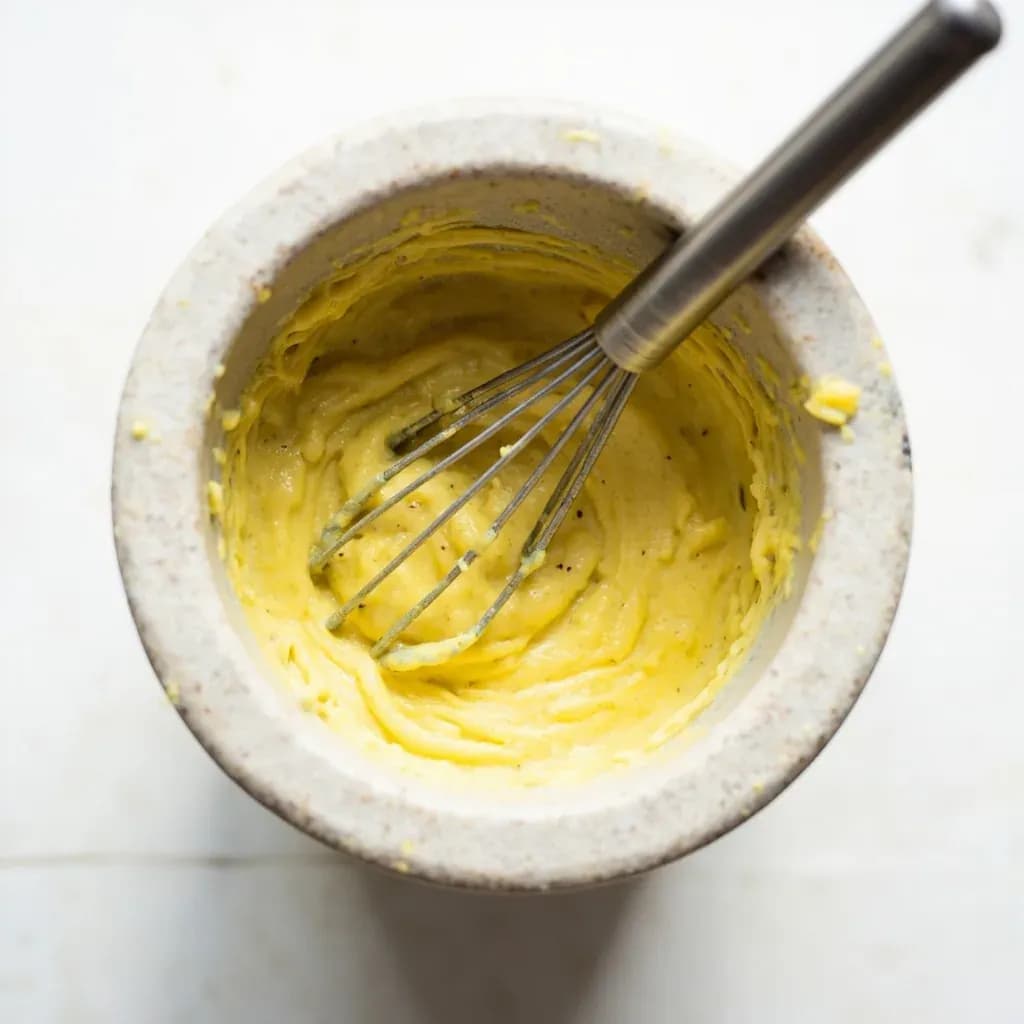
Aioli emulsifying is the technique of suspending droplets of olive oil in a water-based medium — garlic, egg yolk, and a little acid or water — until the mixture thickens into a glossy, stable sauce. Unlike a simple stirred vinaigrette, an aioli is a true emulsion: microscopic oil droplets are coated with an emulsifier (the lecithin in egg yolk, or the mucilaginous compounds released from crushed garlic in the Catalan version) and held apart from one another in a continuous aqueous phase. Done well, the sauce holds its shape on a spoon, clings to food, and can be stored for days. Done poorly, it breaks — oil puddles free, garlic clumps, and the cook reaches for a fresh bowl.
The reason the technique rewards patience is the physics of droplet formation. When oil is added slowly to a yolk, each new droplet is sheared into tinier droplets by whisking before the next arrives, so the yolk's lecithin can coat the enormous new surface area. If oil pours in too quickly, droplets merge faster than they can be coated, and the emulsion collapses. Once the sauce 'takes' — visibly thickening into a pale, ribboning mass — the existing droplets act as seeds and the system can absorb oil much more quickly without breaking. Temperature matters: cold yolks are stiff and resist dispersing the oil, while very warm yolks have lost some of their emulsifying structure; room temperature is the sweet spot.
Beyond mechanics, aioli emulsifying is a discipline that teaches a cook to read a sauce by eye and feel. The whisk begins to feel heavy; the mixture goes from glossy to matte as it thickens; the surface starts to ribbon when the whisk is lifted. Mastering these cues transfers directly to mayonnaise, hollandaise, and any vinaigrette bound with egg. The reward is a sauce that is pungent with raw garlic, bright with olive oil, and stable enough to dress a platter of vegetables, fish, or boiled salt cod the way it has for centuries in Provence and Catalonia.
- Difficulty
- Medium
Types & varieties
Egg-yolk-based garlic emulsion, essentially a garlic mayonnaise; the most common modern interpretation and the base for the grand aioli platter.
Traditional mortar-made sauce of only garlic and olive oil, no egg; depends on several minutes of grinding to release garlic's natural emulsifying compounds.
Classic accompaniment served alongside the Provençal grand aioli platter of boiled salt cod, seasonal vegetables, and boiled eggs; in broader French usage the term also denotes a tomato-and-garlic sauce, so context matters.
Mayonnaise base (often store-bought) finished with raw or roasted garlic; faster and more stable than a from-scratch aioli.
A teaspoon of Dijon mustard is whisked into the yolk before the oil begins; widens the margin for error and adds sharpness.
Finished with fresh lemon juice for brightness and extra acidity that helps stabilize the emulsion against breaking.
How to do it
- 1
Prepare the garlic base
Peel 2–4 garlic cloves per egg yolk. Sprinkle with a generous pinch of coarse salt and crush to a smooth paste using a mortar and pestle, the flat of a chef's knife with a little pressure, or a microplane. Salt seasons the garlic and the abrasive crystals help rupture cell walls, yielding a finer, less harsh paste.
- 2
Build the emulsion foundation
In a wide, non-reactive bowl (stainless steel or glass) whisk one room-temperature egg yolk with the garlic paste. Add 1 teaspoon Dijon mustard and 1 teaspoon of warm water or lemon juice; whisk until the mixture is glossy and slightly looser than the yolk on its own.
- 3
Begin the oil — drop by drop
While whisking continuously with the bowl steadied on a damp cloth, pour oil in an almost imperceptible thread — a few drops at a time. The mixture should visibly thicken within the first teaspoon. Stop and check: when the whisk leaves a trail that holds for a second before collapsing, the emulsion has set and you can move on.
- 4
Increase the flow
Once the sauce has the consistency of loose mayonnaise, increase the oil to a thin, steady stream. Maintain continuous whisking and rotate the bowl as you go. For one yolk you will use about 200–250 ml of oil in total before the sauce becomes heavy and the risk of breaking rises sharply.
- 5
Finish and adjust
Whisk in 1–2 teaspoons of fresh lemon juice to taste, a grind of white or black pepper, and check the salt. If the sauce is too thick, loosen it with warm water a few drops at a time — never more oil at this stage. If the flavor is flat, brighten with another squeeze of lemon rather than more raw garlic, which will only sharpen the harsh notes.
- 6
Rest before serving
Cover and refrigerate at least 30 minutes so the garlic flavor mellows and integrates with the oil; freshly made aioli can taste sharply of raw garlic. To prevent a grayish oxidized cast during storage, press a thin film of water or oil against the surface and pour it off before serving.
The Science of the Emulsion
An emulsion is a suspension of one liquid in another that would normally separate, held stable by a third ingredient — an emulsifier — that sits at the interface between the two phases. In Provençal aioli, that emulsifier is the lecithin in egg yolk, an amphiphilic molecule with a water-loving head and an oil-loving tail. As the whisk shears oil into microscopic droplets, lecithin molecules orient themselves around each droplet, tails inward toward the oil and heads outward toward the surrounding water. The result is a stable dispersion: oil never touches oil, and the sauce stays thick and opaque.
Garlic itself contributes surprisingly little emulsification in the Provençal version — it is essentially a flavoring suspended in the egg-and-oil matrix. In the Catalan all i oli, however, garlic carries the entire emulsion. When garlic is crushed or grated for several minutes, its cells rupture and release a sticky mixture of sugars, proteins, and small amounts of pectin-like mucilage. Whipped vigorously with oil, these compounds act as a weak but serviceable emulsifier. The Catalan sauce is therefore thinner, sharper, and notoriously less stable than its Provençal cousin, and is typically eaten within hours of making.
Choosing and Treating the Garlic
Garlic intensity varies enormously by variety and season, and the difference shows up directly in the finished sauce. Spring garlic (ajo tierno in Spain, green garlic elsewhere) is mild, almost sweet, and can be used raw in generous quantity. Mature hardneck garlic is pungent and can dominate a sauce if used raw. The chemistry here is worth understanding: when garlic is crushed, the enzyme alliinase converts alliin to allicin over the first ten minutes or so, which is when raw garlic reaches its sharpest. Resting crushed garlic briefly does not mellow allicin; it actually completes its formation. To tame the bite, cooks rely on acid (lemon juice, vinegar), on blooming the paste in a little warm oil, or on using roasted garlic instead of raw. A pinch of coarse salt rubbed into the cloves with the flat of a knife — or in a mortar — both seasons the garlic and provides abrasive grit that ruptures cell walls more thoroughly than a knife alone.
Regional Differences and When to Use Each
Provençal aioli and Catalan all i oli are often treated as the same sauce, but they behave differently in the kitchen and at the table. The Provençal version is generous, stable, and mild enough to use as a dip or spread. The Catalan version is a condiment used in smaller quantities, often drizzled over grilled meats, escalivada, or pa amb tomàquet. The Provençal grand aioli — a summer feast of boiled salt cod, artichokes, carrots, beans, and eggs served with a bowl of aioli for dipping — is a meal in itself and a benchmark for the technique.
Common uses
Tips & pitfalls
- Bring eggs to room temperature — a cold yolk is the single most common cause of a broken emulsion, because it is too viscous to disperse oil into fine droplets.
- Start the oil barely dripping, almost drop by drop; only speed up once a tablespoon has been incorporated and the sauce visibly thickens into a ribboning mass.
- Use a mild or light olive oil for the bulk of the sauce and reserve peppery extra-virgin for finishing drizzles; aggressive olive oil can taste bitter in quantity and makes the sauce heavier.
- Grind the garlic with a pinch of coarse salt in a mortar first — salt acts as abrasive grit and helps rupture cells for a smoother, less harsh paste.
- Add a teaspoon of Dijon mustard or a teaspoon of warm water to the yolk before the oil begins; the mustard contains its own emulsifiers and the warm water simply thins the yolk so it can take oil more readily — both widen the safety margin.
- If the sauce becomes too thick, loosen it with a few drops of warm water or lemon juice — never with more oil, which is the surest way to break the emulsion at that stage.
- If the sauce breaks (oil puddles free and the mixture looks glossy and thin), salvage it: wash and dry the bowl, start with a fresh yolk and a teaspoon of mustard, and slowly whisk the broken sauce into it exactly as you would new oil.
- For a Catalan-style all i oli without egg, use a wide marble or wooden mortar and grind the garlic for several minutes until it turns into a smooth, white, almost creamy paste before any oil touches it; this long grind is what releases the mucilage that emulsifies the sauce.
- Add the finishing acid (lemon juice or mild vinegar) at the end, not the beginning; adding large amounts of acid early can interfere with emulsification and sharpens the raw-garlic note unpleasantly.
Good to know
- Technique Type
- Emulsification (oil-in-water)
- Origin
- Provence, France; parallel tradition as 'allioli' in Catalonia, Spain
- Key Emulsifier
- Egg yolk lecithin (modern Provençal) or garlic mucilage alone (traditional Catalan)
- Classic Ratio
- 1 large egg yolk per 200–250 ml oil; 2–4 garlic cloves per yolk
- Oil Choice
- Mild extra-virgin olive oil, or a blend of olive and neutral oil for a softer flavor
- Temperature
- Eggs and bowl at room temperature; cold yolks resist emulsification
- Active Time
- 10–20 minutes by hand; under 1 minute in a food processor or with an immersion blender
- Shelf Life
- 3–5 days refrigerated, sealed; up to 1 week with extra lemon and a thin water or oil seal against the surface
Also called
Cold Soup Emulsifying (Gazpacho/Salmorejo) · Aioli Making · Emulsifying
Dishes that rely on it
Related

Confit
Cook slowly submerged in fat for silky tenderness and keeping

Cure
Draw out moisture with salt and time to preserve and concentrate

Pickle
Steep in acidic brine for bright, tangy, crunchy preservation

Ferment
Let friendly microbes transform food into tangy, complex flavor

Marinate
Soak in a seasoned mix to flavor and tenderize before cooking

Brine
Soak in salt water so meat stays juicy and seasoned throughout

Dehydrate
Slowly dry out moisture to concentrate flavor and extend shelf life

Cold-Smoke
Perfume cured food with smoke without cooking it through