Heat & Fire
Blanch-Frying (Two-Stage Oil)
Frying food first in moderate oil to cook through, then again in hot oil to crisp and color, producing a tender interior and shatter-crisp shell.
Blanch-frying — 复炸 (fù zhá) in Chinese, sometimes called "two-pass oil frying" — is the workhorse technique behind the crisp-shelled, juicy-hearted texture of countless Chinese restaurant dishes. The cook passes food through the oil twice: first at a moderate 140–160°C (280–320°F) to cook it through without browning, then again at a hotter 180–200°C (360–400°F) for a brief, ferocious crisping. What looks like extra work is actually a division of labour: the first stage drives out interior moisture and sets the structure of any coating, the second flash-evaporates surface water and dehydrates the crust to a brittle snap.
The brilliance of the method is that it lets the cook use very hot oil at the end without overcooking the food inside. Single-pass deep-frying has to balance two competing jobs in the same bath — drive heat into a cold centre while browning the outside — and the result is usually a compromise: either pale and oily, or dark and tough. Splitting the job means the second pass can be short and savage, sometimes under thirty seconds, crisping and colouring the shell almost before the heat has a chance to penetrate further. The brief rest between stages matters too: surface moisture migrates out, the coating firms up, and the food is poised to crisp rather than steam in the second bath.
In practice, blanch-frying is rarely the end of a dish. It is almost always a prelude — pieces go from the second fry directly into a hot wok with sauce and aromatics, a salt-and-pepper dust, or a quick glaze. The technique exists to give the wok-toss something to grip and to keep that something crisp under sauce. Hold blanch-fried food for more than a couple of minutes and the crust softens, which is why restaurant stoves run the two passes back-to-back and home cooks should have everything else prepped before oil goes in the wok.
- Difficulty
- Moderate
Types & varieties
Food dusted in dry cornstarch or dipped in a thin batter before the first pass; produces the classic brittle, slightly chalky shell seen on kung pao chicken and sweet-and-sour pork.
No coating — used for peanuts, cashews, dried chillies, and Sichuan peppercorns bloomed in oil to drive off moisture and intensify aroma before the crisping pass.
Pieces marinated in egg white, cornstarch, Shaoxing wine, and salt (the 'velveting' step) before the two oil stages, giving a juicy, almost lacquered exterior.
After the second fry, the item is briefly tossed in a hot wok with aromatics and sauce — the 干煸 'dry-fry' technique. The crisp shell is what makes the toss possible without turning soggy.
How to do it
- 1
Prepare the food
Cut into uniform bite-sized pieces so they cook evenly. For coated versions, pat the surface dry, then dust lightly in cornstarch or dip in a thin batter, shaking off any excess. For velveted versions, marinate first in egg white, cornstarch, a splash of Shaoxing wine, and a pinch of salt for 15–30 minutes.
- 2
Heat oil for the first stage
Pour 5–7 cm (2–3 in) of neutral, high-smoke-point oil into a wok and bring it to roughly 140–160°C (280–320°F). A wooden chopstick should send up a lazy, steady stream of small bubbles.
- 3
First fry — cook through, no colour
Add the food in small batches and move it gently so pieces don't stick. Fry just until the interior is cooked (or the raw taste is gone) and the surface is set and pale, not browned. For a 2 cm piece this is usually 1–2 minutes. Remove with a spider and drain on a rack.
- 4
Rest briefly
Let the food rest 30 seconds to a few minutes. Surface moisture escapes and the interior firms up slightly, which is what lets the second fry crisp the outside without overcooking the inside.
- 5
Raise the oil for the second stage
Bring the oil to 180–200°C (360–400°F). A chopstick should now produce a brisk, foamy sizzle.
- 6
Second fry — crisp and colour
Return the food to the hot oil in small batches for 15–60 seconds, just until the coating is dry, crackling, and evenly golden. Shake the basket or stir gently to even out the colour. Remove and drain again.
- 7
Proceed immediately
Take the crisp pieces straight into the finishing step — tossing with sauce and aromatics in a hot wok, plating with a glaze, or serving with a dry salt-and-pepper dust. Holding blanch-fried food for more than a couple of minutes softens the shell.
The thermal logic
The first pass at 140–160°C sits well below the temperature at which browning happens quickly, but well above the boiling point of water. Surface water boils off as steam, the coating sets or gelatinises, and the interior climbs to done without the crust racing ahead in colour. The brief rest on a rack is doing real work: surface moisture continues to evaporate, and the partial dehydration of the outer layer is what makes the second pass so effective. When the food goes back into oil at 180–200°C, the now-drier surface temperature spikes almost instantly, water at the surface flashes to steam, and the coating dehydrates and browns in tens of seconds — faster than heat can conduct much further inward. That is why a piece that would be raw inside if fried hot for one minute, and pale and greasy if fried cool for three minutes, comes out perfectly when split into a cook-then-crisp sequence.
Cousins in other cuisines
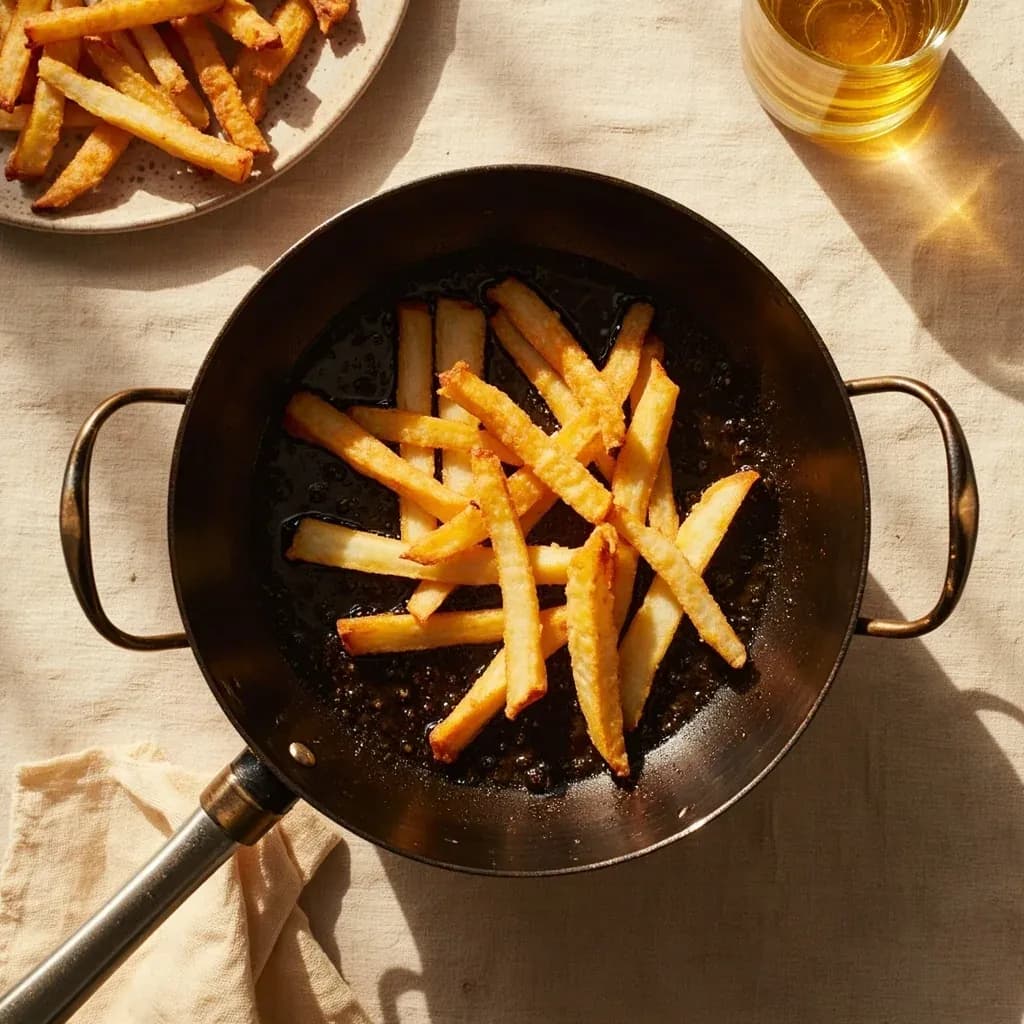
The two-stage logic shows up independently in several deep-frying traditions. Belgian pommes frites run a similar pair of temperatures, often around 150°C then 175–180°C, but with a longer first stage that cooks the potato through and a longer second pass that crisps a thicker crust. Korean twice-fried chicken — the foundation of yangnyeom and other glazed styles — typically goes 160°C then 190°C, with the sauce tossed on at the end. Japanese karaage is generally a single hot fry rather than a deliberate two-stage, and is included here only as a point of contrast: the Chinese version is characteristically fast, hot, and built to lead into a wok-toss rather than stand alone.
Common uses
Tips & pitfalls
- Use a thermometer or a test strip of scallion — a steady, gentle sizzle at the first stage, a vigorous sizzle at the second. Guessing the oil is the most common reason for greasy or dark results.
- Don't crowd the wok. The first stage is for cooking, the second is for crisping — if the oil temperature drops too far on the second pass, you'll stew the food in oil instead of frying it.
- Let pieces rest on a rack, not a flat plate, between stages. Steam trapped under food on a plate softens the coating and undoes the first fry.
- Aim for a thin, even cornstarch coat — shake off excess. Thick clumps of starch trap steam, burst in the oil, and shed into the oil as gunk that burns on the second pass.
- Prep everything else (sauce, aromatics, final toss) before the second fry. The second pass is fast and food cools quickly; you want to go straight from the second fry into the finishing step.
- Save and strain the oil. Blanch-frying leaves little flavour and few impurities if temperatures are kept right — the oil can be reused several times for similar work.
Good to know
- Chinese name
- 复炸 (fù zhá); also 二度油炸 (èr dù yóu zhá), 'two-pass oil frying'
- Origin
- Chinese; deep roots in Sichuan and Cantonese kitchens, now a pan-Chinese restaurant technique
- First-stage oil temperature
- 140–160°C (280–320°F), called 温油 ('warm oil') in Chinese cookbooks
- Second-stage oil temperature
- 180–200°C (360–400°F), called 热油 ('hot oil')
- Oil choice
- Neutral, high-smoke-point: peanut, soybean, canola, or vegetable
- Rest between stages
- 30 seconds to a few minutes, on a rack or paper, just long enough for surface moisture to escape
- Second-fry duration
- 15–60 seconds — long enough to colour and crisp, short enough not to overcook
- Difficulty
- Intermediate; success depends on oil-temperature control and batch sizing
Also called
two-stage frying · blanch fry · low-then-high frying