Prep & Assembly
Grating Coconut
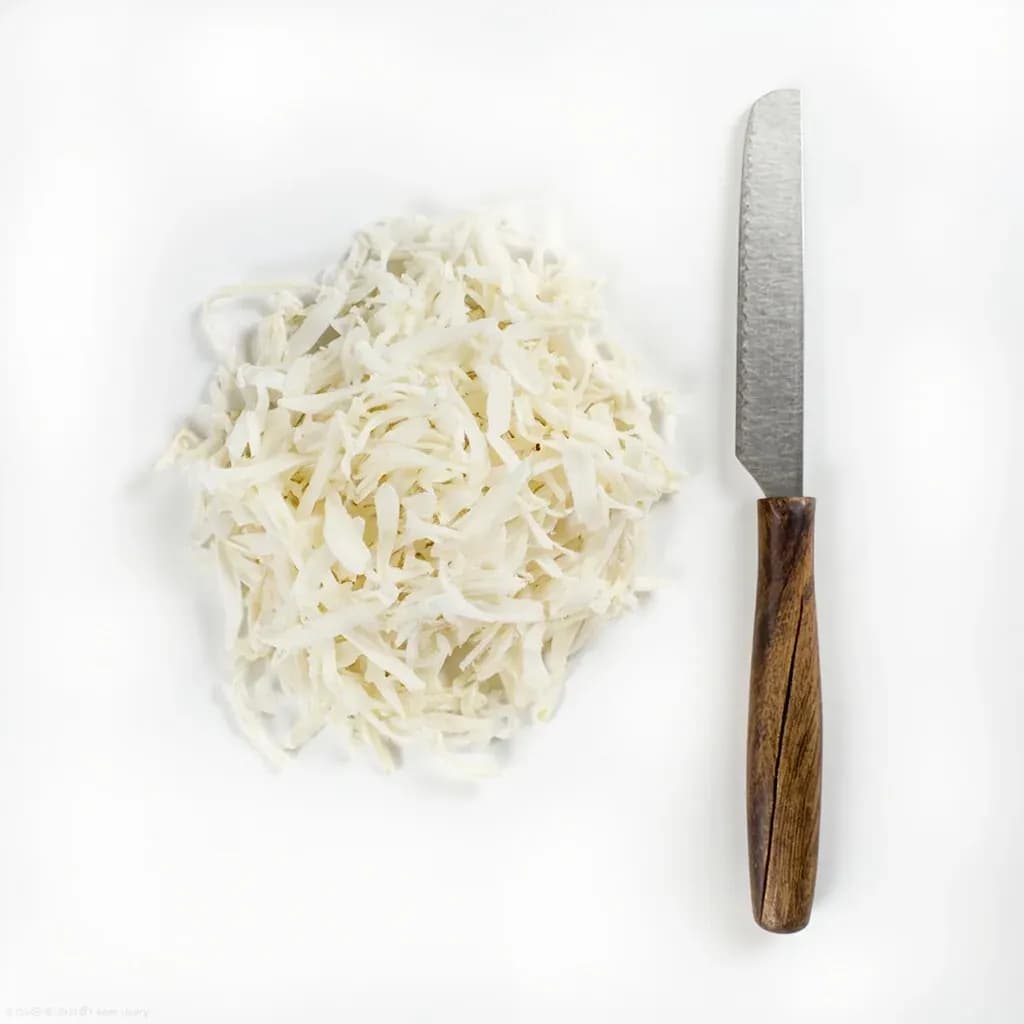
Scraping the white flesh from a coconut into fine shreds for cooking or milk extraction.
Grating coconut scrapes the firm white meat from a mature coconut into fine shreds, often using a serrated coconut scraper or grater. The shredded flesh is used fresh in chutneys, sweets, and garnishes, or squeezed with water to make coconut milk. Freshly grated coconut has a sweeter, richer flavor than dried.
Grating coconut is the foundational prep step of nearly every tropical kitchen — the moment a hard, fibrous nut becomes a workable ingredient. The white flesh of a mature coconut is too tough to chop and too firm to purée raw, but run it across a serrated edge and it falls into tender shreds that can be folded into a batter, scattered over a dish, or pressed into rich, emulsified milk. Without that grating, there is no curry paste, no coconut rice, no macaroon, no bowl of tom kha.
Two decisions shape almost everything that follows. The first is fineness: a rice-grain grate behaves like a paste, releases its fat readily, and is the cut for sweets and for pressing thick first-press milk; a coarse, 1–2 cm strand keeps its bite and is what you want folded into a curry, scattered over a stir-fry, or baked into a cake. The second is whether the thin brown testa is pared away. Skin-off gives the bright white, mild, almost floral flavor that defines Indian mithai, custards, and Western baking; skin-on gives a deeper, nuttier, slightly tannic character prized in rural Sri Lankan and southern Indian cooking, and a tan color that suits savory dishes.
Modern cooks shortcut the work with frozen grated blocks, desiccated coconut, or a food processor — all valid, none identical to the fresh version. A frozen fresh-grated block thaws to nearly the same quality as the day it was grated; desiccated is drier, slightly toasted, and must be rehydrated before it will surrender its milk. In traditional households the bench scraper lives on the counter the way a wooden spoon does in a French kitchen, and the grating is rarely thought of as a separate task.
- Difficulty
- Easy
Types & varieties
Almost a paste when squeezed; the standard cut for Indian sweets such as barfi and laddoo, for macaroons, and for pressing into thick first-press coconut milk.
Holds its shape through cooking; preferred for Thai curries, Sri Lankan polos, Indonesian lawar, Philippine bibingka toppings, and Caribbean cake batters where bite is welcome.
Older rural tradition in Sri Lanka and southern India; the testa is left attached, giving a deeper, nuttier, slightly tannic flavor and a beige color that suits savory dishes.
Mild, sweet, pure-coconut flavor and bright white color; the standard for sweets, custards, and Western baking.
Sold in Asian and tropical groceries in 1 lb / 500 g blocks; thaws to near-fresh quality and is the most practical substitute for grating your own.
Commercially dried to roughly 3% moisture, available as fine or medium 'macaroon' cut; must be rehydrated in warm water or milk before it can substitute for fresh in milk extraction.
Fresh shreds dry-roasted in a pan or low oven until golden; used as a flavor finish or snack rather than a bulk ingredient.
How to do it
- 1
Drain the coconut water
Find the three indented 'eyes' at one end of the nut. Puncture the two softer eyes with a clean screwdriver, nail, or drill bit and pour the water into a glass — reserve it for drinking or cooking. Drain fully so the nut is lighter and less likely to slip when you crack it.
- 2
Crack the shell
Hold the nut in one hand over a cloth or old towel. Strike firmly around the equator with the back of a heavy cleaver, machete, or hammer, rotating a quarter turn between each hit. After 3–4 strikes the shell usually splits cleanly into two halves. Work over a basin of water or a damp surface so you don't lose any liquid or small pieces of meat.
- 3
Release the meat
Slide a short, blunt knife (a butter knife or wide paring knife) between the white flesh and the brown shell and lever the meat out in one piece per half. You should end with two clean, crescent-shaped pieces of coconut meat. Discard the shell.
- 4
Clean and trim the meat
Rinse the halves in cool water and pat dry. Slice off any dark spots, soft patches, or bits of shell with a paring knife. For a pure white, mild-flavored result, pare off the thin brown skin (testa) with a vegetable peeler; for a stronger, nuttier result suited to savory dishes, leave it on.
- 5
Choose your grater and prep the work surface
For speed and safety, the traditional bench scraper is best: clamp or seat it firmly on a stable surface so the serrated disc sits at a comfortable working height. A box grater is the next best option — set it in a wide bowl to catch the shreds. A food processor with a grating disc handles large quantities. A microplane is fine for small garnishing amounts.
- 6
Grate the coconut
Hold a half firmly and rub the cut face across the grater in steady, even strokes. For fine shreds, use the small holes of a box grater or a microplane; for coarse, use the largest holes. On a bench scraper, twist the half into the serrated disc with even downward pressure. If using a food processor, work in 1-cup chunks and never overload the feed tube.
- 7
Use, press, or store
Use the grated coconut immediately for the freshest flavor and best milk yield. To extract milk, combine with hot water (roughly 1 cup grated to 1.5–2 cups water), knead well, and squeeze through cheesecloth or a fine sieve; then re-press the pulp with fresh hot water for a second, thinner milk ideal for rice and soups. To store, pack tightly into a container, press a damp cloth or a thin film of water onto the surface, seal, and refrigerate up to 4 days, or freeze in flat 1-cup portions for up to 6 months.
Choosing your grater
The tool you reach for depends on volume, safety, and the cut you want. The traditional serrated bench scraper is the standard in most coconut-eating cultures because it is fast, keeps the hands well clear of the cutting edge, and produces an even, medium shred in a single pass. It is the right choice for everyday cooking and for working through a nut or two at a time. A box grater is the most accessible alternative in a Western kitchen: use the largest holes for coarse shreds and the small holes for fine, and always grate into a wide bowl to catch the falling shreds. A microplane is excellent for garnishing amounts and for folding into batters, but slow for bulk work and harder on the knuckles. A food processor with a grating disc handles large quantities in minutes; never use the S-blade for fresh coconut, as it pulverises the shreds into a paste and the oil separates almost immediately, ruining both texture and milk yield.
- Bench scraper: fastest and safest by hand; ideal cut for milk and curries.
- Box grater: most common in Western kitchens; grate into a wide bowl, never a plate.
- Microplane: best for small amounts and very fine, almost wet shreds for garnish.
- Food processor with grating disc: use for big batches; pulse in small chunks and never overload the bowl.
Fresh-grated vs frozen vs desiccated
The three forms are not interchangeable in every recipe. Fresh-grated coconut has the brightest aroma, the most intact oil, and the highest milk yield — a single pressing of 1 cup fresh-grated with 1.5–2 cups hot water gives a thick, first-press milk. Frozen fresh-grated blocks, thawed briefly under cool water, behave almost identically and are the closest practical substitute. Desiccated coconut is drier, often slightly toasted, and the cells are no longer intact, so it needs to be soaked in warm water or warm milk for 10–15 minutes before it will release its cream; in baking it can usually be used as-is.
- Fresh-grated: best flavor, best milk yield, shortest shelf life.
- Frozen fresh-grated: the closest substitute; thaw in the bag under cool running water.
- Desiccated: rehydrate in warm water or milk before pressing for coconut milk.
Common uses
Tips & pitfalls
- Always drain the coconut water first by piercing the soft eyes; a full nut is heavy and slippery and can crack unpredictably, spraying water and shredding the meat.
- Tap the shell firmly along its equator with the back of a heavy cleaver, rotating a quarter turn between hits, then give a second hard whack to split it cleanly.
- Use a short, stout knife (a butter knife or wide paring knife) and lever between the shell and the flesh rather than stabbing into the flesh itself, which bruises the meat.
- Pare the brown skin with a vegetable peeler for a white, mild grated coconut; leave it on for stronger, nuttier flavor and a rustic tan color suited to savory dishes.
- Rest the coconut halves in the refrigerator for 15–20 minutes before grating — cold flesh is firmer, releases less oil, and grates cleanly without smearing into a paste.
- Use the grating disc, never the S-blade, in a food processor: the S-blade turns fresh coconut to paste in seconds and the oil separates, ruining the texture for both cooking and milk extraction.
- Grate into a wide, deep bowl instead of a plate — shreds scattered on a plate dry out, lose moisture, and blow off the work surface.
- Rinse the freed halves and rub them with a cloth before grating; embedded grit will scratch your grater and crunch in the finished dish.
- When using a food processor, pulse in small batches; overpacking crushes the shreds, the coconut 'butter' separates, and the milk yield drops sharply.
- Press a damp cloth or a thin film of water onto the surface in the storage container — exposure to air oxidizes the oils and the shreds turn rancid within hours in a hot kitchen.
Good to know
- Best coconut to grate
- Fully mature brown coconuts (11–12 months on the tree) — they yield the most flesh and the highest oil content. Young green coconuts give softer, more gelatinous meat that grates easily but in much smaller quantity.
- Average yield per nut
- A mature coconut weighing 1.4–1.8 kg gives roughly 350–500 g of white meat, about 3–4 tightly packed cups of grated coconut, plus 200–500 ml of coconut water.
- Fat content of fresh meat
- Approximately 33–36% fat, mostly saturated and dominated by lauric acid. This is why a fine grate emulsifies so readily into milk and why a coarse grate holds its body in cooked dishes.
- Time per coconut
- 8–15 minutes by hand on a bench scraper, the traditional and fastest manual method; 2–3 minutes in a food processor fitted with a grating disc.
- Refrigerated storage
- 3–4 days in an airtight container with a damp cloth or a thin film of water pressed onto the surface to keep the shreds from drying and oxidizing.
- Frozen storage
- Up to 6 months at -18 °C / 0 °F; freeze in flat, portioned bags so you can break off only what you need.
- Weight-to-volume
- 100 g grated fresh coconut ≈ 1 tightly packed cup; one medium coconut ≈ 400 g meat ≈ 4 cups grated.
- Tools
- Traditional serrated bench scraper (Philippine kayod, Indian kobbri gadapa, Sri Lankan hiramanaya), box grater, microplane, or a food processor with a dedicated grating disc.
Also called
Coconut Scraping · Grating Root Vegetables · Coconut Shredding
Dishes that rely on it
Related

Whisk
Beat ingredients smooth and aerated with a looping wire motion

Sift
Pass dry ingredients through mesh to aerate and remove lumps

Strain
Pour through mesh to separate solids from liquid for a smooth result

Filter
Pass liquid through fine material to clarify out the smallest particles

Rice
Press cooked potatoes through small holes for fluffy, lump-free texture

Mash
Crush soft cooked food into a rustic, creamy purée

Grind
Crush food into a coarse to fine texture, from spices to meat

Grate
Shred food into fine bits against a sharp-toothed surface