Water & Steam
Combi Steaming
Cooking in a combi oven that blends convection heat with injected steam.
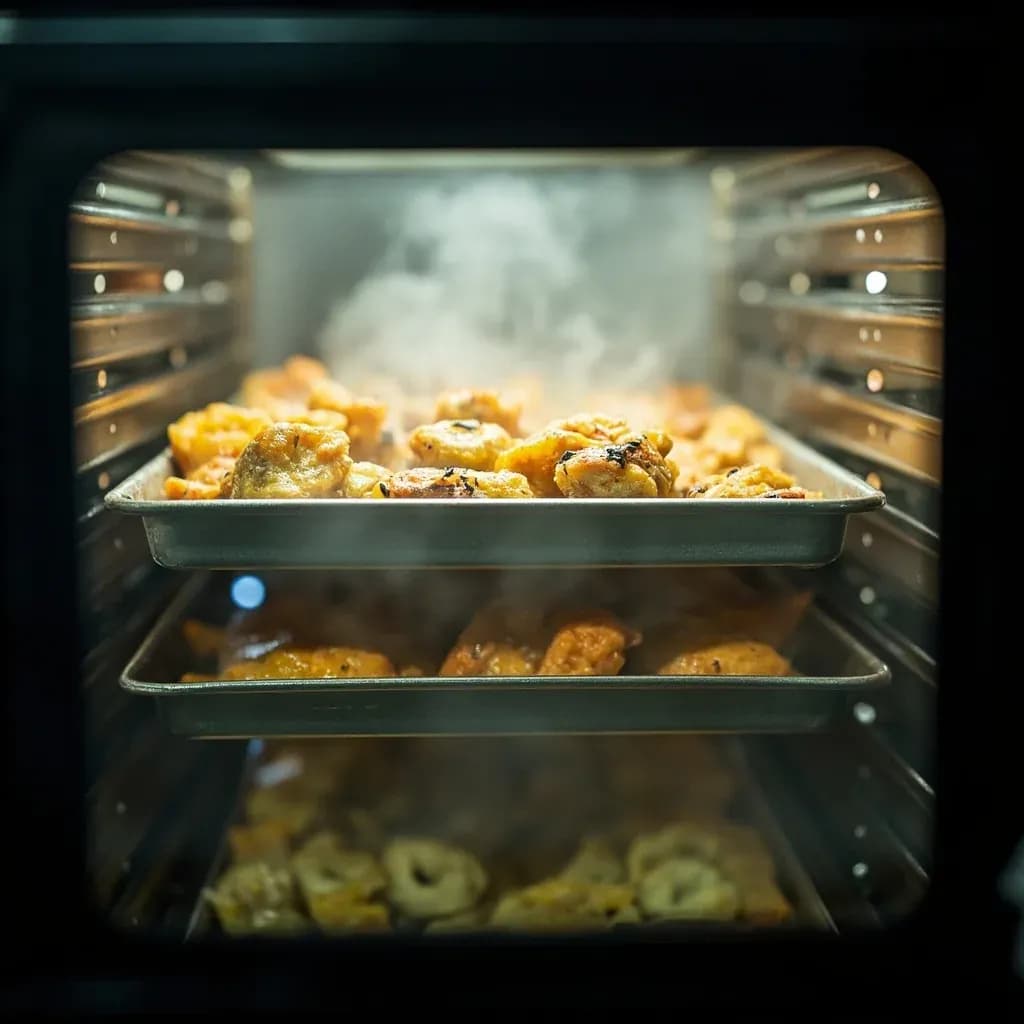
Combi steaming uses a combination oven to apply dry convection heat and controlled steam simultaneously, letting cooks dial in exact temperature and humidity. The steam keeps food moist and speeds cooking while the convection browns and crisps. It's a professional-kitchen workhorse for roasting, proofing, and gentle precise cooking of large batches.
A combi oven — also called a combi steamer or combination oven — is the only piece of equipment in a professional kitchen that lets the cook dial in both temperature and humidity independently for every phase of a cook. It is a convection oven with an integrated steam generator, capable of running as a pure steamer, a dry convection oven, or any blend in between. The same chamber can poach a salmon, roast a pork loin, proof a dough, and finish bread with crackle, without ever moving the food.
The advantage is control. Saturated steam transfers heat roughly five times faster than air and prevents surfaces from drying, so combi cooking shrinks roasts less, holds the color on green vegetables, and brings fish to a precise flake with minimal carryover. When the operator drops the humidity, the same cabinet browns, crisps, and gratinées exactly like a convection oven would. That duality — moisture when you want it, dry heat when you don't — is what makes the combi a workhorse rather than a specialty tool.
Most experienced cooks treat combi steaming less as a single technique than as a control system: you set a target cabinet temperature, a target humidity, and (where available) a target core probe temperature, and the oven holds the food at that intersection until you are ready for service. Understanding that the operator is choosing a microclimate, not just a temperature, is what separates combi cooking from the improvised humidity of a Dutch oven or a sheet pan of water on the floor of a home oven.
- Difficulty
- Medium
Types & varieties
100% humidity at 100°C (212°F) for vegetables, fish, dumplings, custards, gentle braising and proofing
0% humidity; behaves like a standard convection oven for browning, roasting and dry baking
Set humidity between roughly 10% and 90% alongside convection heat — the workhorse setting for most proteins, gratins and bread
Cabinet temperature rises in lockstep with the food's core temperature at a fixed differential (e.g. cabinet = core + 25°C), giving even long roasts with very tight carryover
Steam or combi held at 60–85°C for many hours; common in banqueting, hospital catering and sous-vide style prep
Combination mode at low heat with moderate humidity to regenerate plated, cook-chill or buffet food without drying the edges
High humidity injected at the start of the bake for oven spring and glossy crust, dropped to 0% near the end for color and crackle
How to do it
- 1
Inspect and preheat the combi oven
Confirm the steam generator has water, the drain is clear and the water filter is clean. Close the door and preheat to the planned cooking temperature and humidity for at least 5–10 minutes so the chamber is stable before food goes in — loading into a cold, damp cabinet will drop the temperature sharply and pool condensation on the food.
- 2
Choose pans and load with airflow in mind
Use perforated GN pans for vegetables, fish, dumplings, rice, terrines and any steam-dominant cook. Use solid pans or gridded shelves for roasts and bakes. Load each shelf with even gaps between items — air and steam need to move freely, and overcrowding creates a humid microclimate that prevents browning.
- 3
Set the mode, temperature, humidity and time
Pick the mode that matches the goal: 100% steam for delicate cooking, 0% for dry roasting and browning, or a set humidity in between for combination work. Program time, and where available a core probe setpoint and a finishing humidity drop. On a multi-shelf load, remember that upper shelves run slightly hotter in convection mode and slightly cooler in steam mode — rotate pans if the run is long.
- 4
Run the cook and monitor
Watch the humidity indicator if the unit displays one. Open the door briefly and only when needed — each opening vents humidity and lengthens cook time. Use the core probe for any roast larger than 1.5 kg and for fish that must finish at an exact doneness; the oven can hold the cabinet at the target internal temperature and will not overcook if service slips.
- 5
Switch to a dry finish when needed
For roasted poultry, pork crackling, bread crust, terrine tops or gratinéed dishes, drop humidity to 0% in the last 5–15 minutes so the surface can dry, brown and crisp. Watch closely — combi finishing can take a surface from gold to burnt very quickly because the air is already at temperature.
- 6
Remove, rest and clear the chamber
Pull food promptly at target temperature and rest it loosely tented on the bench. Run a short drying/venting cycle or leave the door ajar before the next cook so residual steam does not dampen the next load, and descale the steam generator on the manufacturer's schedule — scale build-up reduces steam quality and can taint food with mineral flavors.
Thinking in temperature plus humidity
Most cooks are trained to think in temperature alone. Combi cooking adds a second axis: humidity. The two interact in a way that takes some experience to read, and a few reference points help:
- 0% humidity at 160°C behaves like a dry convection oven — surfaces brown and crust, water leaves the food, Maillard runs fast.
- 30–50% humidity at 130–160°C is the sweet spot for roasts: the surface stays moist enough to release fat and baste itself, but dry enough to color.
- 80–100% humidity at 90–100°C is poaching/steaming territory: the food cannot dehydrate, so it cooks through on residual moisture and stays tender.
- Dry-finish phase: dropping humidity to 0% for the last 5–15 minutes of any cook gives you the browning a fully humid chamber cannot.
Choosing a home workaround
If a full combi oven is out of reach, the technique can be approximated in pieces. None of these match a true combi, but they cover most of the behaviors.
- A convection oven with a sheet pan of boiling water on the floor mimics the humidity side for bread baking and gentle roasts; pull the pan for the dry-finish phase.
- A countertop combi steam oven (Anova Precision Oven, Tovala, Miele, Bosch, Gaggenau) brings genuine humidity control into a home kitchen and is the closest substitute.
- A pressure cooker covers the high-moisture, high-temperature side for braises, stocks, and tougher cuts; finish with a dry sear in a hot pan or under the broiler.
- Vacuum-sealed bags in a precision circulator (sous-vide) replicate the gentle, low-loss cooking side; a combi oven does the same thing in open air and adds the browning phase without a transfer.
Common uses
Tips & pitfalls
- Leave 2.5–5 cm of space between items on every shelf so steam and hot air can circulate; overcrowding is the most common reason food comes out pale and steamed rather than browned.
- Switch from combi to 0% humidity in the last 5–10 minutes of a roast to crisp skin, bark or crackling — finishing fully humid is a frequent mistake that leaves food soft and pale.
- Match the pan to the phase: perforated GN pans for steam-heavy work, solid pans or grids for dry roasting; using a solid pan for vegetables traps drippings and prevents even steam contact.
- Don't add steam to a cold oven before preheating; preheat in the mode you will actually cook in, or condensation will pool on the food and dilute seasoning.
- Expect to reduce added salt and fat by roughly 10–20% — combi cooking retains natural moisture and seasoning more efficiently than dry heat, and recipes transplanted from a conventional oven often taste over-salted.
- After a long steam cook, run a short drying cycle or leave the door ajar to clear residual humidity before the next dry-heat job, or you will steam rather than roast whatever goes in next.
- Descale the steam generator on schedule; scale build-up reduces steam quality, lengthens cook times and can taint food with mineral flavors.
- When in doubt, set the core probe a degree or two below the final target and finish on a short dry phase — carryover in a humid cabinet is small but real, and a held-temperature service is much easier than rescuing overcooked protein.
Good to know
- Equipment
- Combi oven (also called combi steamer or combination oven)
- Origin
- Developed in Germany in the mid-1970s; Convotherm and Rational produced the first commercial units
- Temperature range
- Roughly 30–300°C (86–572°F); most pro units reach 250–300°C in hot-air mode
- Humidity range
- 0–100% relative humidity, typically adjustable in 10% increments
- Steam generation
- Internal boiler producing saturated steam, or boilerless injection that sprays water onto a heated element
- Operating modes
- Steam only, hot air (convection) only, and combination at any user-set humidity
- Pan guidance
- Perforated stainless GN pans for steam-dominant cooks, solid pans or gridded shelves for roasting and baking
- Core probe
- Most units accept a removable probe that can hold food at a set internal temperature until service
Also called
combi oven cooking
Related

Boil
Cook in vigorously bubbling liquid at full rolling heat

Simmer
Hold liquid at a gentle shimmer for tender, unhurried cooking

Poach
Cook gently in barely-trembling liquid for silky, tender results

Steam
Cook in rising vapor to keep color, nutrients, and shape intact

Blanch
Plunge briefly in boiling water, then shock cold to lock color

Braise
Sear, then cook slow in a little liquid until fall-apart tender

Stew
Simmer bite-sized pieces fully submerged into a rich, unified pot

Sous-Vide
Seal and cook in precise warm water for edge-to-edge doneness