Prep & Assembly
Rice Noodle Crepe Spreading
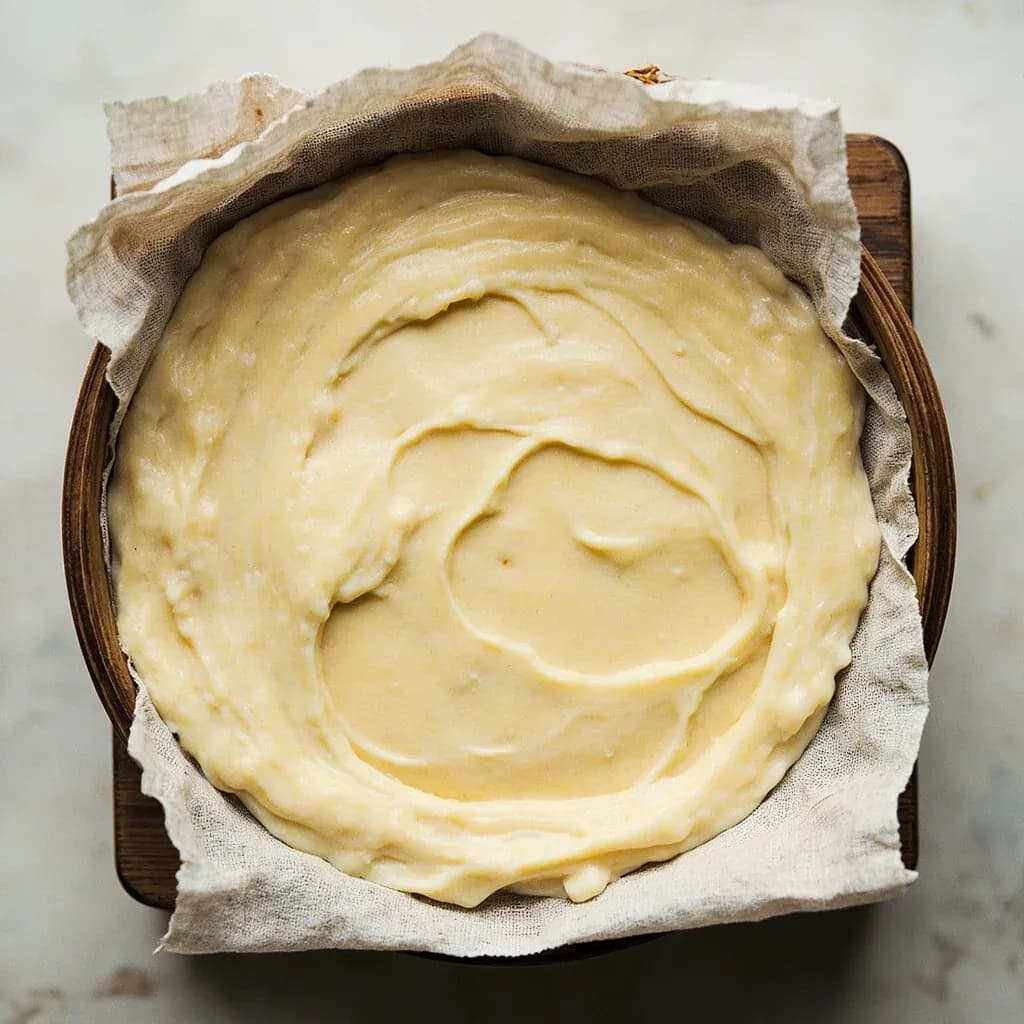
Ladling rice batter into a thin even sheet steamed into noodle crepes.
Rice noodle crepe spreading thinly distributes a loose rice-flour batter across a steaming cloth or tray so it cooks into a delicate, pliable sheet, the basis of dishes like banh cuon and Cantonese cheung fun. The cook must pour and tilt or swipe quickly to get an even, gossamer layer before the steam sets it. The finished sheets are filled, rolled, or cut into noodles while still warm and supple.
Rice noodle crepe spreading is the disciplined act of turning a thin rice-flour batter into a steamed sheet thin enough to almost read through, the foundation for cheung fun, bánh cuốn, popiah skins, and the wider family of Southeast Asian rice rolls. The technique looks effortless in the hands of a Cantonese dim sum cook or a Hanoi street vendor, but it is genuinely technique-sensitive: the final texture depends on a rested, lump-free batter, a surface hot enough to flash-set the moment the liquid lands, and a spreading motion that completes itself in two or three seconds before the batter begins to firm. Get those three things right and the crepe comes off the pan in a single, even, pliable sheet; get any of them wrong and you end up with a gummy, torn, or uneven disc.
There are two main branches of the technique. The Cantonese and Hokkien tradition uses a flat, shallow metal pan lightly oiled between crepes, producing a flexible sheet suited to wrapping generous fillings. The Northern Vietnamese tradition stretches a taut, damp muslin over the steaming frame and sweeps the batter across with a flat wooden spreader, yielding a slightly thinner, more delicate sheet with a faintly translucent surface. Both rely on the same underlying physics — gelatinization of rice starch by live steam — and both reward the same three habits: a long batter rest, a hard rolling boil under the lid, and quick, confident spreading.
- Difficulty
- Hard
Types & varieties
Cantonese; spread on an oiled flat pan in the steamer, rolled with shrimp, beef, char siu, or mushrooms, then finished with sweetened soy.
Vietnamese; spread on a stretched cloth over boiling water with a flat wooden sweep, filled with seasoned ground pork and wood ear mushrooms.
Vietnamese plain steamed rice sheets made by the same cloth method, served without filling alongside grilled meats, fish sauce, and herbs.
A thinner crepe spread on an oiled pan, used as the wrapper for Hokkien/Teochew fresh spring rolls (lobak).
A larger, slightly thicker crepe made without egg, wrapped around the filling at the table rather than rolled around a filling in the rice-flour-roll style.
Sun-dried, not steamed in-pan; related family but a distinct technique, listed for clarity only.
How to do it
- 1
Mix and rest the batter
Whisk rice flour (with 10–20% tapioca or cornstarch blended in for elasticity) into water at roughly a 1:1 to 1:1.5 ratio by weight. Strain through a fine-mesh sieve, cover, and rest at room temperature for at least 30 minutes, ideally 1–4 hours, or overnight in the fridge, so the flour fully hydrates and any entrained air works its way out.
- 2
Prepare the steaming setup
Bring a wide pot or multi-tier steamer of water to a vigorous rolling boil. For the pan method, brush a thin, even film of neutral oil over a flat shallow pan that fits the steamer. For the cloth method, stretch a clean, damp, tightly woven muslin taut over the steaming frame, smoothing out wrinkles.
- 3
Heat the surface
Set the oiled pan (or cloth-on-frame) inside the steamer and preheat 1–2 minutes. The surface must be hot enough to flash-set the batter the instant it lands; a lukewarm surface lets the batter pool and gives an uneven, gummy sheet.
- 4
Ladle the batter
Pour a measured ladleful — about 60–90 ml for a 30–35 cm surface — onto the center of the hot pan. Adjust the volume up or down to land at a final thickness of roughly 1–2 mm; too much and you steam a gummy crepe, too little and the sheet tears on lifting.
- 5
Spread into a thin even sheet
Tilt and rotate the pan in a smooth circular motion, or sweep a T-shaped wooden or bamboo spreader (or an offset scraper) outward from the center, pushing the batter into a uniform layer that covers the entire surface within 2–3 seconds. Hesitation leaves streaks; re-spreading a setting batter breaks the surface.
- 6
Steam covered
Cover the steamer immediately. Steam 60–90 seconds for a 1–2 mm crepe on a 30–40 cm surface. The crepe is done when the surface looks matte and set and the edges lift cleanly when nudged with a scraper.
- 7
Release the crepe
Lift gently with a flexible silicone or plastic scraper. For the cloth method, invert the cloth over a tray so the crepe drapes off on its own. If making filled rolls, add filling at this stage and roll before stacking.
- 8
Re-oil and repeat
Brush the pan (or rinse and re-wring the cloth) between each crepe. Stir the batter briefly each round to keep the solids in suspension, and skim any skin that forms on the surface.
- 9
Hold and serve
Stack finished crepes on a lightly oiled plate or tray and cover with a damp towel to keep them pliable. Use within a few hours, or chill and reheat by gentle steaming just before serving.
Pan method vs. cloth method
The choice of surface shapes the crepe as much as the batter does. An oiled metal pan — the workhorse of Cantonese dim sum kitchens — runs slightly hotter on contact and produces a marginally thicker, more flexible sheet that holds up to hearty fillings and the mechanical stress of being rolled. A taut muslin cloth, the Vietnamese standard, releases steam evenly from beneath and yields a thinner, more delicate crepe with a softer, more uniform surface; the cost is lower heat tolerance, so the cloth must be kept clean and damp, and any scorch buildup will mark and bitter the next crepe. For home cooks, the pan method is more forgiving and easier to source; the cloth method rewards a small investment in equipment with the silkiest possible sheet.
- Metal-pan method: oiled shallow pan, slightly thicker crepe, better for stuffed rolls.
- Cloth method: taut muslin over a steaming frame, thinner and more delicate, traditional for bánh cuốn and bánh ướt.
- Batter composition and hydration time matter more than equipment choice in determining final texture.
Reading the crepe
A correctly cooked crepe gives you immediate sensory feedback. Lift a corner with a flexible scraper: if it releases cleanly with no sticking, the surface is done. Hold the sheet to the light: a properly thin crepe is translucent enough to see the outline of your hand through it. The surface should look matte, not glossy or wet; glossy patches mean the starch has not fully gelatinized and the crepe needs another 15–20 seconds of steam. The edges should curl very slightly inward as steam escapes from underneath; flat, damp edges usually mean the pan was not hot enough when the batter landed.
- Translucent when held to light = correct thickness.
- Matte surface with clean peel at the edges = fully cooked.
- Edges that curl inward as you lift = good steam release underneath.
Common uses
Tips & pitfalls
- Rest the batter at least 30 minutes, ideally 1–4 hours or overnight — skipping this leaves a grainy, pitted crepe because the flour has not fully hydrated and bubbles have not dissipated.
- Strain the batter through a fine-mesh sieve just before using to catch any lumps or unhydrated bits that would show up as bumps in the sheet.
- Keep the steamer at a hard, continuous boil; weak steam gives a rubbery, undercooked crepe with a gummy center.
- Oil the pan with a thin, even film before each crepe — too little and it sticks, too much and the surface fries rather than steams.
- Ladle and spread in one quick motion: once the batter hits the hot surface it begins to set, and any hesitation shows up as streaks or thin spots.
- Aim for translucency; a properly cooked crepe is thin enough to almost read through when lifted to the light.
- Lift the crepe the moment the edges peel cleanly with a flexible silicone or plastic scraper — over-steaming dries it out and causes tearing on release.
- Cover leftover batter between crepes so it does not skin over or thicken from evaporation, and give it a brief stir before each ladle.
- For the cloth method (bánh cuốn), keep the cloth damp, taut, and free of char buildup — scorch marks transfer bitter flavor and darken the sheet.
- Common mistake: pouring into a pan that is not hot enough, which makes the batter pool instead of flash-setting into a uniform sheet.
- Common mistake: steaming a crepe that has been spread too thick — the outside sets before the inside cooks and the sheet turns gummy.
Good to know
- Also known as
- Steamed rice sheet technique; rice crepe spreading; rice batter spreading for steaming
- Batter base
- Rice flour, often blended with 10–20% tapioca starch or cornstarch for elasticity
- Flour-to-water ratio
- Roughly 1:1 to 1:1.5 by weight (about 100–150 g water per 100 g flour); adjusted for thinness
- Batter rest time
- 30 minutes minimum, 1–4 hours typical, overnight preferred for full hydration and bubble dissipation
- Steaming temperature
- Full rolling boil; lid closed immediately after spreading
- Steam time per crepe
- 60–90 seconds for a 1–2 mm sheet on a 30–40 cm surface
- Target sheet thickness
- 1–2 mm; translucent when lifted to the light
- Yield
- Roughly 8–12 crepes per liter of batter on a 35 cm pan
Also called
Banh Cuon Spreading · Rice Sheet Spreading
Related

Whisk
Beat ingredients smooth and aerated with a looping wire motion

Sift
Pass dry ingredients through mesh to aerate and remove lumps

Strain
Pour through mesh to separate solids from liquid for a smooth result

Filter
Pass liquid through fine material to clarify out the smallest particles

Rice
Press cooked potatoes through small holes for fluffy, lump-free texture

Mash
Crush soft cooked food into a rustic, creamy purée

Grind
Crush food into a coarse to fine texture, from spices to meat

Grate
Shred food into fine bits against a sharp-toothed surface