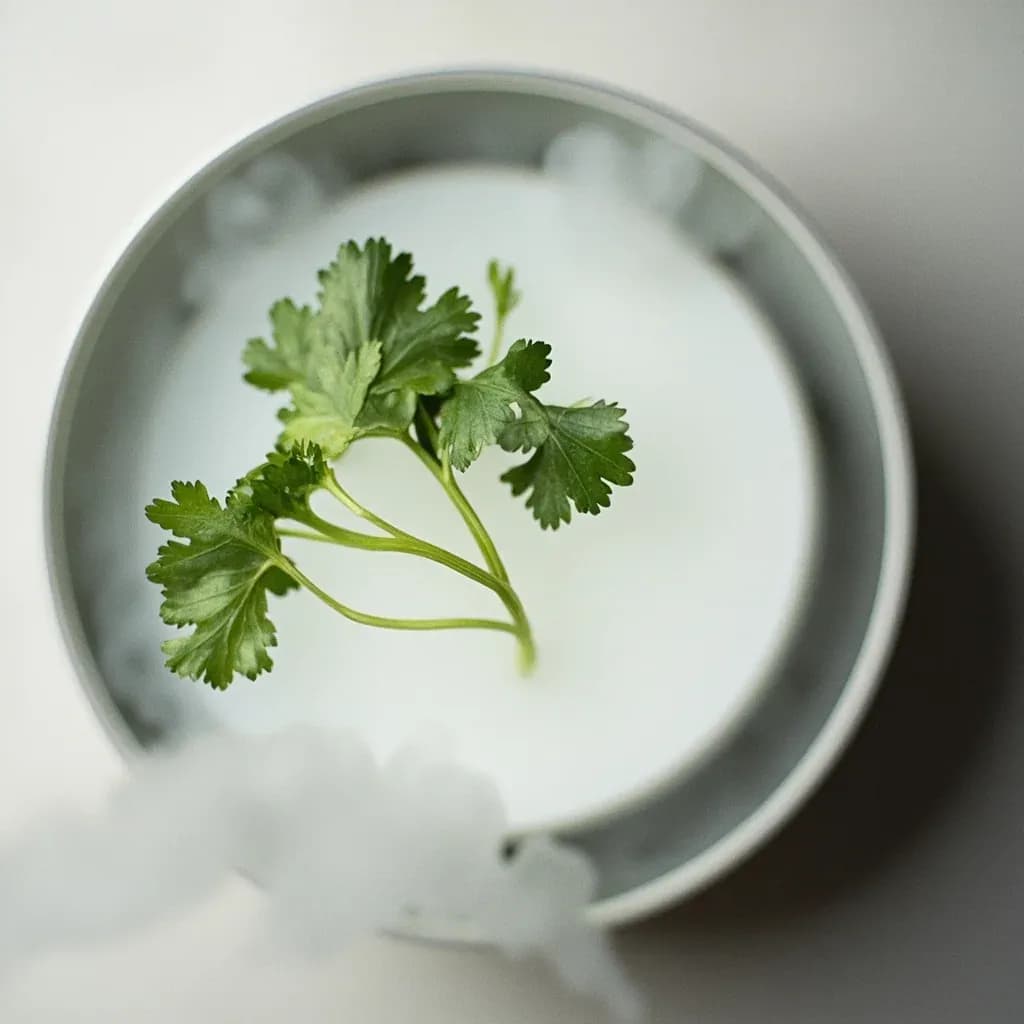
Transform & Preserve
Cryo-Blanching (Liquid Nitrogen)
Flash-freezing food in liquid nitrogen to shatter cell walls or set textures instantly.
Cryo-blanching plunges ingredients into liquid nitrogen at around minus 196 Celsius, freezing them almost instantly to brittle solids. The shock fractures cell walls for ultra-fine powders and purees or sets a crisp frozen shell. It's a modernist technique requiring careful handling, insulated tools, and ventilation for safety.
Cryo-blanching is the technique of plunging food into liquid nitrogen (LN2, boiling point ≈ −196 °C / −321 °F) to freeze it in seconds rather than the hours a home freezer needs. The speed matters because it produces extremely small intracellular ice crystals, and that single physical fact is what gives the technique two opposite uses: it can preserve delicate tissue (color, aroma, and structure survive much better than under slow freezing), or it can render thin, low-moisture tissue so brittle that a light tap turns it into powder. Modernist kitchens from the late 1990s onward — most famously elBulli and WD~50 — turned this duality into a signature repertoire of frozen garnishes, instant foams, and shattered herbs.
In practice, cryo-blanching is less a cooking method than a transformation tool. You are not adding flavor or heat; you are changing state so quickly that you can do things to food afterward — crush it, set it as a foam, plate it tableside, or simply hold it at peak freshness — that ordinary freezing forbids. The same basil leaf can become a vivid green snow, a brittle tuile, or a frozen aromatic that drops into a cocktail without diluting it.
It is also a technique with serious industrial constraints. Liquid nitrogen is supplied in pressurized Dewar flasks by gas companies, evaporates continuously, and demands cryogenic-safety training, ventilation, and PPE. Home use is strongly discouraged; in a professional setting it is treated as a precision tool, not a gimmick — used in small amounts, with food-grade gas, and with full evaporation confirmed before anything reaches the guest.
- Difficulty
- Hard
Types & varieties
Food is fully submerged in liquid nitrogen for the fastest possible core freezing. Used for shattering herbs, citrus zest, or thin vegetable slices.
Food passes through the cold vapor just above the liquid surface. Gentler than immersion; good for individual berries or cocktail garnishes where full shattering is not desired.
Post-freeze step in which frozen-brittle tissue is struck or ground into shards or powders (basil leaf → basil snow, citrus peel → citrus dust).
Repeatedly freezing a liquid and decanting off the purer ice fraction to concentrate flavor in the remaining liquid — a lab-derived technique occasionally borrowed in kitchens.
Using LN2 to instantly set espumas, purées, or reverse-spherification gels from the outside in, locking in airy texture that would slump under conventional freezing.
How to do it
- 1
Set up the station
Work in a ventilated area on a stable, non-absorbent surface. Put on cryogenic gloves, long sleeves, and a face shield. Pour food-grade LN2 from its Dewar into an open, food-safe stainless or insulated container. Do not use glass that is not rated for cryogenic temperatures.
- 2
Prepare the food
Cut items small and uniform — herbs torn from stems, citrus zest in thin strips, berries left whole but dry on the surface. Pat dry; surface water wastes LN2 and slows the freezing step.
- 3
Freeze
Lower food into the LN2 with tongs or a slotted spoon, or hold it in the vapor above the liquid for a few seconds for more delicate items. Bubbling slows and then stops as the food equilibrates to −196 °C; small pieces need only 10–30 seconds.
- 4
Process or portion
For powders or shards, lift the frozen pieces out, let surface LN2 evaporate for a few seconds, then crush in a chilled mortar, between parchment under a heavy weight, or pulse in a cold food processor just until broken. For set foams or purées, work quickly before the structure warms and slumps.
- 5
Finish before service
Confirm all LN2 has boiled off — no visible fog or liquid remaining — before plating or tasting. Plate onto cold or room-temperature dishes as appropriate; serve immediately for the cleanest texture.
- 6
Store or discard LN2
Return unused LN2 to its vented Dewar. Never cap a vessel containing liquid nitrogen tightly. Wipe down the station; spilled LN2 on cold surfaces can briefly re-condense oxygen and leave a slippery frost.
How it works
The behavior of food under LN2 comes down to crystal size. Slow freezing lets water migrate out of cells and form large extracellular ice crystals that rupture membranes — you see this as weeping, browning, or limp texture once thawed. Cryo-blanching drops the temperature so fast that water freezes in place, leaving tiny intracellular crystals that leave cell walls largely intact. Color stays vivid, aromatic volatiles are trapped, and texture on thaw is closer to fresh.
For shattering, the goal is different. You choose tissue that is thin and moderately dry (a basil leaf, a strip of orange peel, a tuile) so that freezing drives it well below its embrittlement point. At −196 °C those items are essentially ceramic: a mortar and pestle, a heavy pan, or a single pulse in a cold food processor breaks them into shards or powder that would be impossible to grind at room temperature, where their oils and sugars would smear and clump.
- Small crystals → preserve structure, color, and aroma better than slow freezing.
- Brittle tissue at LN2 temperatures → clean shattering into powders and shards.
- Same tool, two opposite outcomes: choose by selecting food thickness and moisture.
Safety
Treat LN2 with industrial-gas discipline. The most common failure modes are asphyxiation (LN2 gas displaces oxygen in a closed or low-ventilation room), cryogenic burns (skin contact, splashes from thermal shock), and pressure rupture (sealed containers explode as the liquid boils). Always work in a ventilated space with cryogenic gloves, long sleeves, and a face shield; never seal LN2 in a closed vessel; and confirm full evaporation before any food reaches the guest.
- Work in a well-ventilated room; never in a small closed kitchen.
- Cryogenic gloves, long sleeves, and a face shield are non-negotiable.
- Food-grade LN2 only, in a clean, food-safe, vented Dewar.
- Confirm LN2 has fully boiled off before tasting or plating.
Common uses
Tips & pitfalls
- Work in a well-ventilated room — LN2 displaces oxygen and can asphyxiate in a closed, low-ceiling space.
- Wear cryogenic gloves and a face shield; LN2 on skin causes severe frostbite, and thermal shock can splash the liquid outward.
- Never transfer LN2 into a sealed, airtight container — pressure buildup causes violent rupture.
- Chill your working vessels in advance to slow boil-off and reduce waste.
- Add food to the LN2 rather than pouring LN2 over food on a plate; the splash radius is much larger than expected.
- Confirm full evaporation before tasting — liquid nitrogen in the mouth causes serious internal injury.
- Use the smallest practical amount: at −196 °C, a few seconds are usually enough for small pieces; over-freezing wastes gas and over-brittles delicate items.
- Crush frozen pieces in a chilled mortar or inside a sealed bag between towels; ambient humidity will frost them quickly once out of the LN2.
- Label and date any Dewar; keep it upright and never lift it by the neck or cap — the vent is safety-critical.
Good to know
- Medium
- Liquid nitrogen (LN2), boiling point ≈ −196 °C / −321 °F
- First liquefied
- 1883, by Zygmunt Wróblewski and Karol Olszewski in Kraków
- Adopted in restaurant kitchens
- Late 1990s–2000s; signature of the elBulli / WD~50 modernist era
- Core physical effect
- Ultra-rapid freezing produces very small intracellular ice crystals — better structure than slow freezing, and brittle tissue that shatters cleanly
- Pantry / storage
- Not a pantry item; delivered or rented in pressurized Dewar flasks from industrial-gas suppliers
- Cost driver
- Continuous boil-off losses; LN2 must be replenished regularly
- Difficulty
- High — requires cryogenic-safety training, PPE, and excellent ventilation
- Time per batch
- Seconds to a couple of minutes, depending on mass and cut size
- Regulatory note
- Food-grade LN2 only; treated as an additive — must fully evaporate before service (US/EU)
Also called
nitro-freezing · cryo-shattering
Related

Confit
Cook slowly submerged in fat for silky tenderness and keeping

Cure
Draw out moisture with salt and time to preserve and concentrate

Pickle
Steep in acidic brine for bright, tangy, crunchy preservation

Ferment
Let friendly microbes transform food into tangy, complex flavor

Marinate
Soak in a seasoned mix to flavor and tenderize before cooking

Brine
Soak in salt water so meat stays juicy and seasoned throughout

Dehydrate
Slowly dry out moisture to concentrate flavor and extend shelf life

Cold-Smoke
Perfume cured food with smoke without cooking it through