Transform & Preserve
Flash Freezing (Liquid Nitrogen)
Freezing food almost instantly with extreme cold to form tiny ice crystals and unique textures.
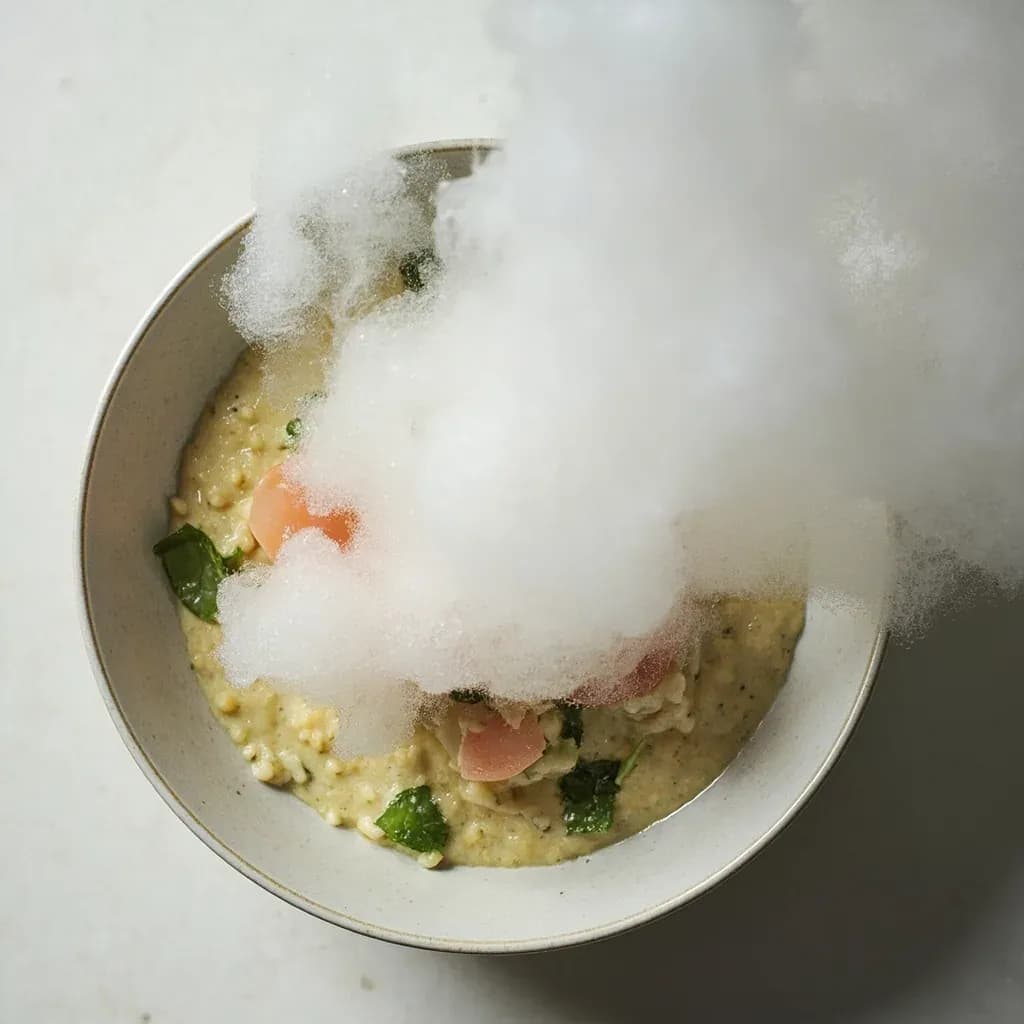
Flash freezing exposes food to extreme cold, often liquid nitrogen at around minus 196 degrees Celsius, so it freezes in seconds. The near-instant freeze forms minute ice crystals that preserve cell structure and texture far better than slow freezing, and in modern cuisine it creates brittle shells, powders, and dramatic tableside effects. It also locks in freshness for storage without large damaging ice crystals.
Flash freezing with liquid nitrogen (LN2) is a modernist technique in which food is plunged into nitrogen at −196 °C (−321 °F), the gas's boiling point at atmospheric pressure. The extreme cold pulls the food's temperature through the freezing zone in seconds, so ice crystals form so small and so fast that they barely rupture cell walls. Compared with a home freezer — which creeps through 0 °C over hours and grows large, blade-like crystals that shred structure — LN2-frozen food loses less water, weeps less on thaw, and can be engineered into textures (powders, brittle shards, instant-set mousses) that ordinary cold simply cannot produce.
For the cook, LN2 is two things at once. It is a precision tool: it sets mousses in seconds without gelatin's setting time, powders herbs and oils into snow-like dust, and concentrates fruit juices by letting you crack cells open and drain away the water. And it is theater — the dense, rolling fog and the audible hiss turn a scoop of ice cream or a smoking cocktail bowl into a tableside performance. Knowing which of those jobs you are actually doing — preserving texture, transforming structure, or putting on a show — dictates how much nitrogen you really need to pour.
The trade-off is safety and regulation. Liquid nitrogen is a true cryogen: it burns skin on contact, can shatter glass from thermal shock, and displaces oxygen in an enclosed room fast enough to cause silent asphyxiation. It is also not a substitute for a blast freezer; the two make small crystals by different means and on different timelines. Anyone using it should be trained, ventilated, gloved, and aware that in many jurisdictions (notably the UK after high-profile injuries, plus parts of the EU and US) serving food that still contains liquid nitrogen is prohibited, and operators are usually required to carry a documented risk assessment.
- Difficulty
- Hard
Types & varieties
Chilled base dipped or stirred in LN2 for instant scoopable texture with essentially no overrun
Solid ingredients (often bound with maltodextrin or similar carriers) frozen solid, then blitzed in a food processor to yield fine powders — olive oil, fruit, miso, peanut
Light aerated mixtures set almost instantly when LN2 is streamed in while whisking
Freezing then controlled thawing lets high-sugar or high-acid juices be drained from the ice, concentrating flavor without heat
Drinks poured over LN2 for an icy, fog-served presentation; alcohol depresses the freezing point, so over-pouring leads to over-chilling rather than a clean set
Delicate leaves frozen crisp in seconds, shattering into glass-like fragments for plating
Very brief immersion used as a surface textural effect — a frozen crust over a raw interior — rather than a true cook-through
How to do it
- 1
Set up a safe workstation
Work in a ventilated kitchen (range hood on, door cracked or window open). Put on cryogenic insulated gloves, long sleeves, and safety glasses. Place the LN2 dewar on a stable, non-slip surface well away from guests. Stage stainless steel or high-density plastic bowls — never glass, never anything sealed. Have a fine-mesh skimmer, slotted spoon, and a timer within reach.
- 2
Prepare and pre-chill the food
Cut food into small, uniform pieces (about 1–2 cm, or smaller if you intend to powder them). Pat dry — surface water wastes nitrogen and slows freezing. For ice cream bases, sorbets, mousses, or any liquid you intend to set, chill the mixture thoroughly over an ice bath first so the LN2 does its job rather than cooling from room temperature.
- 3
Dispense the liquid nitrogen
Pour only as much LN2 as you need from the dewar into an open stainless bowl. Pour slowly to minimize splashing and fog. Keep the bath shallow — deeper pools waste nitrogen and make retrieval slower.
- 4
Add the food to the nitrogen
Lower food into the LN2 with the skimmer or slotted spoon. For powders and small pieces you can drop them in directly; never submerge by hand. For mousses and ice cream bases, slowly stream LN2 into the mixing bowl while whisking or churning continuously.
- 5
Freeze to the right doneness
Small items freeze solid in 10–60 seconds. A 250 ml ice cream base typically needs 1–3 minutes of stirring with periodic LN2 additions. The food is done when it is rigid and no liquid sloshes inside; bubbling of the LN2 will slow and stop once heat transfer is finished.
- 6
Remove and off-gas
Lift the food out with the skimmer onto a tray or plate. Let any clinging LN2 evaporate fully — you should see and hear no further sizzling. This takes 10–30 seconds. Do not serve, taste, or seal the food until evaporation is complete.
- 7
Use immediately or transfer to a freezer
Flash-frozen items are at their best right away, especially ice cream, mousses, and brittle garnishes. For longer holding, transfer to a conventional freezer at −18 °C / 0 °F in a lidded container. Return any unused LN2 to the dewar per supplier guidance; never store finished products submerged in LN2.
- 8
Clean up safely
Let bowls and tools warm fully to room temperature before wiping them — touching frosted cryogenic ware causes burns. Ventilate until fog clears. Close and secure the dewar. Log usage so you never run dry mid-service.
LN2 versus blast freezing
The two techniques share a goal — small ice crystals and good texture retention — but use entirely different mechanisms and timelines. A blast freezer circulates high-velocity air at roughly −35 to −40 °C and takes minutes to hours to pull food through the danger zone. LN2 sits at −196 °C and finishes the same job in seconds, which is why it can also do things blast freezing cannot: set a mousse, powder a fat, or shatter a basil leaf. In a working kitchen the practical question is whether you need speed and theatrical effect (LN2) or throughput and storage (blast). Most pastry and fish kitchens are served perfectly well by a good blast freezer; LN2 earns its keep at the pass, at the bar, or on a tasting-menu dessert course.
Common uses
Tips & pitfalls
- Never serve or bite into food that still sizzles or steams; residual LN2 in the mouth causes severe internal injury — wait until it has fully evaporated.
- Wear cryogenic insulated gloves and keep sleeves down; bare skin sticks to cold metal on contact and tears, producing an instant cryogenic burn.
- Avoid glass bowls and ceramic vessels — thermal shock will shatter them. Use stainless steel or heavy-duty plastic only.
- Never pour LN2 into a sealed container, lidded blender jar, or zip-top bag; the nitrogen boils to gas and will explode the vessel.
- Work under a range hood or with a door cracked open; LN2 displaces oxygen and can asphyxiate silently in an enclosed room.
- Pre-chill your base over an ice bath before adding LN2 — it dramatically cuts the amount of nitrogen you need and speeds the set.
- Stir gently while streaming LN2 into mousses and ice cream bases; a frozen crust on top can trap liquid nitrogen underneath.
- Eat LN2 ice cream within a minute or two of churning — it is genuinely frozen through, not just chilled, so it hardens fast on the plate.
- Track nitrogen usage by weight or volume on the dewar; running dry mid-service is both a workflow and a safety problem.
Good to know
- Freezing agent
- Liquid nitrogen (LN2), food-grade only
- Temperature
- −196 °C / −321 °F (boiling point of nitrogen at atmospheric pressure)
- Primary effect
- Forms extremely small ice crystals in seconds, minimizing cellular damage and preserving texture
- Origin in food
- Adopted by avant-garde chefs in the early 2000s (Heston Blumenthal, Ferran Adrià, Grant Achatz), building on earlier industrial cryogenic freezing
- Equipment required
- LN2 dewar, cryogenic insulated gloves, safety glasses, stainless or heavy plastic bowls, fine-mesh skimmer, well-ventilated workspace
- Typical contact time
- 10 seconds to 3 minutes, depending on piece size and target texture
- Storage after freeze
- Use immediately; for longer holding, transfer to a conventional freezer (−18 °C / 0 °F) once LN2 has fully evaporated
- Purity
- Food-grade LN2 only; industrial grade may carry contaminants
- Skill level
- Advanced — cryogen-handling training and, in many jurisdictions, a documented risk assessment or permit
- Notable hazards
- Cryogenic burns, oxygen displacement in enclosed rooms, pressure rupture in sealed vessels, thermal shock to glass and ceramic
Also called
Cryo-Freezing · Nitro Freezing
Related

Confit
Cook slowly submerged in fat for silky tenderness and keeping

Cure
Draw out moisture with salt and time to preserve and concentrate

Pickle
Steep in acidic brine for bright, tangy, crunchy preservation

Ferment
Let friendly microbes transform food into tangy, complex flavor

Marinate
Soak in a seasoned mix to flavor and tenderize before cooking

Brine
Soak in salt water so meat stays juicy and seasoned throughout

Dehydrate
Slowly dry out moisture to concentrate flavor and extend shelf life

Cold-Smoke
Perfume cured food with smoke without cooking it through