Prep & Assembly
Dough Slapping (Naan/Flatbread Sticking)
Slapping shaped flatbread dough onto a hot tandoor or oven wall so it sticks and bakes against the heat.
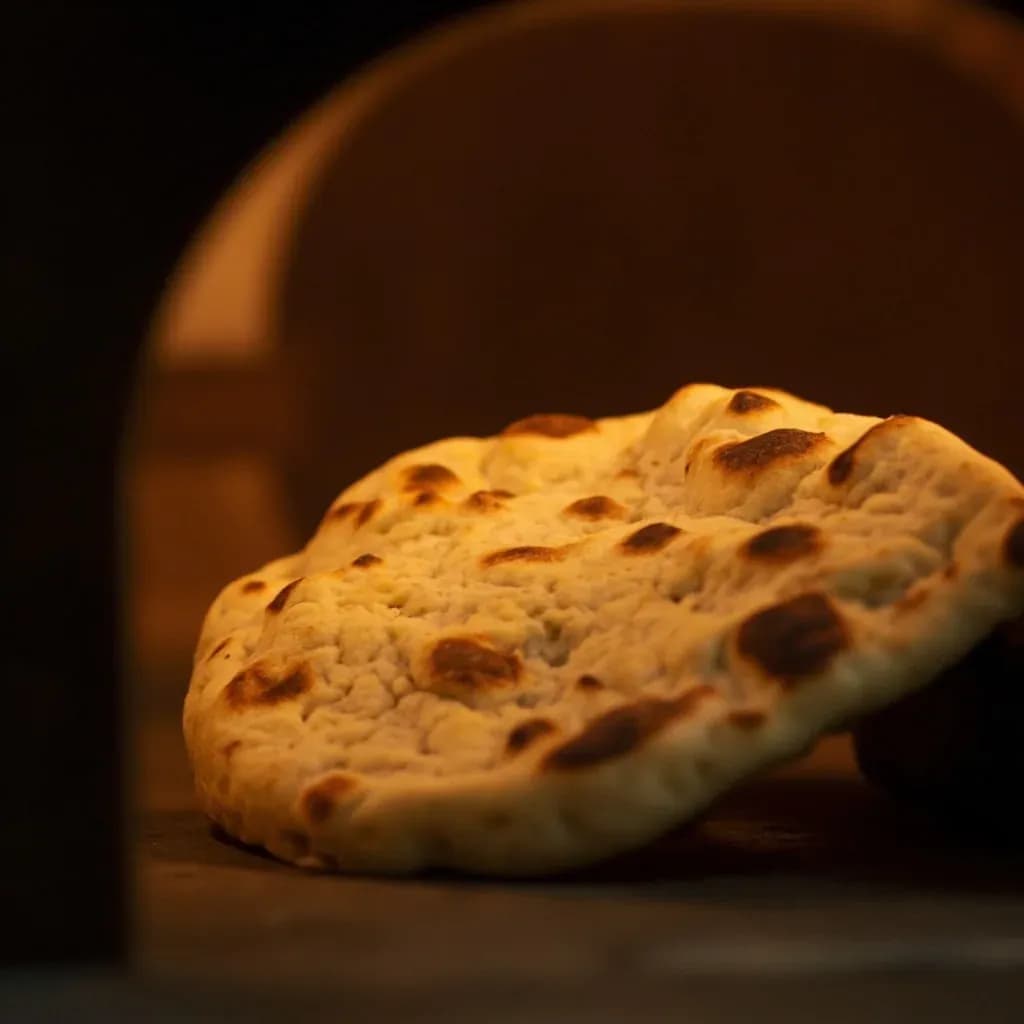
Dough slapping is the act of pressing or throwing a shaped piece of flatbread dough against the searing interior wall of a tandoor or clay oven. The dough adheres instantly and bakes against the radiant heat, puffing and blistering before being hooked off. The slapping motion both shapes the bread and ensures it bonds to the wall without sliding off.
Dough slapping is the shaping and baking technique behind tandoor naan and a wide family of South-Central Asian flatbreads. A rested ball of soft, enriched dough is tossed between the backs of the cook's hands in a rotating, figure-eight pattern; the dough drapes under its own weight, thins to an even disc, and is then thrown — wet side first — against the searing wall of a clay tandoor, where it adheres, puffs, and chars in well under two minutes. The method is genuinely practical rather than theatrical: a hand-shaped disc is faster to produce than a rolled one, accommodates the slack, sticky doughs that tandoor breads require, and produces a slightly thicker center with thin, translucent edges that holds a pocket of steam for the characteristic puff.
The craft has two halves, only one of which is visible. The first is the slap itself, a controlled stretch that relies on developed gluten and gravity rather than force — the disc is rotated 90° between slaps so the center stays even while the rim thins. The second is the wall: a properly seasoned tandoor reaches 400–500 °C at its inner surface, and the dough is wet on one face so that surface steam grips the porous clay for the 60–90 seconds of bake, then releases as the bread dries. Managing that wall — building a carbonized patina, knowing when it has cooled too far for the next bread to stick — is what separates a working naan-wallah from a home cook with a tandoor-shaped problem.
- Difficulty
- Hard
Types & varieties
Leavened maida (refined flour) dough, often yogurt-enriched, stretched into a teardrop or elongated oval; the canonical slap-and-stick bread.
Whole-wheat atta flatbread; usually rolled and pressed, but baked on the tandoor wall in some Punjabi and Pakistani traditions.
Whole-wheat breads from Kashmir traditionally slapped against a tandoor wall and served with noon chai.
Iranian leavened flatbread enriched with saffron and cardamom, shaped by tossing and slapped onto a tandoor wall.
Often stretched on a garch cushion to produce the signature oval with a lengthwise central ridge.
Filled with coconut, raisins, and nuts; the dough is slapped thin before the filling is enclosed and the seam is sealed.
Persian-influenced Lucknowi and Hyderabadi naan enriched with saffron, milk, and ghee; typically hand-stretched.
Round leavened breads baked in a tandyr oven, often stamped with a chekich pattern after slapping.
Unleavened barley flatbread slapped between the palms into a wide disc, then pan-cooked — a related technique without the oven wall.
Cousin technique in which semolina dough is slapped to extreme thinness before dry-toasting; same centrifugal motion, no wall oven.
How to do it
- 1
Mix and ferment the dough
Combine maida (or a maida-and-atta blend) with water, yeast, salt, a little sugar, yogurt, and a small spoon of ghee. Knead 8–10 minutes until smooth, elastic, and tacky but not sticky. Bulk-ferment 1.5–2 hours at warm room temperature until roughly doubled, then degas gently and divide into 100–150 g balls.
- 2
Rest the panned dough
Toss each ball in a thin coat of flour, set on a tray, and rest 30–60 minutes under a damp cloth. This relaxes the gluten so the dough will stretch under its own weight instead of springing back. Dough that fights you on the first slap is under-rested.
- 3
Flatten the ball
Press a rested ball between floured palms into a small disc about 8–10 cm across. This starter shape is what you will be flipping and catching.
- 4
Slap and stretch hand-to-hand
Lay the disc across the back of one hand, fingers spread. With a short outward motion, flip it onto the back of the other hand. Rotate the disc about 90° between slaps and repeat 4–6 times until it reaches roughly 20–25 cm across, with a slightly thicker center and thin, almost translucent edges.
- 5
Optional: shape on a garch cushion
For an oval with a raised central ridge, slap the disc onto a small cloth cushion stuffed with cotton or sawdust. The dough picks up the cushion's contour, giving the Afghan and Iranian profile.
- 6
Wet the top face
Dip a clean hand in a bowl of water (or a thin rice-flour slurry) and pat it across the upper face of the stretched dough. That wet face is what will stick to the tandoor wall.
- 7
Slap onto the tandoor wall
With a confident underarm throw, slap the wet side of the dough onto the inner wall of a fully heated tandoor, slightly above the midpoint so it can settle a few centimeters. The dough should adhere on contact. If it slides off, the wall is not hot enough or the face was not wet enough.
- 8
Watch and remove
The bread will puff, blister, and develop light char in 60–90 seconds. Many breads self-release and tumble to the embers below — a prized, smoky outcome. Lift any that remain with long iron tongs and brush immediately with melted ghee or butter.
- 9
Work around the wall
Slap the next bread on a different arc of the wall so you do not stack hot breads on top of one another or drain one section of heat. A tandoor will turn out 6–12 breads before the wall temperature drops below the point where dough will reliably stick.
The physics of the slap
The motion is a controlled catch, not a throw. The disc is held on the back of one hand, fingers spread, and flipped onto the back of the other with a short outward motion — close enough that gravity does the work, far enough that the dough has room to drape. Each catch is rotated roughly 90° from the last, so a corner that was thick on one pass hangs low on the next, and the edges are repeatedly pulled outward by gravity rather than stretched. The result is a disc that keeps a slightly thicker center while the rim thins to an almost translucent edge — exactly the shape that holds steam for a good puff and survives contact with the wall without tearing.
- A 90° rotation between each hand-to-hand pass is what evens out the thickness.
- The dough should drape on the catch, not be pulled — pulling tears the gluten window.
- Well-developed dough stretches to a point where the rim is almost translucent; that is the visual cue it is ready.
The wall is half the craft
A new tandoor is hostile to dough. Its bare clay is too smooth and too cold at the surface to grip wet dough reliably. Traditional seasoning — coating the inside with oil, lighting a fire, then burning onion skins or damp newspaper — builds a thin, carbonized patina that roughens the wall, insulates it, and contributes the smoky char that defines a tandoor bake. Once seasoned, the wall is the cook's temperature gauge: if a slapped bread slides off in two or three seconds, the wall is no longer hot enough and the oven is finished for that firing.
- Build the patina with repeated high-heat burns before the first bread goes on.
- Wet the face of the dough that meets the wall — steam is what makes it stick.
- Bread that adheres but never releases on its own is lifted with long iron tongs.
Common uses
Tips & pitfalls
- Rest the divided dough for at least 30–60 minutes after panning — cold or under-relaxed dough tears the moment you try to stretch it.
- Flour the hands lightly: too much flour changes hydration and produces a pale, gummy crust; too little and the dough sticks to your palms.
- Aim for a final thickness of 3–5 mm with edges almost translucent — that is the visual cue the gluten is well-developed and the bread is ready for the wall.
- If the dough adheres in the middle but not at the edges, the disc is too thick in the center; rotate more aggressively and let gravity pull the middle down on each catch.
- Wet the face that meets the wall, not the one facing you — steam from the wet side is what creates the temporary grip, and the bread releases as that surface dries under heat.
- Common mistakes: under-fermented dough that will not puff, over-hydrated dough that sags and tears on the slap, slapping too hard (which holes the dough), or pressing the dough onto the wall instead of throwing it (which smears rather than sticks).
- A well-used tandoor builds a carbon layer on the inside walls that improves adhesion and gives smoky char; season a new one with burned-on oil, then onion skins or damp newspaper, before the first bake.
Good to know
- Also known as
- Naan-throwing, dough tossing; the practitioner is traditionally a naan-wallah (or naan-bāī)
- Primary equipment
- Tandoor (cylindrical clay oven); optional cloth-stuffed cushion known as a garch, balish, or tirm
- Tandoor wall temperature
- Approximately 400–500 °C (750–930 °F) at the inner surface
- Bake time per bread
- Roughly 60–90 seconds once adhered
- Dough hydration
- Typically 55–65% — softer than standard bread dough, similar to a slack pizza dough
- Common enrichments
- Yogurt, milk, ghee, and sometimes egg; sugar, nigella, or sesame on the surface
- Key physical principle
- Centrifugal stretch combined with gravity; rotation between slaps evens the thinning
- Difficulty
- Moderate to high; requires well-developed gluten, rested dough, and a practiced wrist
- Yield per firing
- A trained cook shapes one bread at a time and bakes 6–12 before the wall cools below the sticking threshold
Also called
dough-slapping · flatbread-slapping · Tandoor Slapping
Dishes that rely on it
Related

Whisk
Beat ingredients smooth and aerated with a looping wire motion

Sift
Pass dry ingredients through mesh to aerate and remove lumps

Strain
Pour through mesh to separate solids from liquid for a smooth result

Filter
Pass liquid through fine material to clarify out the smallest particles

Rice
Press cooked potatoes through small holes for fluffy, lump-free texture

Mash
Crush soft cooked food into a rustic, creamy purée

Grind
Crush food into a coarse to fine texture, from spices to meat

Grate
Shred food into fine bits against a sharp-toothed surface